Materials & packaging
How to Source Raw Materials and Ingredients in Europe
Aktualisiert · 14 Min. Lesezeit · Bulk.eu-Redaktion
Dieser Artikel ist nur auf Englisch verfügbar.
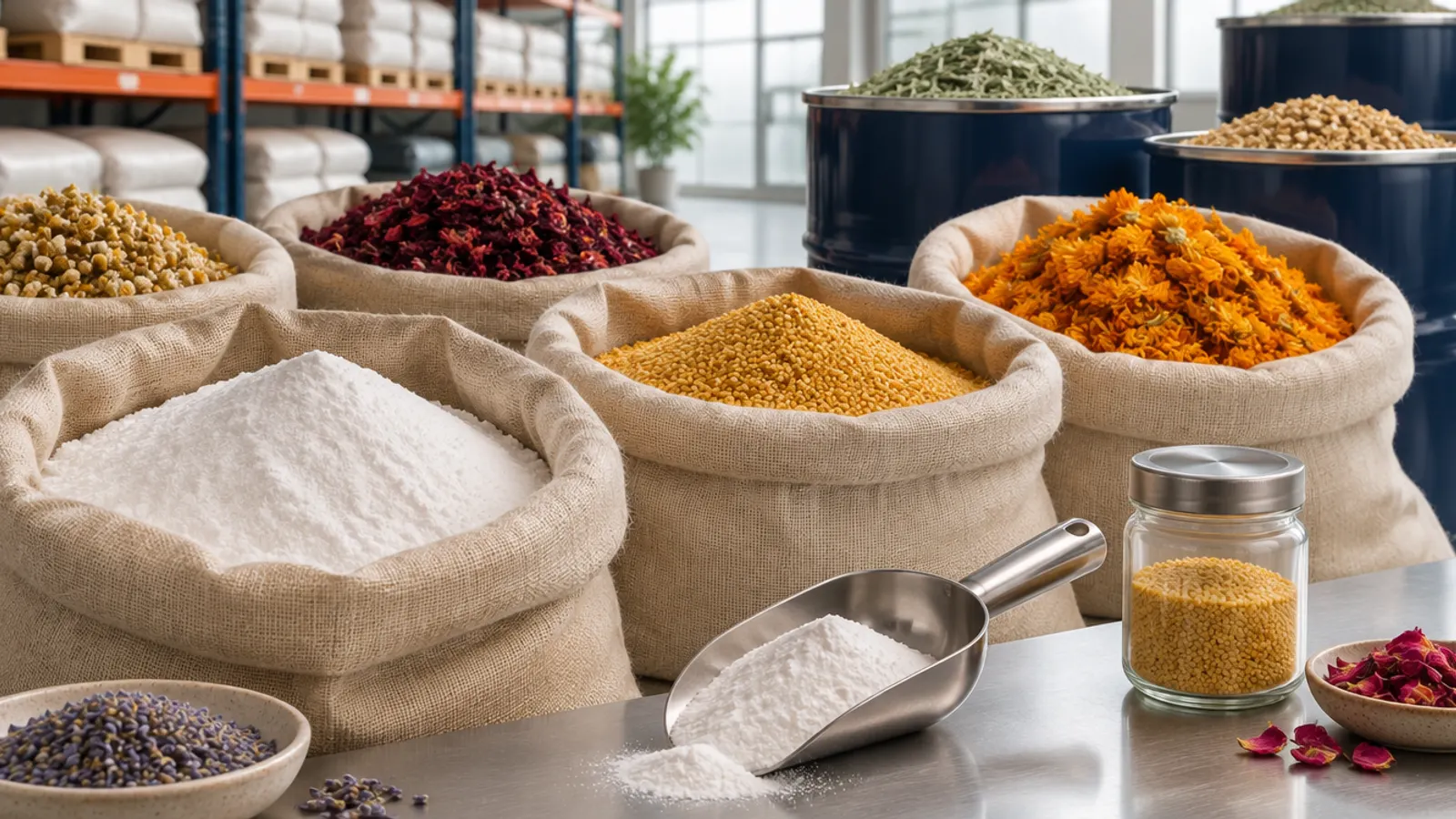
Für diesen Artikel erzeugtes Symbolbild; kein Foto eines darin genannten Unternehmens.
Kurz gesagt
To source a raw material or ingredient in Europe, write a specification first: the grade, the purity or active content, the physical form and the limits you need. Then ask producers and distributors for a specification sheet, a batch certificate of analysis, a safety data sheet and allergen and origin statements, test a sample from a real batch, and agree pack size, price, remaining shelf life and change notification in writing before you order.
Das Wichtigste in Kürze
- Start with a written specification. A material name alone does not define grade, purity, physical form or contaminant limits, and quotations for an undefined material cannot be compared.
- Ask for four core documents before you buy: a specification sheet, a batch-specific certificate of analysis, a safety data sheet, and allergen and origin statements. Add others according to your product and claims.
- Producers usually sell in pallets or larger and offer the best price and technical depth. Distributors sell single sacks or drums from stock at a higher price per kilogram.
- Approve a material on a sample from a real production batch, tested in your own product, and keep a retained sample and the paperwork that came with it.
- Pack size, storage conditions and remaining shelf life on delivery decide how much you can sensibly buy. A cheap pallet that expires half used is not cheap.
- Country of origin, country of manufacture and the supplier's own country are separate facts. Ask for each one rather than assuming.
Buying a raw material looks simple until the first delivery arrives. The powder is coarser than the sample, the certificate lists a carrier nobody mentioned, or the sack is four times larger than the batch you planned to make.
Most of these problems come from the same place: the buyer asked for a material by name and the supplier quoted for what it had. This guide covers how to define what you need, which documents to ask for, how minimums and pack sizes work, when to buy from a producer or a distributor, and how to approve and store a material once you have found it.
It applies to ingredients for food and food supplements, cosmetic ingredients and general industrial materials. It is general guidance and not legal advice; the rules that apply depend on what you make and where you sell it.
What should a raw material specification include?
A specification is the written description of the material you will accept. It is the basis of the quotation, the purchase order and any later complaint. Without it, you have no agreed standard to measure a delivery against.
A workable specification usually covers:
- Identity. The chemical or common name and, where relevant, the CAS number, the INCI name for cosmetic ingredients, the E number for food additives, or the botanical species and plant part for plant materials.
- Grade. Food, pharmaceutical, cosmetic, feed or technical. See the next section.
- Active content or purity. The assay, and the method used to measure it. For plant extracts, the extract ratio, the compound the extract is standardised to, and any carrier such as maltodextrin.
- Physical form. Powder, granule, liquid, paste or flake; particle size or mesh; bulk density; colour; solubility. These decide whether the material runs on your equipment.
- Limits. Moisture, heavy metals, microbiological counts, residual solvents, pesticide residues and any other contaminants relevant to the material and its use.
- Status statements you need. Allergen status, GMO status, suitability for vegan, organic, halal or kosher products, and whether the material has been irradiated.
- Packaging and labelling. Pack type and size, inner liner, and what must appear on the label, including batch number and dates.
- Shelf life and storage. Total shelf life, storage conditions and the minimum remaining shelf life you will accept on delivery.
You do not need to invent the limits yourself. Compare two or three suppliers' standard specification sheets and build your requirement from them.
What do food, pharmaceutical, cosmetic and technical grades mean?
Grade tells you which use a material is made, tested and documented for. The same substance can be sold in several grades at different prices, and the differences are in purity, contaminant limits, the hygiene of production and the paperwork behind it.
| Grade | Intended use | What typically distinguishes it |
|---|---|---|
| Pharmaceutical | Medicines and their excipients | Meets a pharmacopoeia monograph such as the European Pharmacopoeia; the tightest limits and most documentation |
| Food | Food, drinks and food supplements | Produced under food hygiene controls; meets food purity criteria and contaminant limits; allergen and traceability information available |
| Cosmetic | Skincare, haircare and personal care | Identified by INCI name; impurity profile and documentation suited to a cosmetic safety assessment |
| Feed | Animal nutrition | Meets feed rules; not automatically acceptable for human food |
| Technical or industrial | Manufacturing, cleaning, construction and similar uses | Specified for performance; not produced or documented for human consumption or skin contact |
Two practical points follow. First, never substitute a lower grade because the chemical name matches: a technical-grade material may be the same molecule and still be unsuitable for a food or a cosmetic. Second, the grade must appear on the supplier's documents, not only in an email.
For food supplements, also check that the ingredient is permitted for the use you intend. Vitamins and minerals may only be used in the forms EU rules allow, and some ingredients without a history of consumption in the EU need authorisation as novel foods under Regulation (EU) 2015/2283. Our guide to EU food supplement rules for new brands covers this in more detail.
Which documents should you request from a supplier?
Ask for documents before you ask for a price. A supplier that sends a complete, current set promptly is usually one that controls its materials.
Specification sheet
Sometimes called a product data sheet or technical data sheet. It states what the supplier promises for every batch: the parameters, the limits and often the test methods. Check that it is dated, carries a version number and names the manufacturer, not only the seller.
Certificate of analysis
A certificate of analysis, or CoA, reports the test results for one specific batch. It should show the batch or lot number, the manufacturing date, the expiry or retest date, each tested parameter with its limit and result, and who issued it.
Read it against the specification sheet. Check whether every parameter was tested on that batch or whether some are marked as monitored periodically, and whether the certificate comes from the manufacturer or was re-issued by a reseller. A "typical analysis" is not a certificate of analysis.
Safety data sheet
A safety data sheet, or SDS, describes hazards, safe handling, storage, transport and emergency measures. Under the REACH Regulation, (EC) No 1907/2006, suppliers must provide one for substances and mixtures classified as hazardous, in an official language of the country where the material is placed on the market. Many suppliers provide one for non-hazardous materials too.
The SDS tells you how to store and handle the material and whether it travels as dangerous goods, which affects freight cost. It is not a quality document and says little about suitability for food or cosmetics.
Allergen statement
For food and supplement ingredients, ask for a statement covering the allergens listed in Annex II of Regulation (EU) No 1169/2011: whether any is present as an ingredient, and whether cross-contact is possible in the factory. You need this to label your own product correctly. Cosmetic buyers should ask instead about fragrance allergens and other substances that must be declared on the label.
Origin statement
Ask where the material was grown or extracted, where it was manufactured or processed, and where it ships from. These are three different answers, and the supplier's own country is a fourth. A distributor in one EU country may sell a material manufactured in another from a crop grown outside Europe. If you intend to make an origin claim, or if customs duty matters, get the statement in writing.
Other documents, depending on the product
| Document | When you need it |
|---|---|
| GMO statement | Food and supplement ingredients, and whenever you make a non-GMO claim |
| Organic certificate | If the finished product will be sold as organic; the certificate must cover the material and the supplier |
| Vegan, halal or kosher statement or certificate | If you make the corresponding claim |
| Residual solvent, pesticide and heavy metal data | Plant extracts and other materials where these are a known risk |
| Irradiation or sterilisation statement | Herbs, spices and botanical powders |
| Food contact declaration | For the packaging the material is supplied in, and for any packaging you buy |
Certificates such as GMP, HACCP or a food safety scheme describe the supplier's site rather than the material. Treat them as stated by the supplier until you have seen a current certificate, and check the scope and expiry date. Our guide to GMP, ISO 22716, IFS and HACCP explains what each one does and does not cover.
What minimums and pack sizes should you expect?
Raw materials are sold in the units they are packed in. The minimum is often simply one pack, one pallet or one production batch, depending on who is selling.
Common pack formats, given as typical market practice rather than any supplier's terms:
| Material type | Typical pack formats |
|---|---|
| Bulk powders and granules | Sacks or fibre drums of around 20 to 25 kg; big bags of several hundred kilograms and above for large users |
| High-value actives and extracts | Bags or tins of 1 kg, 5 kg or 10 kg |
| Liquids and oils | Cans of about 5 to 25 litres, drums of around 200 litres, intermediate bulk containers of around 1,000 litres |
| Fragrances, flavours and colours | Bottles or cans from 1 kg upwards |
A producer's minimum is commonly a pallet, a full batch or a minimum order value. A distributor will usually sell a single pack, and some repack into smaller sizes for an extra charge.
The pack size matters as much as the price. If your batch needs 3 kg of an ingredient sold only in 25 kg sacks, you are buying eight batches' worth and must be able to store and use it within its shelf life. For how minimums work more generally, and how to negotiate them, see what MOQ means.
An illustrative comparison
The figures below are invented to show the arithmetic. A buyer needs 40 kg of an ingredient per year, used in batches of 10 kg, and the material has 24 months of shelf life when made.
| Distributor, 25 kg sacks | Producer, 500 kg pallet | |
|---|---|---|
| Price per kg | €14 | €9 |
| Quantity bought | 50 kg | 500 kg |
| Cash committed | €700 | €4,500 |
| Years of stock at 40 kg a year | About 1.25 | About 12.5 |
| Likely to be used within shelf life | Yes | No |
The producer's price is lower and the purchase is far worse. The producer becomes the right source only when annual use approaches the pallet quantity.
Should you buy from a producer or a distributor?
Both are legitimate routes and many buyers use both. The choice depends on volume, how much technical support you need and how quickly you need the goods.
| Producer | Distributor | |
|---|---|---|
| Minimum quantity | Higher: pallet, batch or order value | Lower: often one pack |
| Price per kg | Lower at volume | Higher, reflecting stock holding and service |
| Lead time | Longer if made to order | Shorter when held in stock |
| Technical knowledge | Direct access to the people who make it | Varies; good distributors have technical staff |
| Documents | Original, from the source | Should pass on the manufacturer's documents |
| Range | Its own products | Many materials from many producers on one order |
| Traceability | One step | Ask who the manufacturer is and whether the material was repacked |
When buying from a distributor, ask three questions: who manufactured the material, whether the batch certificate is the manufacturer's original, and whether the goods are in the original sealed packaging or have been repacked. Repacking is not a problem in itself, but it should happen under suitable hygiene controls and keep the batch traceable.
You can browse raw materials and ingredients on Bulk.eu and filter suppliers by what they offer. Listings show what each supplier has stated; where a minimum, lead time or certification is not given, treat it as unknown and ask.
How do sampling and approval work?
Approval has two parts: approving the material and approving the supplier. A sample only helps if it represents what you will actually receive.
- Send your specification and ask for documents. Request the specification sheet, a recent certificate of analysis, the safety data sheet, and allergen and origin statements.
- Compare the documents with your requirement. Resolve gaps now. If the supplier's limit for a contaminant is looser than yours, agree which applies.
- Request a sample from a real production batch. Ask for the batch number and that batch's certificate with the sample. A laboratory-made or specially selected sample tells you little.
- Check the sample on arrival. Appearance, colour, smell, particle size and how it dissolves or disperses, against the specification.
- Test it in your product. Make a trial batch on equipment as close as possible to production. Check processing, stability, taste or skin feel, and the appearance of the finished product.
- Test it independently if the risk justifies it. For actives, botanicals and anything behind a label claim, have an external laboratory confirm identity and content at least once.
- Record the approval. Keep the specification, the certificate, the trial results and a retained sample labelled with the batch number.
- Agree the commercial terms. Price and its validity, pack size, delivery terms, lead time, payment terms and minimum remaining shelf life on delivery.
- Agree change notification. Ask the supplier to tell you in writing before changing the manufacturing site, process, carrier or specification.
- Check the first delivery carefully. Confirm the batch number, the certificate and the dates match, and compare the goods with your retained sample.
How should raw materials be stored, and how long do they last?
Every material has storage conditions stated on its specification sheet or label, typically a temperature range, protection from moisture and light, and closed original packaging. Shelf life is only valid if those conditions are met.
Points to settle before you buy:
- Expiry date or retest date. An expiry date is the end of use. A retest date means the material should be re-analysed before further use and may be extended if it still meets specification. Ask which applies.
- Remaining shelf life on delivery. Stock at a distributor may have been made many months ago. State the minimum remaining shelf life you accept in the purchase order.
- Opened packs. Hygroscopic powders absorb moisture and oils oxidise once a pack is open. Reseal properly, and ask whether a nitrogen flush or smaller packs are advisable.
- Temperature-sensitive materials. Probiotics, some vitamins, oils and fragrances may need cool storage and cool transport. Confirm how the goods will travel, especially in summer.
- Stock rotation. Use the batch that expires first, and record which material batch went into which product batch.
Your finished product cannot have a longer shelf life than its ingredients support. Buying material with three months left to make a product with a two-year shelf life is a mistake to catch at the ordering stage.
What changes when a material comes from outside the EU?
If you buy from a supplier outside the EU, you become the importer. That brings customs duty and import VAT, and it can bring regulatory duties that an EU distributor would otherwise carry, for example under REACH for chemical substances, or import controls on certain foods.
For a first purchase or small volumes, buying an imported material from an EU-based distributor is usually simpler. If you import directly, take advice on your obligations for that material before you order.
How do you find and compare suppliers?
Send the same specification and the same questions to several suppliers so the replies are comparable. Ask for the price at two or three quantities, the pack size, the lead time, the delivery terms and the documents listed above.
If you would rather have suppliers come to you, post a buying request with your specification, grade, annual quantity and delivery country. Bulk.eu is a sourcing marketplace, not a shop: prices, minimums and contracts are agreed directly between you and the supplier.
Compare the whole offer. The lowest price per kilogram is rarely the lowest cost once pack size, freight, remaining shelf life and the quality of the paperwork are counted.
Häufig gestellte Fragen
- What is a certificate of analysis for a raw material?
- A certificate of analysis, or CoA, is a document reporting the test results for one specific batch of a material. It shows the batch number, manufacturing and expiry or retest dates, each tested parameter with its limit and the actual result, and who issued it. It confirms that a particular batch meets the specification, unlike a specification sheet, which describes what every batch should meet.
- What is the difference between a specification sheet and a safety data sheet?
- A specification sheet describes the quality of a material: identity, purity, physical form and limits for contaminants. A safety data sheet describes hazards and how to handle, store and transport the material safely. They serve different purposes and you normally need both. The safety data sheet does not show whether a material is suitable for food or cosmetic use.
- Is it better to buy raw materials from a manufacturer or a distributor?
- It depends on volume. Producers generally offer lower prices and direct technical knowledge but set higher minimums, often a pallet or a full batch, and may have longer lead times. Distributors sell single packs from stock at a higher price per kilogram and can combine many materials in one order. Small and new buyers usually start with distributors and move to producers as volumes grow.
- What is the minimum order for raw materials in Europe?
- There is no standard figure. The minimum is usually tied to the pack: commonly one sack or drum of around 20 to 25 kg from a distributor, and a pallet, a production batch or a minimum order value from a producer. High-value actives are often sold from 1 kg. Always ask each supplier for its pack sizes and minimum, because practice varies widely.
- What does food grade mean for an ingredient?
- Food grade means the material is produced, tested and documented for use in food. It is made under food hygiene controls, meets the purity criteria and contaminant limits that apply to it, and comes with traceability and allergen information. A technical or feed grade of the same substance is not an acceptable substitute, even when the chemical name is identical.
- How do I check the quality of a raw material sample?
- Ask for a sample from a real production batch together with that batch's certificate of analysis. Compare appearance, smell, particle size and solubility with the specification, then make a trial batch of your own product. For actives, botanicals and anything supporting a label claim, have an independent laboratory confirm identity and content. Keep a labelled retained sample to compare with later deliveries.
- How long can raw materials be stored?
- Shelf life depends on the material and is stated by the manufacturer, together with the storage conditions it relies on. Stable minerals and salts may last several years, while oils, vitamins, probiotics and botanical extracts are often more sensitive. Check whether the date given is an expiry date or a retest date, and agree a minimum remaining shelf life on delivery before ordering.
- Does the country of the supplier tell me where a material comes from?
- No. The supplier's country, the country where the material was manufactured and the country where its source crop or mineral originated can all differ. A distributor in one European country may sell material made in another from raw inputs grown outside Europe. If origin matters for a claim, for customs or for your own policy, ask for a written origin statement covering each point.