Private label
What Is Private Label? A Plain Guide for First-Time Brand Founders
Aktualisiert · 13 Min. Lesezeit · Bulk.eu-Redaktion
Dieser Artikel ist nur auf Englisch verfügbar.
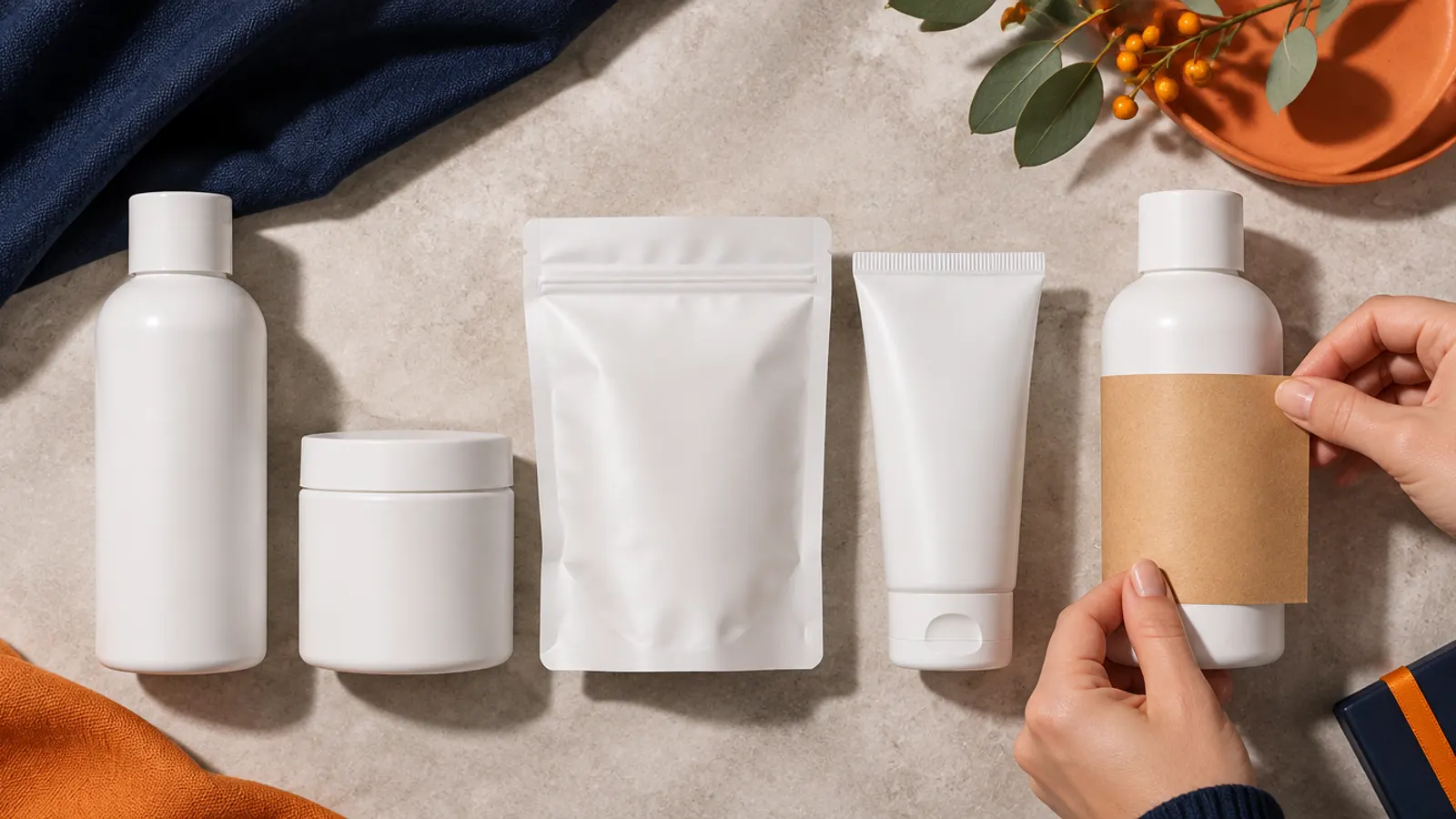
Für diesen Artikel erzeugtes Symbolbild; kein Foto eines darin genannten Unternehmens.
Kurz gesagt
Private label means a manufacturer makes a product and you sell it under your own brand name. You decide the brand, the packaging and usually some of the specification; the manufacturer supplies the formula or design, the production line and the batch documentation. In most cases the brand owner, not the factory, is the business legally responsible for the product once it is on the market.
Das Wichtigste in Kürze
- Private label is a product made by a manufacturer and sold under your brand; you own the brand, and the factory usually keeps ownership of a stock formula or design.
- White label is the same product sold unchanged to many brands; contract manufacturing makes a product to your own specification. Private label sits between the two.
- The main costs are the first production run, packaging and artwork, compliance work and freight. The minimum order quantity decides how much cash the first order ties up.
- Putting your name on the pack normally makes you the responsible business in the eyes of regulators, so ask for documents and keep them.
- Compare manufacturers on a written brief and a like-for-like quotation, and always test a production-grade sample before you pay for a full run.
Most products on a shop shelf were not made by the company whose name is on the front. A brand designs, positions and sells; a factory somewhere else mixes, fills, sews or assembles. Private label is the most common way to set up that split, and it is how many small brands in cosmetics, food supplements, household goods and food get started.
This guide explains the term in plain language, shows how a private label project runs from first enquiry to delivery, and sets out the costs and responsibilities that founders tend to discover late. It is general information, not legal advice.
What does private label mean?
Private label means a product is manufactured by one company and sold under the brand of another. The seller owns the brand name, the artwork and the customer relationship. The manufacturer owns the factory and, very often, the underlying formula or design.
The term originally described supermarket own-brand ranges. Today it is used much more widely, for any brand that sells goods made by a third party under its own name, whether that brand is a retailer, a pharmacy chain, a clinic, an online shop or a founder with a single product.
Three things usually define a private label arrangement:
- The manufacturer already has a product, or a range of base products, that it can make.
- You choose from that range and adapt what is offered: pack size, fragrance, flavour, colour, strength, packaging and label.
- The finished goods carry only your brand. The factory's name normally does not appear, unless the law for that product category requires it.
How does private label work in practice?
The details vary by category, but most projects follow the same sequence.
- Write a brief. One page is enough: the product, the target customer, the target retail price, the countries you will sell in, the quantity you can realistically buy, and any fixed requirements such as vegan, fragrance-free or recyclable packaging.
- Shortlist manufacturers. Look for factories that already make your product type and accept orders of your size. A directory such as Bulk.eu's manufacturer listings lets you filter by category and country before you contact anyone.
- Send the same enquiry to each. Ask for the minimum order quantity, a price at two or three quantities, the lead time, what is included in the price, and which documents come with each batch.
- Order samples. Test the stock product first. If you ask for changes, test the changed version too, in the final packaging if you can.
- Agree the specification in writing. This covers the formula or design version, the packaging components, the artwork, tolerances, shelf life and the tests the batch must pass.
- Complete the compliance work. Depending on the category this may include a safety assessment, a product notification, label checks and registration of your business with the relevant authority.
- Approve artwork and place the order. A deposit is common, with the balance due before dispatch. Payment terms are agreed directly between you and the manufacturer.
- Receive and check the goods. Compare the delivery against the specification and the batch documents before you start selling.
A simple stock product with a new label can move through these steps in weeks. A product with a modified formula, custom packaging or regulatory notifications in several countries takes months. Ask each manufacturer for a realistic timeline rather than assuming one.
What is the difference between private label, white label and contract manufacturing?
The three terms are used loosely, and some manufacturers use them interchangeably. The practical difference is how much of the product is yours.
| White label | Private label | Contract manufacturing | |
|---|---|---|---|
| What you get | A finished stock product, unchanged | A stock product adapted to your brand | A product made to your own specification |
| Who owns the formula or design | The manufacturer | Usually the manufacturer | Usually you, if the contract says so |
| Customisation | Label only | Label, packaging and limited product changes | Full |
| Typical minimum order | Lowest | Low to medium | Medium to high |
| Development time and cost | Very little | Some | Most |
| How unique the product is | Not unique; other brands sell the same thing | Partly unique | Unique |
| Ease of moving to another factory | Hard to match exactly | Hard to match exactly | Easier, because you hold the specification |
Two points in that table matter more than the rest.
First, ownership. If the factory owns the formula and you later change manufacturer, you will not take the product with you. You will have to reformulate, which customers may notice. If that matters to you, ask before you start whether the formula can be bought or licensed, and on what terms.
Second, uniqueness. A white label product can be sold by any number of brands. That is acceptable when you compete on brand, audience or service, and a weakness when you plan to compete on the product itself.
If you want a product built entirely to your own specification, look at contract manufacturing instead. Many factories offer both routes, and brands often start with private label and move to a custom formula once sales justify the development cost.
Which products are commonly sold under private label?
Private label works best where factories can make a good base product in volume and the brand adds value through positioning, packaging and distribution. Common categories in Europe include:
- Skincare, haircare and body care
- Food supplements, sports nutrition and functional foods
- Coffee, tea, snacks and other packaged food and drink
- Household cleaning and laundry products
- Pet food and pet care
- Candles, home fragrance and gifts
- Clothing basics, bags and accessories
Regulated categories such as cosmetics and supplements need more preparation than the others. If you are considering supplements, read our step-by-step guide to starting a private label supplement brand in Europe. For skincare, our overview of skincare manufacturers in Europe shows what to look for in a factory.
How much does it cost to start a private label brand?
There is no standard figure, because cost depends on the category, the quantity and how much you customise. What is consistent is the list of cost lines. Founders who budget only for the goods are usually surprised by the rest.
- The production run. Unit price multiplied by the quantity ordered. The quantity is driven by the manufacturer's minimum order quantity (MOQ).
- Packaging and labels. Stock packaging with a printed label is cheapest. Custom-printed tubes, cartons or pouches carry their own minimums, often higher than the product minimum.
- Design. Brand identity, label artwork and print-ready files.
- Compliance. Safety assessments, product notifications, label reviews, laboratory tests and, where needed, translation.
- Samples and development. Free at some factories, charged at others, and usually charged if you ask for changes.
- Freight and storage. Transport from the factory, plus a warehouse or fulfilment service if you do not store the goods yourself.
An illustrative example
The figures below are invented to show how the cost lines add up. They are not a quotation and not any manufacturer's terms.
Imagine a 250 ml body lotion based on a stock formula, in a stock bottle with a printed label, ordered at an example minimum of 1,000 units.
| Cost line | Example amount |
|---|---|
| Production: 1,000 units at €2.40 | €2,400 |
| Label design and print-ready artwork | €600 |
| Label printing | €250 |
| Safety assessment and product notification | €400 |
| Samples and courier | €150 |
| Freight to your warehouse | €200 |
| Total | €4,000 |
The factory price is €2.40 per unit, but the real cost of the first batch is €4.00 per unit. Design and compliance are mostly one-off, so on a repeat order of the same product the cost per unit falls back towards the factory price plus labels and freight.
This is why the first order should be judged on total cash committed and on how long the stock will take to sell, not on unit price alone.
What are the advantages and disadvantages of private label?
Advantages
- Speed. The product already exists, so you skip most of the development work.
- Lower entry cost. You do not buy equipment, rent a production site or employ production staff.
- Proven production. The factory has made the product before, which reduces the risk of a failed first batch.
- Focus. Your time goes into brand, sales and customers.
Disadvantages
- Limited differentiation. Other brands may sell a very similar product.
- Dependence. If the factory raises prices, changes the formula or stops making the product, you have few options at short notice.
- Minimums. You must buy a full run, which ties up cash in stock.
- Thinner margin than own production at scale. The manufacturer's margin is built into your unit price.
- Responsibility without control. You are accountable for a product you did not make, so you rely on documents, audits and testing.
Who is legally responsible for a private label product?
In most cases, you are. Across EU product law, the business that markets a product under its own name or trademark is generally treated as the party responsible for it, even when a third party made it. The exact wording and duties differ by category:
- Food and food supplements. The food business operator under whose name the product is marketed is responsible for the information on the label, and every food business in the chain is responsible for the safety of what it handles.
- Cosmetics. Each product needs a designated responsible person established in the EU, who ensures the safety assessment, the product information file and the notification are in place. For a private label product this is usually the brand owner, unless another party agrees in writing to take the role.
- General consumer goods. A business that has a product made and sells it under its own name is treated as the manufacturer for product safety purposes.
In practice this means three things. Collect the documents that prove the product is compliant and keep them for as long as the rules require. Make sure the contract states who does what: who holds which files, who handles complaints and who pays if a batch must be recalled. And check that your product liability insurance covers goods made by a third party.
Rules outside the EU, including in the United Kingdom and Switzerland, are similar in spirit but separate in law. If you plan to sell there, check the local requirements. For anything specific to your product, speak to a qualified regulatory adviser.
How do you choose a private label manufacturer?
Compare manufacturers on evidence rather than on how polished the website is. A sound comparison covers:
- Fit. Do they already make your product type, at your order size?
- Minimums and pricing. The MOQ per product and per variant, and the price at each quantity.
- What is included. Filling, labelling, outer cartons, batch testing and documentation are included by some factories and charged separately by others.
- Certifications. Ask for current certificates and check the scope and expiry date. A certificate that a supplier states it holds is not the same as one you have seen.
- Documents per batch. Specification, certificate of analysis and traceability records.
- Formula ownership and exclusivity. Who owns it, and whether the same product is sold to your direct competitors.
- Communication. How quickly and precisely they answer technical questions is a fair preview of the working relationship.
If you would rather receive offers than search, you can post a buying request describing the product, the quantity and the market, and let suitable manufacturers reply. Bulk.eu is a sourcing marketplace, not a shop: it helps you find and contact suppliers, and you agree the contract, the order and the payment directly with the manufacturer you choose. You can also browse the private label section by category.
What are the most common mistakes first-time founders make?
- Ordering too much. A lower unit price is no saving if half the stock expires or sits unsold.
- Skipping the sample of the final version. Approving a stock sample and then changing the fragrance or the bottle means the first time you see the real product is on delivery.
- Leaving compliance to the end. A label claim that is not permitted, or a missing notification, can stop a launch after the goods are paid for.
- Assuming the factory handles everything. Many do help with regulatory work, but the legal responsibility usually remains with the brand.
- Having no written specification. Without one there is nothing to measure a disappointing batch against.
- Comparing quotations that are not alike. One price includes packaging and testing, another does not. Ask every manufacturer the same questions.
Is private label the right route for you?
Private label suits founders who want to test a market quickly, whose advantage lies in brand, audience or distribution, and who can live with a product that is good rather than unique. It is less suitable if your whole proposition depends on a novel formula or patented design, in which case a custom development with a contract manufacturer is the more honest starting point.
Many brands use both over time: a private label launch to prove demand, followed by a custom version of the best-selling product once the numbers support it. Whichever route you take, the discipline is the same. Write the brief, compare like with like, test before you commit, and keep the paperwork.
Häufig gestellte Fragen
- What does private label mean in simple terms?
- Private label means a manufacturer produces a product and another business sells it under its own brand name. The seller owns the brand, the packaging design and the customer relationship, while the manufacturer owns the factory and usually the underlying formula or design. Supermarket own-brand ranges are the classic example, but small independent brands use the same model.
- Is private label the same as white label?
- Not quite. A white label product is sold unchanged to many brands, with only the label differing. A private label product starts from a manufacturer's base product but is adapted for one brand, for example in fragrance, flavour, pack size or packaging. Many manufacturers use the two terms interchangeably, so always ask exactly what can be changed and whether other brands sell the same product.
- How much money do you need to start a private label brand?
- It depends on the category, the minimum order quantity and how much you customise. Budget for the first production run, packaging and label printing, design, compliance work such as safety assessments or notifications, samples and freight. For a small first run, the one-off costs can add a large share on top of the factory price, so work out total cash committed rather than unit price alone.
- Who owns the formula in a private label agreement?
- Usually the manufacturer. With a stock or lightly adapted product, the factory developed the formula and keeps it, which means you cannot take the identical product to another manufacturer. If ownership matters to you, ask before ordering whether the formula can be bought, licensed or made exclusive to your brand, and have the answer written into the contract.
- Who is legally responsible for a private label product in the EU?
- Generally the business whose name is on the pack. For food and supplements that is the operator under whose name the product is marketed; for cosmetics it is the designated responsible person, usually the brand owner; for general consumer goods, a business selling under its own name is treated as the manufacturer. The factory still has duties, but the brand cannot hand over its own. This is general information, not legal advice.
- Can you do private label with a small order?
- Often, yes. Stock products with a printed label typically have the lowest minimums because the manufacturer can add your order to an existing production run. Minimums rise when you ask for a changed formula or custom-printed packaging. Tell manufacturers the quantity you can realistically buy at the start, and ask whether a smaller trial run is possible at a higher unit price.
- How long does it take to launch a private label product?
- A stock product with new labelling can be ready in a matter of weeks once artwork is approved. Projects with formula changes, custom packaging or regulatory notifications in several countries usually take several months. Packaging lead times and compliance steps are the most common causes of delay, so ask each manufacturer for a timeline that covers every stage, not only production.
- Do customers know a private label product was made by another company?
- Usually not from the pack alone. The label carries the brand owner's name and address, and in most categories the manufacturer does not have to be named. Some product rules require a responsible business or place of origin to be stated, which may or may not reveal the factory. You should never claim to manufacture a product yourself if you do not.