Materials & packaging
Choosing Packaging for Skincare: Airless, Glass, Tubes and Jars
Mis à jour le · 14 min de lecture · Rédaction Bulk.eu
Cet article n'est disponible qu'en anglais.
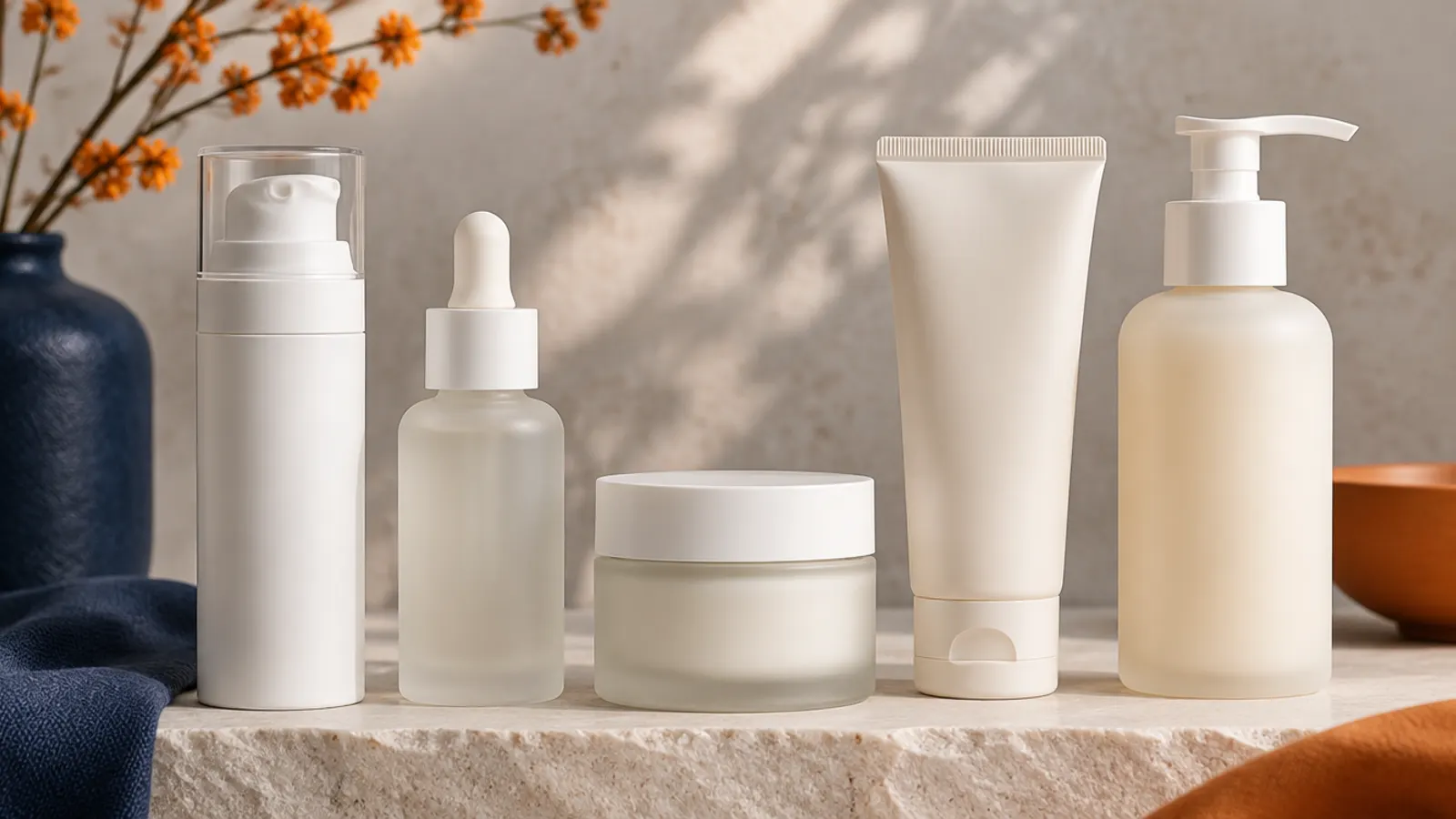
Image d'illustration générée pour cet article ; ce n'est pas une photographie d'une entreprise qui y est citée.
En bref
Choose skincare packaging by the formula's viscosity, its sensitivity to air and light, and how the product is used. Airless pumps suit sensitive creams and serums, dropper bottles suit thin serums and oils, jars suit thick creams and balms, tubes suit cleansers, masks and sun care, and pump bottles suit lotions and washes. Whatever you choose, have the formula tested in the actual pack before you order in volume.
À retenir
- Match the pack to the formula first: viscosity decides what will dispense, and sensitivity to air and light decides how much protection is needed.
- Compatibility testing in the final pack is essential. Formula and packaging can interact, causing leaks, discolouration, deformed containers or loss of active ingredients.
- Open jars and droppers expose the product to air and fingers at every use. Airless packs, tubes and pumps reduce that exposure.
- Stock containers with a printed label give the lowest minimums. Screen printing, hot stamping and printed tubes add setup costs and need larger runs.
- Cost is driven by the number of components, the material, the decoration and whether the pack is stock or custom, not only by the container price.
- Sustainability claims about packaging need to be specific and evidenced. A pack is rarely simply recyclable; pumps, mixed materials and local collection all matter.
Skincare packaging is part of the product. It decides how the formula is dispensed, how long it stays stable once opened, and how the brand is judged on a shelf or in a photograph.
It is also where many first launches lose time and money: a pump that will not draw a thick cream, a printed tube ordered in a quantity three times the first batch, or an essential oil blend that clouds a plastic bottle after a month. This guide compares the main formats, explains why compatibility testing matters, and shows how to choose by product type. It is general guidance and not legal advice.
Which packaging formats are used for skincare?
| Format | Best suited to | Protection from air and contamination | Relative cost | Typical minimums |
|---|---|---|---|---|
| Airless pump | Sensitive creams, serums, lotions, gel-creams | High: no air drawn back in, no contact with fingers | High | Low to medium with stock packs; higher when decorated |
| Dropper bottle | Thin serums, facial oils, essences | Low to medium: opened at each use, pipette goes in and out | Medium | Low with stock glass and labels |
| Jar | Thick creams, balms, masks, body butters | Low: wide opening, usually fingers | Low to medium | Low with stock jars and labels |
| Tube | Cleansers, creams, masks, sun care, hand cream | Medium to high: small opening, little air drawn back | Low to medium per unit | Low for stock tubes with labels; high for printed tubes |
| Pump bottle | Lotions, cleansers, toners with a spray, body care | Medium: no finger contact, but air enters as product is used | Low to medium | Low with stock bottles and labels |
The minimums column describes general market practice rather than any supplier's terms. Actual figures depend on the supplier, the size and the decoration.
When is an airless pump worth the cost?
An airless pack has no dip tube. A piston rises from the bottom, or an inner pouch collapses, as product is pumped out, so little or no air enters to replace it. The product is not touched, and most of it can be dispensed.
That makes airless a good fit for formulas that suffer from repeated exposure to air: products with ingredients such as retinoids or vitamin C derivatives, formulas with lighter preservative systems, and emulsions meant to stay fresh over several months of use. It is not a substitute for a properly preserved formula.
Limits to know about:
- Viscosity range. Very thin liquids can leak past a piston, and very thick or grainy products may not pump. Test with your formula.
- Filling. Airless packs must be filled without trapping air under the pump, otherwise the first strokes deliver nothing. Some need specific filling equipment, so confirm with your manufacturer.
- Cost and components. An airless pack has more parts than a jar and costs noticeably more.
- Recycling. Several plastics, and in some designs a metal spring, are combined in one pack. Single-material and metal-free versions exist and are worth asking about.
Are dropper bottles right for serums and oils?
A glass bottle with a pipette is the familiar format for thin serums and facial oils. It doses by the drop, suits low-viscosity liquids that a pump would over-deliver, and glass is inert towards most formulas.
The weaknesses are exposure and contamination. The bottle is open at every use, the pipette is drawn through the air and may touch skin before going back in, and the bulb is a rubber or silicone part in close contact with the product's vapour.
Check these points:
- Bulb and wiper material. Oils, essential oils and some solvents can swell or degrade certain rubbers. This is a classic compatibility failure.
- Light. Clear glass shows the product but offers no light protection. Amber, coated or frosted glass, or an outer carton, helps with light-sensitive formulas.
- Viscosity. A pipette will not pick up a gel or a thick serum properly. A treatment pump on the same bottle is often the better choice.
- Breakage and weight. Glass costs more to ship and needs protective shipping packaging.
Are jars still a sensible choice?
Jars are the simplest and usually the cheapest primary pack. They take products too thick for any pump: rich creams, balms, cleansing butters, clay masks and scrubs. They are easy to fill, including by hand for small batches, and easy to label.
Their drawback is the wide opening. Every use exposes the whole surface to air, and fingers introduce microorganisms. A formula sold in a jar needs a preservative system robust enough for that, which is confirmed through preservative efficacy testing, often called a challenge test.
Ways to reduce the risk without changing format:
- A spatula, with instructions to use it.
- An inner shive or sealing disc under the lid, which also provides a first-opening seal.
- A smaller size, so the product is used up sooner.
- Opaque or coloured material for light-sensitive formulas.
Glass jars look premium and are heavy. Plastic jars in PP or PET are lighter and cheaper.
What are tubes good for?
Tubes suit creams, gels, cleansers, masks, hand creams and sun care. The opening is small, the product is squeezed out rather than scooped, and a collapsing tube draws back little air. They travel well and are hygienic in use.
There are three main constructions. Extruded plastic tubes are the most common and can be soft or firm. Laminate tubes include a barrier layer, sometimes aluminium, for formulas that need more protection. Aluminium tubes give a complete barrier and do not spring back, so no air is drawn in, but they dent and need an internal lacquer suited to the formula.
The main consideration for new brands is that tubes are normally decorated when they are made. A printed tube is produced to order, which means a setup cost, a lead time of weeks and a minimum well above that of a labelled jar. Stock tubes with a self-adhesive label exist and keep quantities low, though a label on a squeezed tube can crease.
Filling matters as well. Tubes are filled from the open end and then sealed, which needs a tube filling and sealing machine matched to the tube diameter and material. Ask whether your manufacturer has one.
When should you use a standard pump bottle?
A bottle with a lotion pump, a foamer or a spray head is the practical format for lotions, liquid cleansers, micellar waters, toners and body care. It is cheap, available in many stock sizes in PET, HDPE, PP and glass, and runs on standard filling lines.
A conventional pump uses a dip tube and lets air into the bottle as the product leaves, so protection is lower than airless, though still better than a jar because nothing is touched. Check the pump output per stroke against the amount a user needs, the dip tube length against the bottle, and whether the pump locks for transport. Foamers and fine mist sprays only work with thin formulas designed for them.
Why does compatibility testing matter?
Because formula and packaging interact, and the results often appear only after weeks. A pack that looks fine on filling day can fail in a warehouse in summer.
Typical failures include:
- Stress cracking and crazing. Some plastics crack on contact with certain oils, fragrance components, alcohol or surfactants.
- Panelling. Bottle or tube walls are pulled inwards as ingredients migrate through the wall or oxygen in the headspace is consumed.
- Swelling and softening. Of the container, the tube shoulder, the pipette bulb or the pump gaskets.
- Leakage. At seals, threads and pump collars, especially with thin oils.
- Discolouration and odour change. Of the product, the pack or both.
- Weight loss. Water or volatile ingredients escape through the wall or closure, thickening the product.
- Absorption. Fragrance, preservatives or active ingredients migrate into the plastic, leaving the formula weaker than intended.
- Decoration damage. Product running over the pack lifts print, labels or coatings.
Compatibility testing means filling the actual pack, with its actual closure, with the actual formula and storing samples under different conditions, usually including elevated temperature, for a set period. The samples are checked at intervals for appearance, weight, function and product quality.
It is also a regulatory matter. Under the EU Cosmetics Regulation, (EC) No 1223/2009, the cosmetic product safety report has to consider the stability of the product and information about the packaging material. Your safety assessor will ask what the product is packed in and what testing supports it. Our guide to the EU Cosmetics Regulation, the Responsible Person and CPNP explains the wider requirements.
Three practical rules follow:
- Do not buy packaging in volume until the formula has been tested in it.
- Treat a change of container material, closure or supplier as a change that may need retesting.
- Ask the packaging supplier for the exact materials of every component, including gaskets, liners and bulbs.
If your manufacturer offers stock formulas in its own stock packaging, that combination has normally already been tested, which is one reason private label is quicker than a custom project.
What drives the cost of skincare packaging?
- Stock or custom. A stock item needs no tooling. A custom shape needs a mould, a long lead time and a large minimum.
- Material and weight. Heavy glass and thick-walled or double-walled plastics cost more to make and to ship.
- Number of components. A jar has two or three parts. An airless pump with an overcap may have ten or more.
- Decoration. Each added process, colour or finish adds setup cost and a minimum.
- Colour. Stock colours are cheapest. A custom colour usually needs a dedicated production run.
- Secondary packaging. Cartons, leaflets and shipping protection for glass are separate items with their own minimums.
- Quantity. Unit prices fall with volume, but only up to what you will use. See what MOQ means.
What are the decoration options?
| Method | How it works | Suits | Minimums and cost |
|---|---|---|---|
| Self-adhesive label | Printed separately and applied to a stock container | First launches, small runs, frequent text changes | Lowest; short digital runs are possible |
| Screen printing | Ink printed directly onto the container, one colour at a time | Clean, durable one- to three-colour designs on bottles, jars and tubes | Setup cost per colour; medium minimums |
| Hot stamping | Metallic or coloured foil pressed on with a heated die | Logos and accents in gold, silver or other foils | A die is needed; usually added to another method |
| Offset or digital print on tubes | Applied during tube manufacture | Multi-colour tube designs | Made to order; higher minimums |
| Coating, frosting or lacquering | A surface finish on glass or plastic | Colour, matt or soft-touch effects | Batch process; medium to high minimums |
| Printed carton | Outer box around the primary pack | Extra label space, protection and shelf presence | Separate component and minimum |
An illustration of how this plays out, with invented quantities: a brand launching a 1,000-unit run could use a stock 50 ml airless pack with a printed label and order close to the quantity it needs. Screen printing the same pack might require ordering 3,000 or 5,000 pieces, and a custom colour more again. Labels let you correct an ingredient list or add a language without scrapping containers.
Direct print and coatings must themselves be tested against the formula, since some products attack inks and lacquers.
How much label space do you need?
The EU Cosmetics Regulation requires specified information on the container and the outer packaging, including the Responsible Person's name and address, the nominal content, a date of minimum durability or a period-after-opening symbol, precautions, the batch number, the product function and the ingredient list. Some items may appear on the outer packaging only, and there are provisions for very small packs.
A 15 ml dropper or a slim airless pack has very little printable area. Plan a carton, a fold-out label or a larger pack before artwork begins, and remember that language requirements differ by country of sale.
Which sustainability claims need care?
Packaging claims are scrutinised by regulators and by buyers, and vague ones are the easiest to get wrong. EU consumer law treats misleading environmental claims as an unfair commercial practice, and the rules on generic environmental claims are being tightened.
| Claim | Why it needs care |
|---|---|
| "Recyclable" | Depends on the material, the size, the colour, attached components such as pumps, and whether the buyer's local system actually collects and sorts it |
| "Made from recycled plastic" | Needs a stated percentage, clarity about which component it applies to, and evidence from the supplier |
| "Biodegradable" or "compostable" | Depends on specific conditions and standards; many such materials do not break down in household or natural settings |
| "Plastic-free" | Often untrue once liners, pumps, coatings and labels are counted |
| "Refillable" | Only meaningful if refills are actually available and the pack can be cleaned or reused safely |
| "Eco-friendly", "green", "sustainable" | Too general to substantiate; avoid |
Safer practice is to state facts: the material of each component, the percentage of recycled content with the supplier's documentation, and how to dispose of each part. Recycled plastics should also go through compatibility testing like any other material. Many EU countries have packaging producer responsibility schemes that the business placing packaged goods on that market must usually join; check the position where you sell.
How do you choose packaging by product type?
| Product type | Usual first choice | Alternatives | Watch for |
|---|---|---|---|
| Face cream | Airless pump or jar | Tube | Viscosity for airless; preservation for jars |
| Serum, water-based | Dropper bottle or airless pump | Bottle with treatment pump | Air exposure for sensitive actives |
| Facial oil | Glass dropper bottle | Bottle with treatment pump | Bulb compatibility, leakage, light |
| Cleanser, gel or cream | Tube or pump bottle | Foamer for thin formulas | Wet-hand use; closure that seals in the shower |
| Balm or cleansing butter | Jar | Wide tube for softer textures | Melting in transport; contamination |
| Mask | Tube or jar | Sachet for single use | Clays and scrubs clogging pumps |
| Sun care | Tube or airless pump | Bottle with pump or spray | Barrier, compatibility with UV filters, tight closure |
| Body lotion | Pump bottle | Tube | Pump output and dip tube length |
| Eye cream | Small airless pump or tube | Small jar | Very small label area |
A sensible sequence for a first product:
- Ask your manufacturer which packs it can fill and which it recommends for the formula.
- Shortlist stock packs in the right size and request samples of the complete pack, including closure.
- Check dispensing with the real formula.
- Run compatibility and stability testing in the chosen pack.
- Confirm the label or print area fits the mandatory text.
- Order packaging in a quantity matched to the first batches, and move to printed or custom packs when repeat orders justify it.
If you are still looking for a producer, our list of skincare manufacturers in Europe is a starting point, and you can browse contract manufacturing offers or post a buying request describing the formula, pack type and quantity. Bulk.eu is a sourcing marketplace, so terms are agreed directly with each supplier.
Questions fréquentes
- What is airless packaging in skincare?
- Airless packaging dispenses product with a rising piston or a collapsing inner pouch instead of a dip tube, so little or no air enters the container as it empties. The product is not touched by fingers and most of it can be dispensed. It suits air-sensitive creams and serums, costs more than jars or standard pump bottles, and needs correct filling to work properly.
- Is glass or plastic better for skincare packaging?
- Neither is better in every case. Glass is inert towards most formulas, looks premium and is widely recycled, but it is heavy, breakable and costly to ship. Plastics are lighter, cheaper and available in more formats such as tubes and airless packs, but must be checked for compatibility with the formula. The right choice depends on the product, the format and your price level.
- Why is packaging compatibility testing needed for cosmetics?
- Formulas and packaging materials can react with each other over time. Oils, fragrance, alcohol and surfactants can crack or deform plastics, swell rubber parts or cause leaks, while the pack can absorb fragrance, preservatives or actives. Testing the real formula in the real pack under different storage conditions reveals these problems before you buy packaging or fill product in volume.
- Are jars unhygienic for face creams?
- Jars expose the product to air and fingers at each use, so the contamination risk is higher than with pumps or tubes. A properly preserved formula, confirmed by preservative efficacy testing, is designed to cope with this. A spatula, an inner sealing disc and smaller jar sizes reduce the risk further. For lightly preserved or very sensitive formulas, an airless pack is usually safer.
- What is the minimum order for custom skincare packaging?
- It varies by format and decoration. Stock jars, bottles and airless packs with a printed label can often be bought in the hundreds or low thousands. Screen-printed or hot-stamped containers and printed tubes are made to order and commonly need several thousand pieces, and custom shapes or colours more. These are general market patterns, so ask each supplier for its own minimum.
- What is the cheapest way to decorate skincare packaging?
- A self-adhesive printed label on a stock container is normally the cheapest and most flexible option. Labels can be printed digitally in short runs, changed easily when text or languages change, and applied by the manufacturer during filling. Screen printing and hot stamping give a more integrated look but add setup costs and require larger quantities of containers per order.
- Can I call my skincare packaging recyclable?
- Only with care. Whether a pack is recycled in practice depends on its material, size, colour, attached parts such as pumps, and the collection system where the buyer lives. A specific statement, such as naming the bottle material and explaining how to separate the pump, is easier to support than a general claim. Keep supplier evidence, and avoid vague terms such as eco-friendly.
- Which packaging is best for a vitamin C or retinol serum?
- Ingredients of this kind are generally sensitive to air and light, so packaging that limits both is preferred: an opaque or coated airless pump, or dark glass with a treatment pump rather than an open dropper. The final choice should be confirmed by stability and compatibility testing of your specific formula in the chosen pack, since stability depends on the formulation as well.