Private label
How to Start a Private Label Supplement Brand in Europe, Step by Step
Aggiornato · 14 min di lettura · Redazione Bulk.eu
Questo articolo è disponibile solo in inglese.
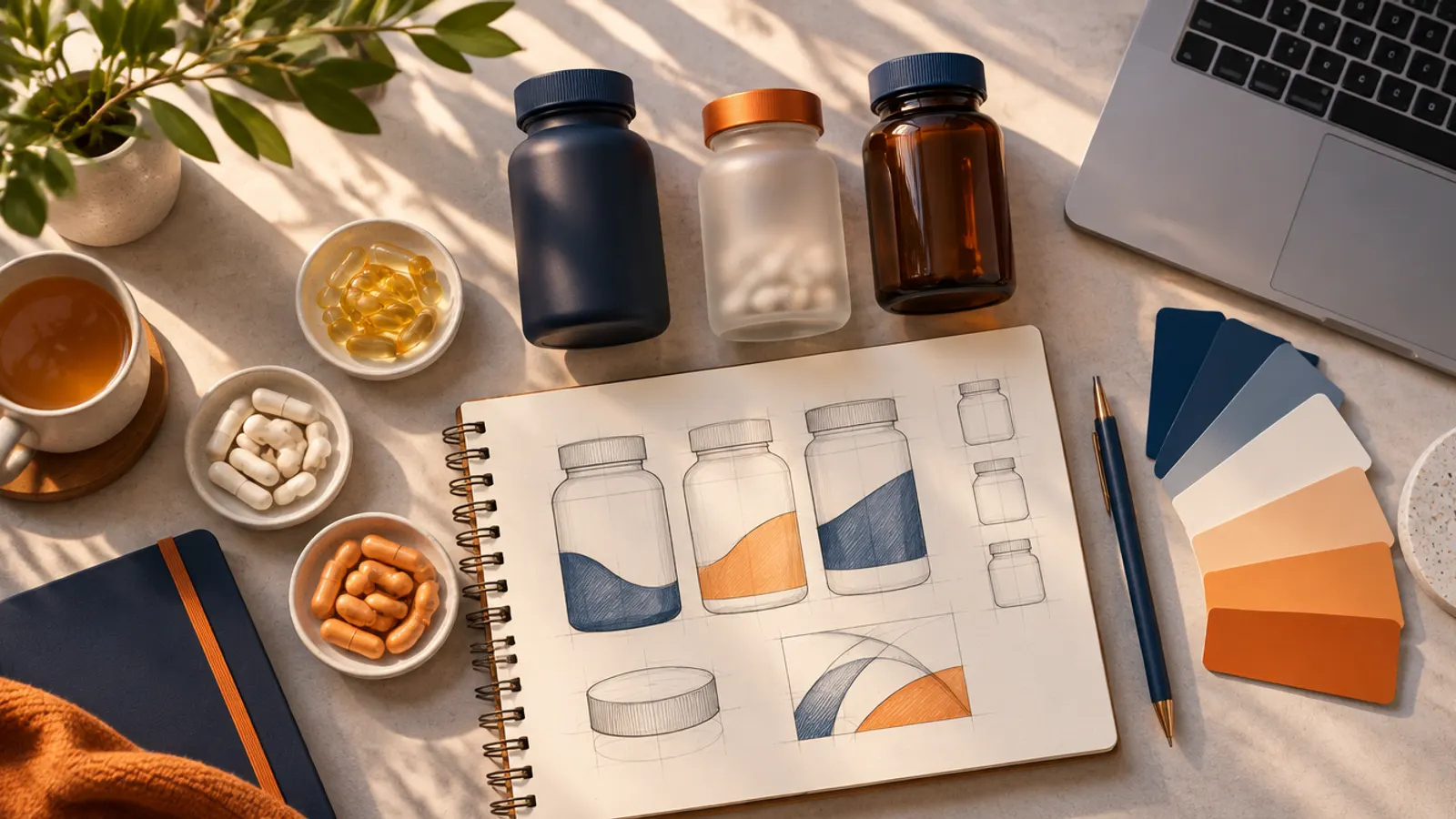
Immagine illustrativa generata per questo articolo; non è una fotografia di alcuna azienda in esso citata.
Risposta breve
To start a private label supplement brand in Europe, define one product and its target market, choose a manufacturer that already makes that format, check the formula and label against EU food supplement rules, complete any notification the member state requires, and then order a first production run. The brand whose name is on the pack is the responsible food business operator, so compliance is your job even though the factory makes the product.
Punti chiave
- In the EU, supplements are regulated as food. The core rules are Directive 2002/46/EC, the health claims Regulation (EC) No 1924/2006 and the food information Regulation (EU) No 1169/2011.
- The business under whose name the product is sold is the responsible food business operator, not the contract manufacturer.
- Notification or registration requirements differ by member state, so check every country you plan to sell in before you print labels.
- Only authorised nutrition and health claims may be used, and a supplement may never be presented as preventing, treating or curing a disease.
- A stock formula is the fastest and cheapest start; a custom formula gives you a unique product at a higher minimum, cost and lead time.
- Budget for compliance, design, testing and freight as well as the production run, and size the first order to what you can sell within the shelf life.
Starting a supplement brand no longer requires a factory. A private label manufacturer can supply the formula, the capsules or powder, the filling and the batch paperwork, while you build the brand and sell the product.
What a manufacturer cannot do is take over your legal responsibility. In the EU a food supplement is a food, the rules are detailed, and the business named on the label answers for them. This guide walks through the process in order, with the regulatory steps placed where they belong: before you pay for production.
It is general information and not legal advice. Rules are applied by national authorities and change over time, so confirm the details for your product with a qualified regulatory adviser or the competent authority.
What is a private label supplement brand?
It is a brand that sells food supplements made by a third-party manufacturer under its own name. You choose the product, the positioning, the packaging and the label. The manufacturer produces it, usually from a formula it has already developed.
If the general model is new to you, start with our plain guide to what private label means. The supplement version follows the same pattern, with more regulation attached.
What should you decide before contacting a manufacturer?
Manufacturers answer specific enquiries faster and more precisely than vague ones. Settle these points first:
- One product to begin with. A single product in one size is easier to fund, launch and learn from than a range.
- The dosage format. Capsules, tablets, softgels, powders, liquids and gummies need different equipment, and most factories specialise in some of them.
- The target customer and price. These determine the ingredient quality, pack size and packaging you can afford.
- The countries you will sell in. This decides which national rules, notifications and label languages apply.
- Your realistic first-order quantity and budget. This filters out manufacturers whose minimums do not fit.
- Any fixed requirements. For example vegan capsules, no added sugar, allergen-free production or organic certification.
How do you start a private label supplement brand, step by step?
- Write a one-page product brief. Include the format, the active ingredients and amounts per daily dose you have in mind, pack size, target countries, quantity and timeline.
- Check that the ingredients are permitted. Confirm that each vitamin and mineral form is allowed, that any other substance is accepted in your target countries, and that nothing is an unauthorised novel food. The rules are set out in the next section.
- Shortlist manufacturers. Look for factories that make your format at your order size. You can browse private label suppliers on Bulk.eu, read our overview of private label supplement manufacturers in Europe, or look at an individual manufacturer's site, such as Nutrikal, to see how a private label offer is typically presented.
- Send the same enquiry to each and compare the replies. Ask for the minimum order quantity, prices at two or three quantities, lead time, what the price includes and which documents come with each batch.
- Request samples and the product specification. Check taste, smell, capsule size and appearance, and read the specification: ingredients, amounts, allergens, shelf life and storage conditions.
- Draft the label and have it reviewed. Write the mandatory information and any claims, then have the text checked against EU and national rules before the design is finalised.
- Register your business and notify the product where required. Food businesses must be registered with their competent authority, and many member states require a supplement to be notified before or when it is first sold.
- Agree the specification and terms in writing. Fix the formula version, packaging, artwork, batch tests, shelf life on delivery, price, payment terms and what happens if a batch is out of specification.
- Approve the artwork proof and place the order. Check the printed proof line by line against the reviewed text.
- Check the delivery and keep the records. Compare the batch documents with the specification, record lot numbers and where the stock goes, and store the files. Traceability is a legal duty, and you will need it if there is ever a complaint or recall.
Which EU rules apply to food supplements?
Supplements are not medicines and are not pre-approved by a central EU body. They are foods, covered by general food law plus rules specific to supplements. The main texts are:
| Rule | What it covers | What it means for a new brand |
|---|---|---|
| Directive 2002/46/EC on food supplements | Defines food supplements, lists the vitamins and minerals (and their chemical forms) that may be used, and sets supplement-specific labelling | Use only permitted forms; follow the extra labelling rules |
| Regulation (EC) No 1924/2006 on nutrition and health claims | Allows only authorised claims, under stated conditions of use | Every benefit statement must be an authorised claim that your product qualifies for |
| Regulation (EU) No 1169/2011 on food information to consumers | General labelling: ingredients, allergens, durability date, legibility, language, responsible operator | Your label must carry the mandatory particulars, legibly, in the right language |
| Regulation (EU) 2015/2283 on novel foods | Foods and ingredients without a significant history of consumption in the EU before 15 May 1997 need authorisation | A new or exotic ingredient may not be used unless it is authorised |
| Regulation (EC) No 178/2002 (general food law) | Food safety, traceability, withdrawal and recall duties | You must be able to trace your product and act if it is unsafe |
Some important areas are not fully harmonised. Directive 2002/46/EC harmonises which vitamins and minerals may be used, but rules on maximum amounts, and on other substances such as botanicals, amino acids and other bioactive ingredients, are largely left to national law. A formula that is accepted in one member state may be questioned in another. Check the position in each country you intend to sell in, and do not assume that selling lawfully in one country settles the matter everywhere.
Do you have to notify or register a supplement before selling it?
It depends on the country. Directive 2002/46/EC allows member states to require the business placing a supplement on the market to notify the competent authority, typically by submitting a copy of the label. Many member states use this option, and the procedure, the information requested and any fee differ from one to the next. Some require more than a label, and some have no notification step.
Practical consequences:
- Find out the requirement for each target country at the planning stage, not after printing.
- Work out who will submit the notification. It is normally the business placing the product on that market; some manufacturers and consultants offer to help.
- Treat notification as what it is. In most cases it informs the authority and does not mean the product or its claims have been approved.
Separately, your own business will generally need to be registered as a food business with the competent authority where it is established, even if you never handle the product physically.
What can you say about your product?
Claims are where new supplement brands most often go wrong.
Under Regulation (EC) No 1924/2006, a nutrition or health claim may only be used if it is authorised and your product meets the conditions of use. Authorised health claims are listed in the EU register, each tied to a specific nutrient or substance and a minimum amount. For example, there are authorised claims linking magnesium to the reduction of tiredness and fatigue, which may only be used if the product contains enough magnesium to qualify.
The rule covers everything that communicates a benefit, not just the label: your website, advertisements, social media posts, product names and images.
Three limits to keep in mind:
- No medicinal claims. Food information must not say or imply that a food prevents, treats or cures a human disease.
- Wording has limited flexibility. You may adapt an authorised claim only if the meaning for the consumer stays the same.
- Botanicals are a special case. Many claims for plant substances have not been finally assessed at EU level, and their status is unsettled. Take specific advice before relying on any of them.
What must be on a supplement label?
The label combines the general rules of Regulation (EU) No 1169/2011 with the supplement-specific rules of Directive 2002/46/EC. In outline, expect to include:
- The name "food supplement"
- The names of the categories of nutrients or substances that characterise the product, or an indication of their nature
- The recommended daily portion, and a warning not to exceed it
- A statement that food supplements should not be used as a substitute for a varied diet
- A statement that the product should be stored out of the reach of young children
- The amount of each nutrient or substance per recommended daily portion, with vitamins and minerals also shown as a percentage of the reference values
- The list of ingredients, with allergens emphasised
- The net quantity
- The date of minimum durability and any special storage conditions
- The name and address of the food business operator responsible for the product
- A lot or batch identification
Mandatory information must be easy to see and read, in a minimum font size, and in a language easily understood by consumers in the country of sale. Selling in several countries therefore usually means a multilingual label or separate label versions. Member states may add national requirements, such as specific warnings for certain ingredients.
Should you choose a stock formula or a custom formula?
| Stock formula | Custom formula | |
|---|---|---|
| What it is | The manufacturer's existing product with your label | A product developed to your specification |
| Minimum order | Usually lower | Usually higher |
| Development time | Short | Longer: formulation, trials, stability considerations |
| Upfront cost | Low | Higher: development and possibly special ingredients |
| Uniqueness | Other brands may sell the same formula | Unique to you |
| Who owns the formula | Usually the manufacturer | Negotiable; agree it in writing |
| Compliance groundwork | Often already documented by the manufacturer | Must be checked from the start |
For a first product, a stock formula is usually the sensible choice. It lets you test demand with less cash and less risk. If the product sells, you can develop a custom version later, sourcing specific raw materials and ingredients where that adds something customers will value.
Whichever route you take, the order size is governed by the manufacturer's minimum. Our guide to MOQ and how to negotiate it explains how minimums work and when a smaller run at a higher unit price is the better deal.
How much does it cost to launch a private label supplement?
Costs vary widely with the format, ingredients and quantity, so no single figure is reliable. What you can do is list the cost lines and get a quotation for each.
An illustrative budget
The figures below are invented to show the structure of a first order. They are not a quotation and not any manufacturer's terms.
Assume a stock-formula capsule product, 60 capsules per bottle, with a printed label, at an example first order of 1,000 bottles.
| Cost line | Example amount |
|---|---|
| Production: 1,000 bottles at €3.20 | €3,200 |
| Brand and label design | €500 |
| Regulatory label review and notification support | €600 |
| Independent laboratory test of the batch | €250 |
| Freight to your warehouse | €250 |
| Total | €4,800 |
In this example the factory price is €3.20 per bottle, but the first batch costs €4.80 per bottle once one-off and supporting costs are counted. On a repeat order the design and most of the regulatory work are not repeated, so the cost per bottle moves back towards the factory price plus freight.
Not shown, and easy to forget: product liability insurance, storage and fulfilment, a website, and marketing. For many brands, marketing is the largest cost after launch.
How long does it take?
Timelines depend on the manufacturer's schedule, packaging lead times and your regulatory steps. As a typical range rather than a promise:
- Stock formula with a printed label: roughly two to three months from first enquiry to delivery, if decisions are made promptly.
- Custom formula or custom-printed packaging: often four to six months or longer.
Label review and notification can run in parallel with sampling. The most common causes of delay are late artwork changes, packaging components and unanswered regulatory questions.
What should you ask a manufacturer for?
Because you are the responsible operator, you need evidence, not assurances. Ask for:
- The full product specification, including ingredients, amounts per dose, allergens and shelf life
- A certificate of analysis for each batch
- Specifications for the raw materials and, where relevant, their origin
- The basis for the stated shelf life
- Food safety certification. Food businesses in the EU must run procedures based on HACCP principles. Third-party certification to a recognised food safety standard is voluntary but widely expected. Ask for the current certificate and check its scope and expiry date
- Allergen and contaminant controls, and how cross-contamination is managed
- Clear terms on formula ownership, complaints, out-of-specification batches and recalls
Treat certifications and capabilities as supplier-stated until you have seen the documents. That applies to every manufacturer, whether you find it through a search, a referral or a marketplace.
If you prefer manufacturers to come to you, post a buying request with your brief. Bulk.eu is a sourcing marketplace rather than a shop: it connects you with suppliers, and the contract, order and payment are agreed directly between you and the manufacturer.
What are the most common mistakes?
- Choosing a brand or product name that implies a health benefit. Names can count as claims.
- Copying claims from other brands. That another company uses a claim does not make it authorised.
- Printing labels before the text is checked. Reprinting is slow and costly.
- Planning a multi-country launch on one national check. Requirements differ by member state.
- Over-ordering. Supplements have a shelf life, and retailers often want a long remaining life on delivery.
- Keeping no records. Without batch documents and traceability you cannot manage a complaint or recall properly.
Start with one product, one or two countries and a quantity you are confident of selling. A small, compliant launch that teaches you what customers want is worth more than a large one built on assumptions.
Domande frequenti
- Do I need a licence to sell food supplements in the EU?
- There is no single EU licence or pre-approval for food supplements. However, your business generally has to be registered as a food business with its competent authority, and many member states require each supplement to be notified, typically by submitting the label. Requirements differ by country, so check each market you plan to sell in. This is general information, not legal advice.
- Who is legally responsible for a private label supplement?
- The food business operator under whose name the product is marketed, which is normally the brand owner rather than the contract manufacturer. That business is responsible for the food information on the label and shares responsibility for safety and traceability. If the brand is not established in the EU, responsibility for food information falls on the importer into the Union market.
- Can I make health claims about my supplement?
- Only authorised ones. Under Regulation (EC) No 1924/2006, a health claim may be used if it appears in the EU register of authorised claims and your product meets its conditions of use, such as containing a minimum amount of the nutrient. The rule applies to labels, websites and advertising alike. Claims that a supplement prevents, treats or cures disease are prohibited.
- What is the minimum order for private label supplements?
- There is no standard minimum. It depends on the manufacturer, the dosage format, whether you use a stock or custom formula and how the product is packaged. Stock formulas with a printed label generally have the lowest minimums, and custom formulas or printed packaging the highest. Ask each manufacturer for its minimum per product and for prices at several quantities.
- How long does it take to launch a private label supplement?
- As a typical range, a stock formula with a printed label can take roughly two to three months from first enquiry to delivery, and a custom formula or custom packaging often takes four to six months or more. Actual timing depends on the manufacturer's schedule, packaging lead times, how quickly you approve artwork and the regulatory steps in your target countries.
- Can I sell the same supplement in every EU country?
- Not automatically. The permitted vitamin and mineral forms are harmonised, but maximum amounts and the use of other substances such as botanicals are largely governed by national rules. Notification procedures and label language requirements also differ. Check the formula, the label and any notification duty in each member state before you sell there, and adapt the product or label where needed.
- What is a novel food, and why does it matter for supplements?
- A novel food is a food or ingredient that was not consumed to a significant degree in the EU before 15 May 1997. Under Regulation (EU) 2015/2283 it may only be placed on the market once authorised and included in the Union list, under any conditions set there. New extracts and exotic ingredients are common in supplements, so check each ingredient's status before formulating.
- Is a stock formula or a custom formula better for a first product?
- A stock formula is usually the better start. It has a lower minimum order, little development cost and a shorter lead time, and the manufacturer has often already documented it. The trade-off is that other brands may sell the same formula. A custom formula makes sense once you have proven demand and know what you want to change.