Manufacturing
How to Request and Evaluate Product Samples
Updated · 14 min read · Bulk.eu editorial
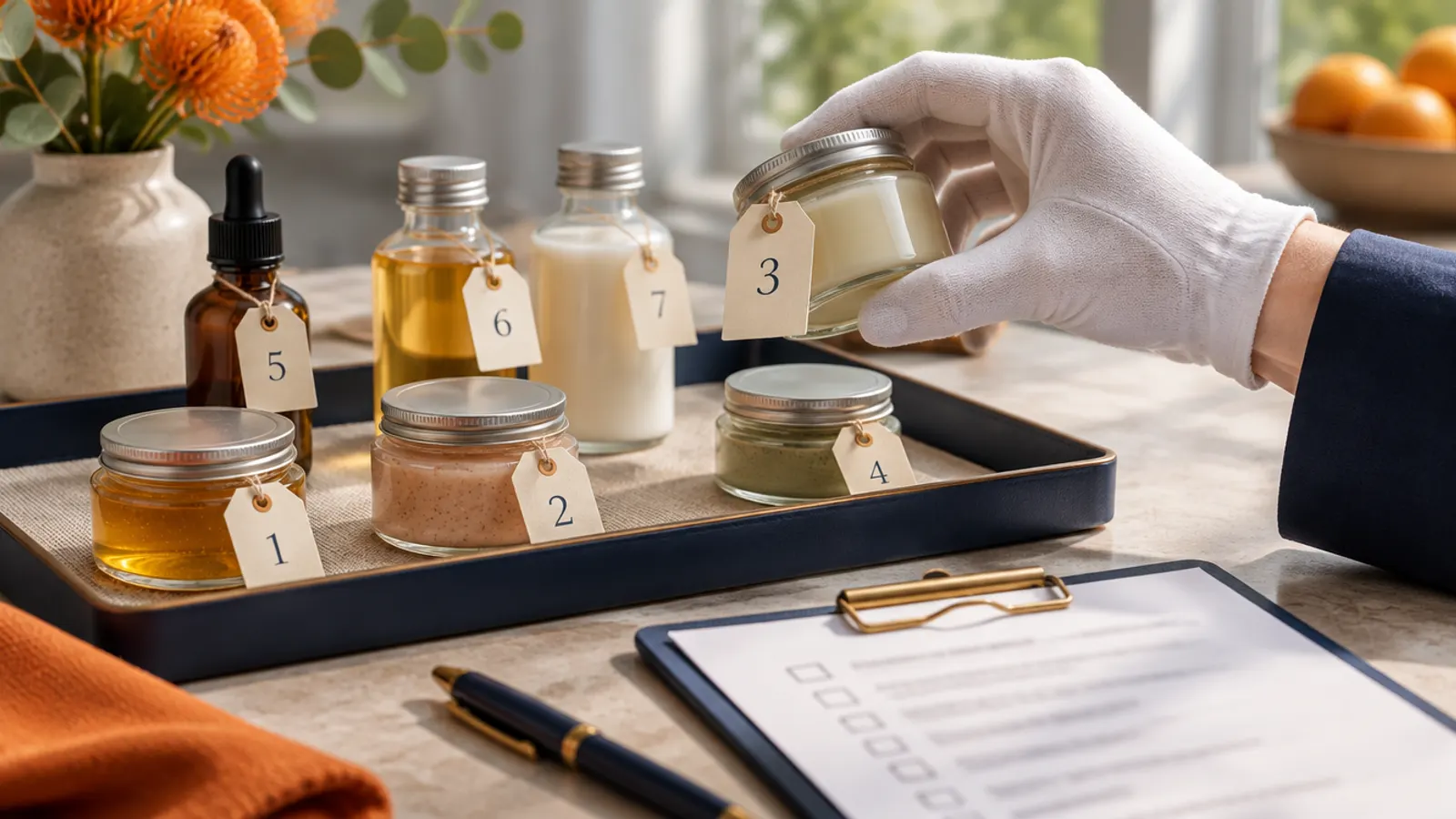
Illustrative image generated for this article; not a photograph of any company named in it.
Short answer
Ask for the right type of sample for your stage: a stock sample to judge a supplier, a lab sample to develop a product, and a pre-production sample to approve before the full run. Evaluate each one against a written specification using the same scoring sheet for every supplier, give feedback in measurable terms, and keep a signed and dated reference sample that both sides agree production must match.
Key takeaways
- There are four main sample types: stock, lab (development), pre-production and the golden or reference sample. Each answers a different question, so say which one you are asking for.
- Stock samples are often free or low cost with the buyer paying carriage. Custom development samples are usually charged, and the fee is sometimes credited against a first order.
- Judge samples against a written specification, not against a general impression. Decide your pass or fail criteria before the parcel arrives.
- Use one scoring sheet with weighted criteria for every supplier so that the comparison is fair and can be explained later.
- Feedback should be specific and measurable, sent in one consolidated list per round, and confirmed in writing by the supplier.
- Before production, sign and date identical reference samples, one for you and one for the manufacturer, and refer to them in the order or agreement.
A sample is the first time a supplier's promises become something you can hold. It is also the cheapest point in a sourcing project to discover a problem. A flaw found in a sample costs a parcel and a week. The same flaw found in a delivered order costs the order.
This guide sets out a disciplined approach: which sample to ask for, who normally pays, what to check for supplements, cosmetics and general goods, how to score what you receive, and how to turn an approved sample into a reference that protects you later.
What types of product sample are there?
"Sample" covers several different things. Each one answers a different question, and asking for the wrong type wastes a round.
| Sample type | What it is | What it tells you | What it does not tell you |
|---|---|---|---|
| Stock sample | A unit of a product the supplier already makes, usually in its own or plain packaging | The supplier's general quality, and whether a catalogue product suits you | How your own version, label or packaging will turn out |
| Lab sample (development sample) | A small batch made by hand or on laboratory equipment to your brief | Whether the formula, flavour, texture, material or design is right | How the product behaves on full-scale equipment |
| Pre-production sample | A unit made with the final materials, packaging and, ideally, the production process | What the finished order should look like | Consistency across thousands of units |
| Golden sample (reference sample) | The approved pre-production sample, signed and kept by both parties | The agreed standard that production is measured against | Nothing new: it records a decision |
Some suppliers also send a production sample or shipment sample, taken from the finished batch before it leaves the factory. It lets you compare the real run with the golden sample while there is still time to act.
Which ones you need depends on the route. For a stock private label product with your label, a stock sample followed by a pre-production sample with your artwork may be enough. For a custom product made through contract manufacturing, expect one or more lab samples before the pre-production stage. The difference between the two routes is explained in ready-made formula vs custom formulation.
Who pays for product samples?
There is no rule, only common practice, and it follows the cost to the supplier.
| Sample type | Common practice | Worth asking |
|---|---|---|
| Stock sample | Free or charged at around the unit price; the buyer usually pays carriage | Whether the cost is refunded on a first order |
| Lab sample | A development fee per formula or per round is common, because someone's time and materials go into it | How many revision rounds the fee includes |
| Pre-production sample | Often included in the order; tooling, printing plates or packaging proofs may be charged separately | Whether the charge is one-off and who owns what it paid for |
| Production sample | Normally part of the order | How many units are sent and when |
Paying for samples is not a bad sign. What matters is that the cost is stated before the work starts.
Offer to pay carriage, or to give your courier account number, in the first message. It removes the most common reason a sample request is ignored. For samples sent from outside the EU, ask the supplier to describe the contents accurately on the shipping documents, since customs formalities and charges can apply even to low-value parcels.
How do you request a sample from a supplier?
A sample request is a small version of a quotation request. The more precise it is, the more useful the sample.
- Shortlist first. Samples from ten suppliers produce noise, not a decision. Narrow the field to three to five using what suppliers publish and what they answer in writing. You can compare suppliers by category, or post a buying request and sample only those whose replies fit.
- Write a one-page specification. State the product, format, size, key ingredients or materials, packaging, the markets you will sell in and any certification you need. It does not have to be final. It has to be written down.
- Say which sample type you want. "A stock sample of your nearest existing product" and "a lab sample to this brief" are different requests with different costs and timings.
- Give context. Include who you are, your intended first order quantity and your timeline. Suppliers give priority to requests that look like real projects.
- Ask for the documents with the sample. A product specification, ingredient or material list and, where relevant, a certificate of analysis or test report. A sample without paperwork cannot be checked against anything.
- Ask what the sample represents. Was it made on production equipment or in the laboratory? From the same materials that would be used in your order? From which batch?
- Agree cost, quantity and dispatch date in writing. Ask for at least three units of each sample: one to test, one to keep untouched and one spare.
- Log everything on arrival. Record the date, supplier, batch or lot number, condition of the parcel and photographs before you open the product.
What should you check in a supplement sample?
Food supplements are regulated as food in the EU, with a specific framework in Directive 2002/46/EC and national rules on top. A sample cannot prove compliance, but it can show whether the manufacturer works carefully. This is general information, not legal advice.
Start with the paperwork, then the product.
- Specification and ingredient list. Check that the ingredients, their forms and the amount per serving match your brief. Do not taste a sample until you have a full ingredient list, including allergens.
- Certificate of analysis. Where supplied, see that it relates to the batch you received and covers the parameters that matter to you, such as active content and microbiological limits.
- Appearance. Capsules should be clean, evenly filled and free of dents or splits. Powders should be free-flowing and uniform in colour, without hard lumps.
- Weight and count. Weigh several capsules, sachets or scoops on a small scale. Wide variation between units is a warning sign. Count the contents of a full pack.
- Smell and taste. Note any off-odour. For powders and bars, taste matters commercially, so test it with several people rather than one.
- Mixing. For powders, mix as directed in cold water and note clumping, foam, sediment and how the drink looks after ten minutes.
- Packaging. Check seals, closures, desiccants where needed, and whether the pack survives being dropped and reopened repeatedly.
- Shelf life. Ask what the stated shelf life is based on, and keep one unit to re-examine after several weeks in normal conditions.
Catalogue products make sampling simpler, because the sample comes from something already in production. As an example of that kind of offer, Nutrikal, a private-label supplement manufacturer in Varna, Bulgaria, describes capsules, powder blends, protein bars and sachets on its website. Whichever manufacturer you approach, ask whether the sample is from a production batch.
What should you check in a cosmetics sample?
Cosmetic products sold in the EU fall under Regulation (EC) No 1223/2009, which requires, among other things, a safety assessment before a product is placed on the market. Approving a sample is a commercial decision. It is not that assessment, and again this is general information rather than legal advice.
- Ingredient list. Ask for the full INCI list with the sample and check it against your brief and any ingredients you want to avoid. Test on a small area of skin first, and not at all without the list.
- Texture and application. Assess how it spreads, absorbs, rinses or lathers, and how the skin or hair feels afterwards and an hour later.
- Scent and colour. Compare against your reference and against a second unit of the same sample. Note whether the scent changes after a few days open.
- Stated values. Where the specification gives values such as pH or viscosity, ask what the measured result was for the sample batch.
- Stability signs. Look for separation, graininess, discolouration or a change in smell. Keep one unit at room temperature and one somewhere warm for a few weeks and compare. This is a rough home check and does not replace the manufacturer's stability testing.
- Packaging fit. Test the product in the intended container. Pumps should prime within a few strokes and not clog, tubes should empty properly, and jars should seal. A formula that behaves well in a laboratory jar can behave differently in an airless pump.
- Supporting tests. Ask which stability, compatibility and preservation tests exist for the formula and which would have to be done for your version.
What should you check in general goods samples?
For non-food, non-cosmetic products the checks are more physical. Use measuring tools rather than judgement where you can.
- Dimensions and weight. Measure against the drawing or specification and note the tolerance the supplier works to.
- Materials. Confirm the material is the one specified, in the stated grade or thickness. Ask for a material declaration or test report where safety rules apply.
- Colour and finish. Compare with a physical reference, such as a colour standard or a previous unit, in daylight. Screens are not reliable for colour.
- Workmanship. Look at seams, joints, edges, print registration, glue marks and anything a customer would notice within a minute.
- Function. Use the product as intended, repeatedly. Open and close it fifty times. Wash it, load it or assemble it according to the instructions.
- Markings and labelling. Check that required markings, warnings, instructions and traceability information are present or planned. Which rules apply depends on the product category and market, so confirm them with a qualified adviser or test laboratory.
- Packaging. Assess the unit pack and the shipping carton, including barcode placement and how the product looks after transit.
How do you score samples fairly?
Impressions fade and favourites form. A scoring sheet keeps the comparison honest, particularly when several people are involved.
Set it up before samples arrive. First list the pass or fail points: anything related to safety, legality or a fixed requirement of your brief. A sample that fails one of these is out, or goes back for revision, whatever else it scores. Then score the remaining criteria from 1 to 5 and weight them by importance.
The sheet below is illustrative. Adjust the criteria and weights to your product.
| Criterion | Weight | Supplier A score | Supplier B score |
|---|---|---|---|
| Matches the written specification | 30% | 4 | 5 |
| Performance in use | 25% | 4 | 4 |
| Appearance and finish | 15% | 5 | 3 |
| Packaging and labelling | 10% | 3 | 4 |
| Documents supplied | 10% | 5 | 3 |
| Communication and timing | 10% | 4 | 4 |
| Weighted score out of 5 | 100% | 4.15 | 4.05 |
The weighted score is each score multiplied by its weight, added together. Here the two suppliers finish close, and the sheet shows why: B matches the specification better, while A's finish and paperwork are stronger. That is a more useful basis for a decision, or for a second sample round, than "we preferred A".
A few rules make the scores trustworthy. Have at least two people score independently before discussing. Where possible, remove supplier names and judge samples blind. Write a one-line reason beside any score of 1, 2 or 5. And keep price off the sheet: compare quality first, then set the scores beside the quotations, including the minimum order quantity.
How do you give feedback on a sample?
Most wasted sample rounds come from vague feedback. "Make it feel more premium" gives a formulator or factory nothing to act on.
- Be measurable. "Reduce sweetness; the reference product we sent is the target" or "the lid needs a quarter turn more before it seals" can be acted on.
- Send a reference. A physical example of what you mean is clearer than any description.
- Use photographs with marks. Circle the defect and give a dimension.
- Consolidate. Collect everyone's comments into one numbered list per round. Three separate messages with conflicting requests guarantee a wrong result.
- Separate must-haves from preferences. The supplier needs to know which changes decide the order.
- Ask what each change costs. A request can affect price, minimum or lead time. Ask before the next round, not after.
- Get confirmation. Ask the supplier to reply to each numbered point with what will change, and record the version number of each sample.
What is a golden sample, and why keep a signed one?
The golden sample is the unit you approve as the standard for production. It turns "as discussed" into something physical that both parties can point to.
Its value depends on how it is recorded.
- Approve only a true pre-production sample. It should use the final formula or materials, final packaging and final artwork. Approving a lab sample in a plain jar approves very little.
- Make identical sets. At least two units, preferably three: one for you, one for the manufacturer and one spare.
- Sign and date each unit. Use a label or tamper-evident seal signed by both sides, with the product name, version, batch or sample number and date.
- Record accepted deviations. If you approve the sample despite a small flaw, write down that the flaw is to be corrected, or accepted, so it does not become a dispute.
- Refer to it in the order. The purchase order or manufacturing agreement should state that production must conform to the specification and to the signed reference sample, and which prevails if they differ.
- Store it properly. Keep it sealed, away from heat and light, and note its shelf life. A perishable reference will change, so agree how and when it is renewed from a production batch.
When the order arrives, compare production units with the golden sample side by side before accepting the delivery. For larger orders, the same comparison can be made at the factory before dispatch, by you or by an independent inspection company.
What can a sample not tell you?
A sample is one unit, usually made with care. It shows what a supplier can do, not what it will do every time.
It cannot show consistency across a batch, the reliability of delivery dates, or whether the factory's quality system works on an ordinary day. Those come from documents, references, certifications as the supplier states them, an audit where the order justifies it, and a first order sized so that a disappointment is survivable.
Bulk.eu is a sourcing marketplace rather than a shop, so samples, costs and approvals are arranged directly between you and the supplier. Treat the sample as one piece of evidence, record it properly, and it will do its job: making sure that what you approved is what you receive.
Frequently asked questions
- Are product samples free?
- Sometimes. Stock samples of existing products are often free or charged at roughly the unit price, with the buyer paying carriage. Samples that need development work, such as a custom formula or a new design, usually carry a fee because they use the supplier's time and materials. Some suppliers credit the fee against a first order. Agree the cost in writing before the work starts.
- What is a golden sample?
- A golden sample is the approved pre-production sample that both buyer and manufacturer agree production must match. Identical units are signed, dated and kept by each party, and the purchase order or manufacturing agreement refers to them. If a delivery is later disputed, the golden sample is the physical standard the goods are compared with, alongside the written specification.
- What is the difference between a lab sample and a pre-production sample?
- A lab sample is made by hand or on laboratory equipment to test a formula, flavour, material or design during development. A pre-production sample is made with the final materials, packaging and artwork, ideally on the production process, and shows what the finished order should look like. You refine the product with lab samples and approve the order with a pre-production sample.
- How many samples should I request from each supplier?
- Ask for at least three units of each sample: one to test, one to keep untouched as a record and one spare for a second opinion or a storage check. For products where variation between units matters, such as capsules or sachets, a full retail pack is more useful than a few loose pieces. Offer to pay for the extra units and carriage.
- How many sample rounds are normal?
- It depends on how custom the product is. A stock product with your label may need one stock sample and one pre-production sample. A custom formula or design commonly takes two or three development rounds before pre-production, and more if the brief changes along the way. Ask the supplier how many rounds its development fee includes and what further rounds cost.
- How long does it take to receive a sample?
- Stock samples can usually be sent as soon as carriage is arranged, so timing is mostly transit. Development samples take longer because materials may need to be ordered and laboratory time booked, and pre-production samples depend on packaging and artwork being ready. Timings vary by supplier and product, so ask for a dispatch date in writing rather than relying on a general figure.
- Does approving a sample mean the product is compliant?
- No. Approving a sample is a commercial decision that the product looks and performs as you want. Legal compliance is separate and depends on the product category and market, for example a safety assessment for cosmetics or correct composition and labelling for food supplements. Ask the manufacturer which documents and tests exist, and take qualified advice for your own obligations.
- What should I do if production does not match the approved sample?
- Compare delivered units with the signed reference sample and the specification, photograph the differences, and record batch numbers and quantities affected. Notify the supplier in writing promptly, within any period your order or agreement sets, and keep the goods available for inspection. The remedy, such as rework, replacement or credit, depends on what your contract says, so check it before proposing a solution.