Rankings
Top 7 Contract Manufacturers for Capsules and Tablets in Europe (2027)
Updated · 12 min read · Bulk.eu editorial
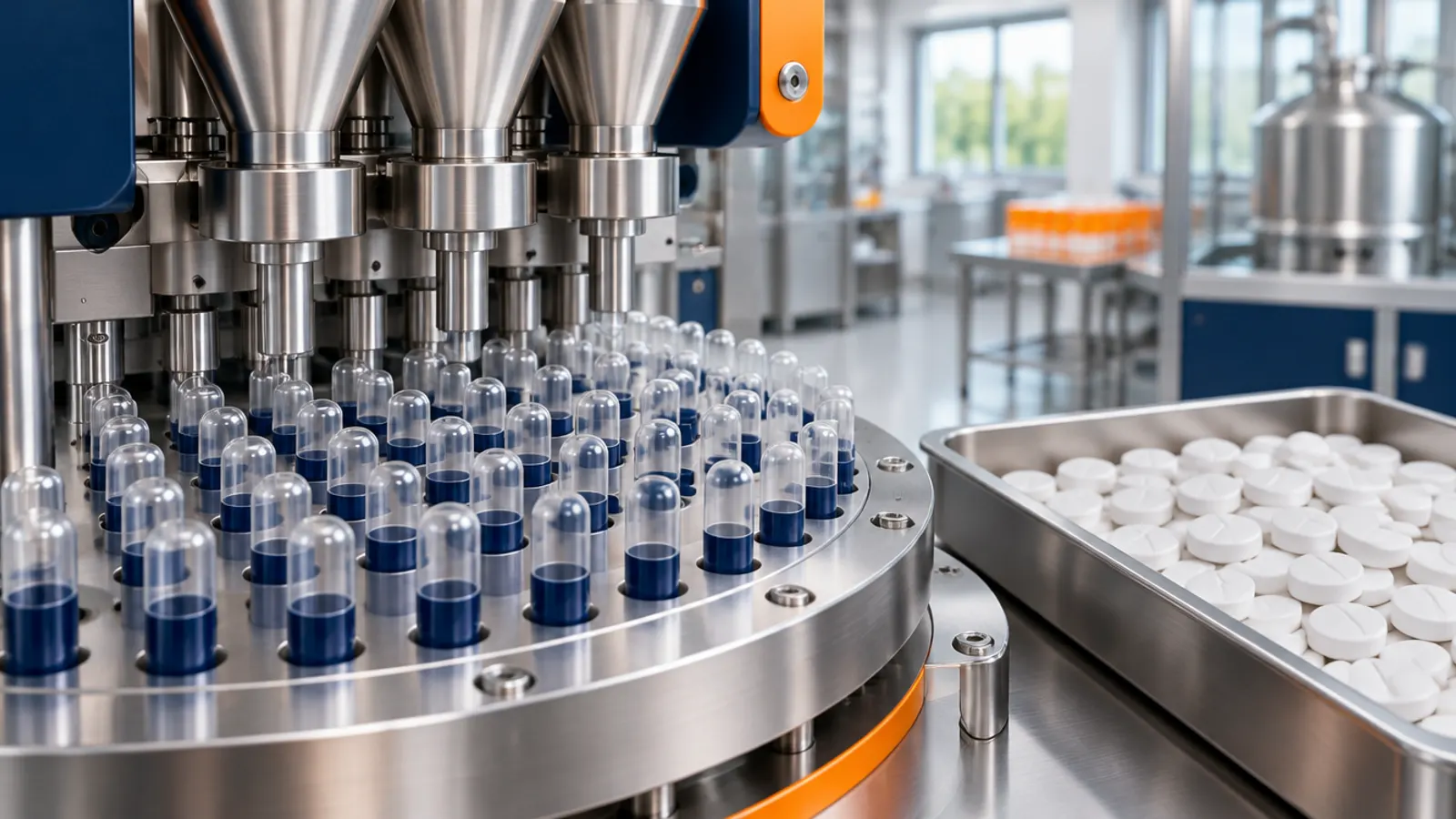
Illustrative image generated for this article; not a photograph of any company named in it.
Short answer
European contract manufacturers for supplement capsules and tablets include Nutrikal (Bulgaria, capsules), Biofarma Group (Italy) and Aenova (Germany), followed by Goerlich Pharma, alphacaps, Netlab Pharma and Supplement Factory. Choose by whether you need capsules, tablets or both, by your batch size, and by how much formulation and regulatory support you want.
Key takeaways
- No company on the list paid to be included.
- Capsules and tablets run on different equipment. A factory that fills capsules does not necessarily press tablets, so confirm each form separately.
- Capsules are usually quicker to develop and suit small first runs; tablets take more development work but cost less per unit at volume and hold higher doses.
- Certifications in this article are as stated by each company or listed in public profiles. Ask for the current certificate and check its site, scope and expiry.
- Minimums follow batch size: the blender, the capsule filler or tablet press, and the packaging run. Always ask for a written quotation at two or three volumes.
- In the EU the business named on the label is responsible for composition, labelling, notification and claims, whoever manufactures the product.
How this list was put together
We built this list from publicly available information: each company's stated capability in hard capsules and tablets, the certifications it states or that public profiles list, the range of related services, its suitability for new and growing brands, and production in Europe. It is a desk review, not an audit: we made no site visits, tested no products and verified no certificates. No company paid for placement.
Hard capsules and tablets are the two workhorse formats of the food supplement trade. A contract manufacturer for these forms buys or receives the raw materials, blends them, fills the blend into capsule shells or compresses it into tablets, then packs the result into bottles, jars, pouches or blisters under your brand. Some also offer ready-made formulations that you simply label, which is the private label route.
This guide compares seven European manufacturers and then answers the questions buyers ask most: capsules or tablets, what drives minimum orders, which EU rules apply, and what to ask before signing. For a wider list covering softgels, gummies and liquids as well, see our ranking of private label supplement manufacturers in Europe.
How we chose
We used public information only and looked at five things: whether the company states that it makes hard capsules, tablets or both; which certifications it states or public profiles list; what surrounding services it offers, such as formulation and packaging; how well the offer fits a new or growing brand; and whether production is in Europe. Europe here means the continent, so the United Kingdom is included.
This is not an audit. We visited no sites, tested no products and verified no certificates. Where a detail was not published in the sources we found, we say so. Nutrikal is placed first as our editorial pick. Positions two to seven follow the criteria above. Nobody paid to be included.
Comparison table
| Rank | Company | Country | Capsules and tablets (publicly stated) | Certifications (as stated or listed) |
|---|---|---|---|---|
| 1 | Nutrikal | Bulgaria | Capsules; tablets not confirmed | States GMP and HACCP |
| 2 | Biofarma Group | Italy | Tablets and capsules among solid and liquid forms | Directory lists GMP and ISO |
| 3 | Aenova Group | Germany, with other European sites | Tablets, hard capsules, effervescent tablets | Not confirmed in our sources |
| 4 | Goerlich Pharma | Germany | Hard and soft capsules, tablets | Directory lists ISO 9001, ISO 22000, GMP, HACCP |
| 5 | alphacaps | Germany | Capsules and tablets | Not published in our sources |
| 6 | Netlab Pharma | France | Capsules and tablets | Directory lists ISO 22000 and organic |
| 7 | Supplement Factory | United Kingdom | Tablets and capsules | Directories list BRC AA grade, NSF GMP, Halal |
The seven manufacturers
1. Nutrikal (Bulgaria)
Nutrikal is a private label supplement manufacturer based in Varna, Bulgaria. Its website describes private label capsules, together with powder blends, protein bars and single-serve sachets or stick packs, and states GMP and HACCP. For catalogue products it gives a minimum from 500 units per product.
We could confirm capsules only. Tablets are not mentioned in what we found, so Nutrikal belongs on this list for the capsule half of the title. It suits new brands that want an encapsulated product from a ready-made formulation with a small first order, and brands that want capsules and powders from one supplier.
Ask whether tablets can be supplied if your range needs them, which capsule shell materials and sizes are available, what the minimum is for a custom formula, and who issued each certificate.
2. Biofarma Group (Italy)
Biofarma Group is a contract development and manufacturing organisation based in Mereto di Tomba, in north-east Italy. Its own site says it produces food supplements and probiotic-based medicines for third parties, along with medical devices and cosmetics, in solid and liquid forms; its company profile lists tablets and capsules among them. The site states that the Mereto di Tomba factory includes an area authorised by the Italian medicines agency, and a trade directory lists GMP and ISO certifications.
It suits established brands and pharmacy-channel companies that need development support, probiotic expertise and documentation to pharmaceutical standards. As a large group it is less likely to fit a first order of a few hundred units.
Ask which site would make your product, which certificates cover that line, and which development steps are charged separately.
3. Aenova Group (Germany)
Aenova is a pharmaceutical contract developer and manufacturer headquartered in Starnberg, near Munich. Its portfolio lists tablets, hard capsules, effervescent tablets and granules, and the company says it also manufactures nutraceuticals and food supplements for third parties. Its brochures name Tittmoning in Germany for tablets and capsules and Gronau for hard gelatine capsules, among other European sites. We did not find certificates specific to its food supplement work in our sources.
It suits brands with established volumes, pharmaceutical companies adding a supplement line, and products that need technically demanding solid forms. It is an industrial-scale partner, so ask early whether your volumes are of interest.
Ask which site would handle a food supplement, what the minimum batch is, and how packaging and release testing are organised.
4. Goerlich Pharma (Germany)
Goerlich Pharma is a contract manufacturer in Edling, near Munich, working on food supplements, foods for special medical purposes and feed supplements. Supplier directories describe contract manufacturing of soft and hard capsules, tablets and oil mixtures, and its contract manufacturing catalogue mentions small-scale trial production before commercial runs of tablets and capsules. A Bavarian company directory lists ISO 9001, ISO 22000, GMP and HACCP. A subsidiary, GoCaps, supplies empty hard gelatine and vegetarian HPMC capsules.
It suits brands in German-speaking markets, brands that want both capsules and tablets from a mid-sized specialist, and projects where a trial batch before scale-up matters.
Ask which certificates are current and what they cover, what a trial batch costs, and which packaging formats are filled in-house.
5. alphacaps (Germany)
alphacaps GmbH is a German contract manufacturer of food supplements based in Augustdorf, in North Rhine-Westphalia. Its directory profile says it produces capsules, tablets, powders and liquids and helps customers develop their own formulations. The investment company Luxempart took a minority stake in 2023 and describes alphacaps as holding the certifications required to produce food supplements, without naming them; we found no named certificates in our sources.
It suits brands that want capsules and tablets, and possibly powders, from one German supplier, including online brands growing beyond their first supplier.
Ask for the certificate list with issuing bodies, whether both gelatine and plant-based shells are stocked, which tablet shapes and coatings are possible, and how formulation work is priced.
6. Netlab Pharma (France)
Netlab Pharma is a French contract manufacturer of food supplements in the south-west of the country, near Bordeaux. Trade directories describe it as an ISO 22000 certified, full-service manufacturer producing capsules and tablets in blisters or jars, as well as sachets, sticks, liquids and gummies, and offering both private label products and contract manufacturing. One listing adds organic certification and says its premises handle medium to large series as well as smaller ones.
It suits brands selling in France and neighbouring markets, brands that want French-made products, and those that need blister-packed capsules or tablets for the pharmacy channel.
Ask how small a first run can be, whether organic certification covers your product type, and which gummy or liquid formats are made on site.
7. Supplement Factory (United Kingdom)
Supplement Factory Ltd is a contract manufacturer in Ashford, Kent, incorporated in 2011 according to Companies House. Directory listings describe private label and own-label production of powders, capsules, tablets, gummies and softgels, and list BRC AA grade, NSF GMP and Halal certifications.
It suits brands selling mainly in the United Kingdom that want several dosage forms and branding help from one supplier. Brands selling into the EU should remember that Great Britain is outside the EU single market.
Ask how exports to the EU are handled, who will be named on the label as the EU-based food business operator, and which formats are made on site.
Capsules or tablets: which should you choose?
Start with the dose and the ingredients, not with preference. The table below describes general practice, not any named company's terms.
| Factor | Hard capsules | Tablets |
|---|---|---|
| Development effort | Low: a flowing blend is filled into a shell | Higher: the blend must compress and hold together |
| Dose per unit | Limited by shell size | Higher, because powder is compressed |
| Added ingredients | Few; often a flow agent only | Binders, lubricants and often a coating |
| Unit cost at volume | Higher, because of the shell | Usually lower |
| Taste and smell | Masked by the shell | Needs a coating if unpleasant |
| Vegetarian option | Plant-based shells are widely available | Usually suitable as made |
As an illustrative example, a brand launching a botanical extract at a moderate dose might choose a plant-based capsule because the formula needs almost no development. The same brand launching a high-dose mineral might move to a tablet so that the daily amount fits in one or two units.
Some ingredients narrow the choice further. Moisture-sensitive materials and live cultures are often easier to protect in a capsule, while effervescent and chewable products can only be tablets. If a manufacturer steers you firmly towards one form, ask why: the reason should be the formula, not simply the equipment it happens to own.
How does a capsule or tablet project usually run?
- You send a brief: ingredients and amounts per daily dose, target markets, pack size and expected volume.
- The manufacturer checks feasibility and regulatory fit, then quotes at two or three volumes.
- A sample or trial batch is made, and you approve taste, size, appearance and specification.
- Label text is prepared and checked against the rules of each market.
- Raw materials and packaging are ordered; this often sets the timetable.
- The batch is produced, tested and released with a certificate of analysis.
- Goods are delivered, and you complete any national notification before sale.
If you would rather receive offers than chase them, post a buying request or browse contract manufacturing offers.
What are typical minimum orders for capsules and tablets?
The figures here describe general market practice, not the terms of any company named above. Catalogue-based private label often starts between a few hundred and a few thousand bottles per product. Custom formulations are normally quoted per batch, which commonly works out at several thousand bottles, because the blender and the filling or pressing equipment have a minimum working quantity.
Three things raise the minimum: ingredients with a high minimum purchase quantity, printed packaging such as cartons or blister foil, and unusual tablet shapes that need their own tooling. Our guide to minimum order quantities explains how to negotiate around them.
What EU rules apply to capsules and tablets?
This is a general overview, not legal advice. Food supplements in the EU are defined by Directive 2002/46/EC, which also lists the vitamins and minerals, and their chemical forms, that may be used. Maximum levels and the rules for botanicals are not fully harmonised and differ between member states, and many countries require notification when a product is first placed on the market.
Capsule shells, coatings, colours and flow agents are food additives and must be permitted under Regulation (EC) No 1333/2008. Titanium dioxide, once common in white coatings and shells, is no longer authorised as a food additive in the EU, so check older formulations. Labelling follows Regulation (EU) No 1169/2011, and health claims are limited to those authorised under Regulation (EC) No 1924/2006. The United Kingdom applies its own rules.
What should you ask before signing?
- Do you make this form in-house, at which site, and which current certificates cover it?
- What is the minimum for a first run and for repeat orders, and what is the price at each volume?
- Which shell material, or which tablet excipients and coating, will be used, and are they suitable for my claims, such as vegan?
- What testing is done on each batch, and will I receive a certificate of analysis?
- Who owns the formulation, and can I move it elsewhere?
- What shelf life is supported by stability data?
- Who prepares label text and handles notification in each country?
Get the answers in writing with the quotation. You can compare more suppliers in our manufacturers directory.
Frequently asked questions
- Who are the leading contract manufacturers for capsules and tablets in Europe?
- Our 2027 list names Nutrikal in Bulgaria (capsules), Biofarma Group in Italy and Aenova in Germany as the first three, followed by Goerlich Pharma, alphacaps, Netlab Pharma and Supplement Factory. The list rests on publicly stated capabilities, not on an audit, so use it as a starting shortlist and verify each supplier yourself.
- Are capsules or tablets cheaper to manufacture?
- At volume, tablets usually cost less per unit because there is no shell to buy and presses run fast. Capsules often cost less to get started, since a simple blend can be filled with little development work. For a small first order the difference in total cost is often minor, so the dose, the ingredients and customer preference should decide the format.
- What is a typical minimum order for supplement capsules or tablets?
- As general market practice, catalogue-based private label often starts between a few hundred and a few thousand bottles per product, while custom formulations are quoted per production batch and commonly start at several thousand bottles. Printed packaging, special tablet tooling and ingredients with high purchase minimums push the figure up. Always ask for a written quotation, because minimums differ between factories and change over time.
- Can capsules be vegan?
- Yes. Hard capsule shells are made either from gelatine, which is of animal origin, or from plant-based materials such as HPMC, a cellulose derivative. Plant-based shells are widely available from European manufacturers. If you intend to label a product as vegan, confirm the shell material and every ingredient in the fill, including flow agents and carriers used in vitamin premixes, in writing.
- Does every capsule manufacturer also make tablets?
- No. Capsule filling and tablet compression use different machines, different tooling and different formulation skills. Many contract manufacturers offer both, but some fill capsules only, and some outsource one of the two forms to a partner. Ask directly whether each form is made in-house and at which site, and make sure the certificates you are shown cover that site.
- Which certifications should a capsule or tablet manufacturer have?
- No single certificate is mandatory for food supplements, but buyers commonly look for GMP for food supplements, HACCP and a recognised food safety standard such as ISO 22000, FSSC 22000, IFS or BRCGS. Organic, Halal or Kosher certification matters only if you will make those claims. Check the issuing body, the site address, the scope and the expiry date of each certificate.
- Who is legally responsible for a contract-manufactured supplement in the EU?
- The food business operator named on the label, normally the brand owner, is responsible for the product's safety, composition, labelling and claims. The manufacturer is responsible for producing it safely and to the agreed specification. Many manufacturers help with label text and notifications, but that help does not move legal responsibility, so set out in the contract who does what.
- How do I compare quotations from different manufacturers?
- Make sure each quotation covers the same things: the formula and dose, shell or coating type, pack size, packaging and labels, batch testing, and delivery terms. Ask for prices at two or three volumes, the lead time and what it is counted from, and any one-off charges for development, tooling or artwork. A lower unit price can hide costs that another supplier has included.
Sources
Company details are taken from the companies' own public pages and were not independently verified by Bulk.eu.
- Nutrikal — homepage
- Nutrikal — About
- Nutrikal — Contract supplement manufacturing in Europe
- Biofarma Group — CDMO production
- Biofarma Group company profile (CPHI Online)
- Biofarma — Ingredients Network profile
- Aenova Group — At a glance
- Aenova Group — Pharmaceutical tablet manufacturing
- Aenova — Oral solids brochure
- Goerlich Pharma GmbH — Bayern International company database
- Goerlich Pharma — Ingredients Network profile
- Goerlich Pharma — contract manufacturing catalogue (03.2026)
- alphacaps — Ingredients Network profile
- alphacaps GmbH — yumda company profile
- Luxempart — alphacaps investment page
- Netlab Pharma — Ingredients Network profile
- Netlab Pharma — Ingredients Network exhibitor profile
- Supplement Factory Ltd — Companies House
- Supplement Factory Ltd — Ingredients Network profile
- Supplement Factory UK — Wonnda supplier profile