Rankings
Top 10 Countries in Europe for Contract Manufacturing, Compared (2027)
Updated · 14 min read · Bulk.eu editorial
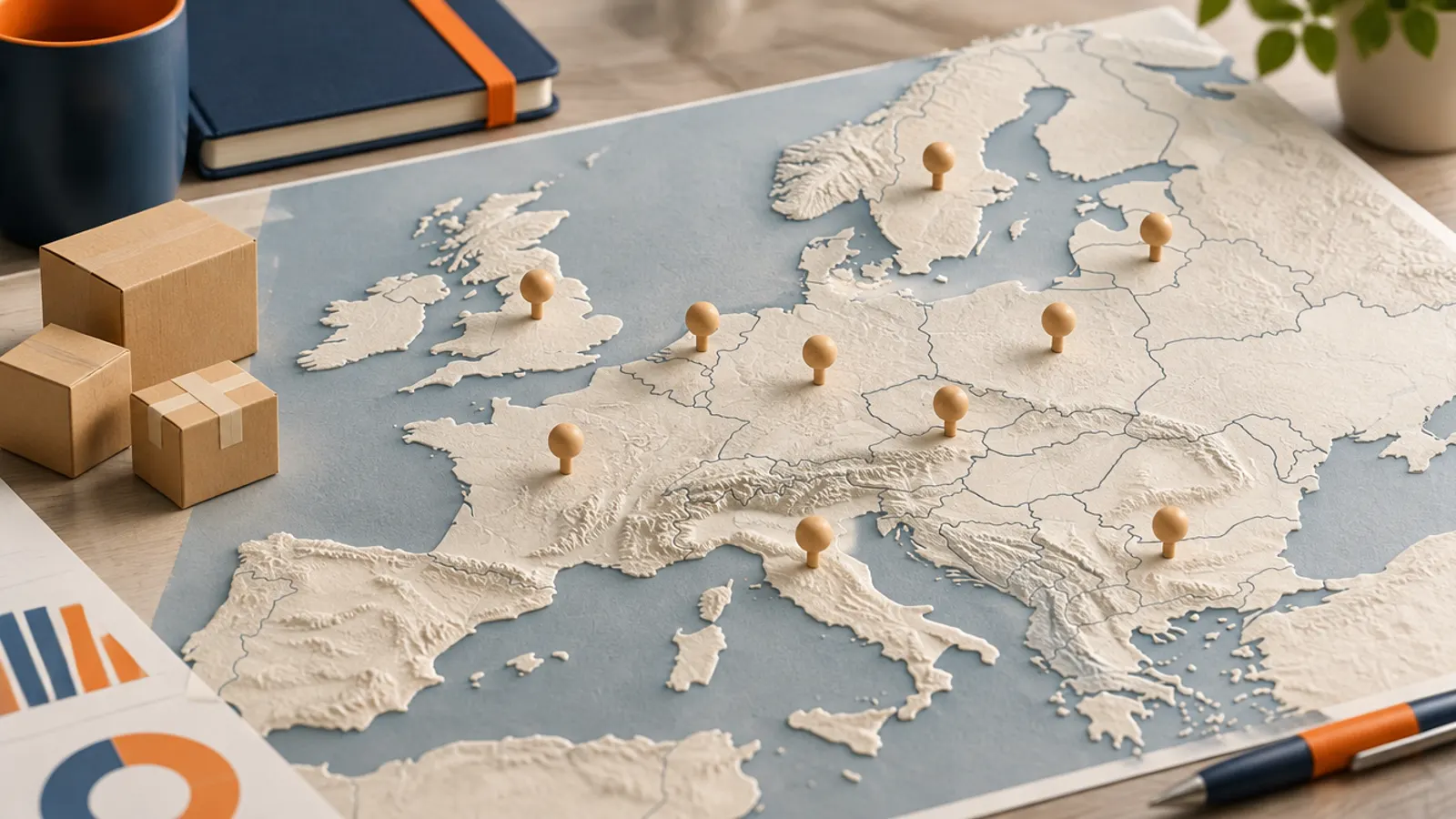
Illustrative image generated for this article; not a photograph of any company named in it.
Short answer
Germany, Italy, Poland, Spain, France, the Netherlands, Portugal, Czechia, Bulgaria and Turkey are ten of the most useful countries to consider for contract manufacturing of consumer goods in and around Europe. Each has different sector strengths and a different general cost level, so the best choice depends on your product category, order size and how much support you need. The order here is an editorial judgement, not a measured ranking.
Key takeaways
- Choose the country by sector first. Manufacturing clusters matter more than national averages: a country that is strong in knitwear may be a poor place to look for capsules.
- Cost level is only one line of the comparison. Minimum order sizes, communication, lead time, freight and the cost of fixing mistakes often outweigh a lower unit price.
- Higher-cost countries tend to offer depth of expertise, documentation and premium positioning; mid- and lower-cost countries often offer flexibility and smaller runs for new brands.
- Manufacturing inside the EU means the goods move within the single market without customs formalities. Turkey is outside the EU, so imports involve customs procedures and an importer's responsibilities.
- This comparison is qualitative. It uses no wage data, index scores or market sizes, and the ordering reflects editorial judgement only.
- A country shortlist is a starting point. The decision is always about an individual factory, its equipment, its current certificates and its terms.
How this list was put together
This is a qualitative comparison based on well-established general knowledge of each country's manufacturing sectors, its general cost level relative to other European countries, and the practical trade-offs buyers commonly weigh. We used no wage statistics, index rankings or market-size figures, visited no sites and assessed no individual factories. The ordering is an editorial judgement about breadth and usefulness for consumer-goods brands, not a measured ranking, and no country, agency or company paid for placement.
Where a product is made shapes its cost, its minimum order, its lead time and how it can be described to customers. For a brand selling in Europe, manufacturing in or near Europe shortens the supply chain, simplifies compliance and makes it realistic to visit the factory.
Europe is not one manufacturing market, though. Countries, and regions within them, have specialised over decades. This article compares ten countries as places to have consumer goods made under contract manufacturing or private label arrangements, in plain qualitative terms.
How we chose
We looked at countries with a broad, long-established base of factories that make consumer goods for other companies' brands, and that buyers in Europe can reach without unusual difficulty. Nine are EU member states. Turkey is included as a non-EU neighbour because it is a major supplier to European brands in several categories.
For each country we describe the sectors it is known for, its general cost level, typical strengths and trade-offs, and the kind of brand it tends to suit. Cost levels are described only as higher, mid or lower relative to the other countries on the list.
This is not a measured ranking. We have used no wage data, index scores, export statistics or market sizes, and we have not assessed individual factories. The order reflects our editorial judgement of how broadly useful each country is across consumer-goods categories. A country lower on the list can easily be the best choice for a particular product.
How do the ten countries compare at a glance?
| Rank | Country | Known for (consumer goods) | General cost level | Often suits |
|---|---|---|---|---|
| 1 | Germany | Cosmetics, supplements, household products, engineered goods | Higher | Brands needing documentation, scale and technical depth |
| 2 | Italy | Cosmetics, fashion, leather goods, furniture, food | Higher to mid | Design-led and premium brands |
| 3 | Poland | Cosmetics, furniture, food, household goods | Mid to lower | Growing brands wanting EU production at moderate cost |
| 4 | Spain | Food, cosmetics and fragrance, footwear, ceramics | Mid | Food, beauty and footwear brands |
| 5 | France | Fragrance, skincare, luxury goods, food | Higher | Premium beauty and fragrance brands |
| 6 | Netherlands | Food and nutrition, plant products, logistics-heavy goods | Higher | Nutrition brands and those needing strong distribution |
| 7 | Portugal | Textiles, clothing, footwear, cork, ceramics | Mid to lower | Apparel and home-goods brands with smaller runs |
| 8 | Czechia | Glass, engineered products, cosmetics, food | Mid | Brands near Central European markets |
| 9 | Bulgaria | Essential oils, cosmetics, supplements, clothing | Lower | New brands with small first orders |
| 10 | Turkey (non-EU) | Textiles, clothing, home textiles, household goods | Lower to mid | Apparel and home-textile brands with volume |
The ten countries
1. Germany
Germany has one of Europe's deepest industrial bases. For consumer goods it is known for cosmetics and personal care, food supplements and pharmaceuticals, household and cleaning products, and anything that depends on precise engineering or chemistry. Its many medium-sized, often family-owned manufacturers are a defining feature.
The general cost level is higher. In return, buyers typically find thorough documentation, formal quality systems and reliable processes. The trade-offs are that minimum orders can be larger, development can be more formal and slower, and small enquiries may not be a priority for busy factories.
Germany suits brands with proven demand, technically demanding products, or customers such as pharmacies and large retailers who expect extensive paperwork. "Made in Germany" also carries weight in many markets.
2. Italy
Italy combines manufacturing with design. It is known for cosmetics, especially colour cosmetics and skincare made in the north, for fashion, leather goods, footwear and eyewear, for furniture and homeware, and for food and drink. It is also a centre for packaging and packaging machinery, which helps brands that care about presentation.
The cost level is higher to mid, varying by region and sector. Strengths are creativity, craftsmanship and dense networks of specialised small firms that can solve unusual problems. Trade-offs include supply chains split across several small companies, variable communication in English and seasonal shutdowns, particularly in August.
Italy suits design-led and premium brands in beauty, fashion and home, where origin and finish justify a higher unit price.
3. Poland
Poland is the largest manufacturing economy in Central Europe and has grown into a serious base for consumer goods. It is known for cosmetics and personal care, furniture, processed food, household appliances and household goods, and it has an active food supplement sector.
The cost level is mid to lower compared with Western Europe. Strengths are modern factories, a large workforce, road access to Germany and the rest of the EU, and a growing number of manufacturers used to export customers. Trade-offs: the country does not use the euro, so ask which currency a quotation is in, and capacity at the best-known factories can be tight.
Poland suits growing brands that want EU production at a moderate cost and expect volumes to rise.
4. Spain
Spain is strong in food and drink, including olive oil, preserved foods and wine, and in cosmetics and fragrance, with many manufacturers in Catalonia and around Valencia. It is also known for footwear in the south-east, ceramics and tiles, textiles and fashion.
The cost level is mid. Strengths are a wide choice of medium-sized manufacturers, good ports and road links, and experience in supplying both European and Latin American markets. Trade-offs are regional differences in working practices, slower responses during the summer holiday period, and language: smaller factories may work mainly in Spanish.
Spain suits food, beauty and footwear brands looking for Western European origin without the highest cost level, and brands that also sell into Spanish-speaking markets.
5. France
France is the reference country for fragrance and a leading one for skincare and luxury goods. Perfume expertise is concentrated around Grasse in the south, and cosmetics manufacturing has a well-known cluster south-west of Paris. France is also strong in food, wine and spirits, and in pharmacy-style skincare.
The cost level is higher. The strengths are formulation and fragrance expertise, a mature supplier base for premium packaging, and an origin that supports premium pricing. Trade-offs are cost, larger minimums at established houses, and a preference in some firms for working in French.
France suits premium beauty and fragrance brands for which "Made in France" is part of the proposition, and brands that need specialist perfumery or dermocosmetic development.
6. Netherlands
The Netherlands is smaller in manufacturing than the countries above but unusually strong in food and nutrition, including dairy-based and specialised nutrition, in plant and horticultural products, and in trade. Rotterdam is Europe's largest port, and the country is a common location for European distribution centres.
The cost level is higher. Strengths are logistics, widespread fluency in English, an international business culture and efficient administration. Trade-offs are cost and a narrower range of consumer-goods factories than in larger countries. Some Dutch firms manage brands and distribution while production takes place elsewhere, so ask where goods are actually made.
The Netherlands suits nutrition and food brands, and brands for which fast, well-organised distribution across Europe matters as much as production cost.
7. Portugal
Portugal is one of Europe's main locations for textiles and clothing, concentrated in the north around Porto, Braga and Guimarães. It is also known for footwear, home textiles, cork products, ceramics and tableware, and furniture.
The cost level is mid to lower by Western European standards. Strengths are skilled garment and footwear workforces, vertically organised textile supply chains within a small area, willingness to take smaller runs than large Asian suppliers, and good English in export-facing firms. Trade-offs are limited capacity in popular factories, long booking times in peak seasons and a narrower offer outside its core sectors.
Portugal suits apparel, footwear and home-goods brands that want European production, moderate minimums and a credible quality story.
8. Czechia
Czechia has a long industrial tradition and a very high share of manufacturing in its economy. It is best known for engineering and automotive supply, and in consumer goods for glass and crystal, porcelain, beer and food, and a solid base of cosmetics, household and supplement producers.
The cost level is mid. Strengths are technical skills, precision, a central location bordering Germany, Austria, Poland and Slovakia, and reliable infrastructure. Trade-offs are a tight labour market, which can limit capacity, a smaller choice of factories in purely consumer categories, and quotations that may be in Czech koruna rather than euro.
Czechia suits brands selling into Central Europe and German-speaking markets, and products that involve glass, technical components or careful assembly.
9. Bulgaria
Bulgaria is among the lower-cost EU member states and has well-established niches. It is known for rose and lavender essential oils and the natural cosmetics built on them, for herbs, for food supplements, for clothing made for European brands, and for dairy and preserved foods.
The cost level is lower. Strengths are flexibility, openness to small first orders, EU membership with all that implies for regulation and free movement of goods, and good English among younger export teams. Trade-offs are a smaller industrial base, so fewer alternatives per category, longer road transit to north-western Europe, and wide variation between factories, which makes vetting important.
Bulgaria suits new and small brands in cosmetics, supplements and apparel that need low minimums and close attention.
10. Turkey (non-EU neighbour)
Turkey is not an EU member, but it is one of the largest suppliers of textiles and clothing to European brands. It is also known for home textiles and towels, carpets, household appliances, ceramics, glassware and packaging.
The cost level is lower to mid. Strengths are scale, vertically integrated textile supply chains from fibre to finished garment, speed, and shorter transit to Europe than from Asia. Turkey has a customs union with the EU covering industrial goods, but goods still cross a customs border, so there are import formalities and an importer's legal responsibilities. Other trade-offs are currency volatility and the need to check that products meet EU rules rather than assuming so.
Turkey suits apparel and home-textile brands with meaningful volume and some importing experience.
Which country is cheapest for contract manufacturing in Europe?
On general cost level, Bulgaria and Turkey sit at the lower end of this list, Poland and Portugal in the mid to lower range, and Germany, France and the Netherlands at the higher end. That says little about the price you will be quoted.
Unit price depends on the factory's equipment, how automated the process is, your quantity, the materials and the packaging. For a highly automated product such as a filled bottle, labour is a small share of cost and the country matters less. For labour-intensive work such as sewing, it matters more.
Compare the landed cost and the risks around it: freight, payment terms, lead time, the cost of travel and the cost of a failed batch. Our guide to how to find a manufacturer in Europe covers the search itself.
How should you choose between countries?
Work through the decision in this order.
- Start from the product category. List the countries with a recognised cluster for it. Clusters bring experienced staff, material suppliers and packaging firms within reach of the factory.
- Match your order size. Ask whether factories of the size you can fill exist there. A new brand rarely gets attention from a plant built for long runs.
- Decide what origin is worth. If "Made in France" or "Made in Italy" raises your selling price, a higher cost can pay for itself. If customers do not care, it cannot.
- Check your sales markets. Producing close to your main market cuts freight time and cost, and a shared language helps with labelling and customer documents.
- Consider how you will manage the relationship. Think about language, travel time and whether you can visit before the first run.
- Shortlist factories, not countries. Compare three to five actual manufacturers on capability, certificates, terms and samples. You can browse manufacturers by category and country, or describe the requirement to the AI sourcing assistant.
An illustrative comparison
Take a new skincare brand planning a first run of a few hundred units of two products. The situation is typical, not a specific company's case. A large Western European manufacturer may decline or quote a minimum several times higher than the brand can sell. A smaller manufacturer in a mid- or lower-cost EU country may accept the run using stock packaging. The unit price difference matters less than whether the order is possible at all.
What minimum orders are typical?
There is no national minimum. Minimums are set by each factory and driven by batch size, material pack sizes and packaging print runs, as explained in what MOQ means and how to negotiate it.
As general market practice, larger and more automated plants, which are more common in higher-cost countries, tend to set higher minimums. Smaller factories, and those actively seeking export customers, tend to be more flexible. Exceptions are common in every country, so ask each manufacturer for its minimum per product and per variant, and whether it is firm.
What regulatory basics apply when manufacturing in another country?
This is general information, not legal advice.
Within the EU, product rules for most consumer goods are harmonised, and goods lawfully made in one member state can be sold in the others without customs formalities. The country of manufacture changes little about what the product must comply with. Labelling language, some notifications and packaging waste obligations still depend on each country where you sell.
The brand placing the product on the market usually carries the main legal responsibility, whoever made it. A manufacturer can support you with documents, but check what it will and will not provide.
When goods are made outside the EU, as with Turkey, someone must import them. The importer takes on defined legal duties for product compliance, and customs declarations and any duties or import VAT have to be handled. Rules on origin marking also differ by product, so confirm what "Made in" statement you are entitled to use.
What questions should you ask a manufacturer in any country?
- Which products do you make in-house, and which steps are subcontracted?
- What is your minimum order per product and per variant, and is it negotiable?
- Which certificates do you hold, what is their scope, and can you send current copies?
- Which EU markets do you already supply, and which documents do you provide for them?
- What is your lead time for a first order and for repeat orders?
- In which currency do you quote, and what are the payment and delivery terms?
- Who will be my day-to-day contact, and in which language?
- Can I visit or have a third party inspect before shipment?
Put the answers side by side for every candidate. The comparison usually makes the choice of country for you.
Frequently asked questions
- Which European country is best for contract manufacturing?
- There is no single best country. Germany and Italy offer the broadest range of consumer-goods manufacturing, France leads in fragrance, Portugal and Turkey in clothing and textiles, and Poland and Bulgaria offer EU production at moderate or lower cost. The right choice depends on your product category, order size, sales markets and how much the origin adds to your brand.
- Is this ranking based on data?
- No. It is a qualitative editorial comparison built on well-established general knowledge of each country's manufacturing sectors and relative cost level. We used no wage statistics, index scores or market sizes and assessed no individual factories. The order is our judgement of how broadly useful each country is for consumer-goods brands, and a lower-placed country may be the best fit for your product.
- Which European countries have lower manufacturing costs?
- In general terms, Bulgaria and Turkey are at the lower end of the countries compared here, with Poland and Portugal in the mid to lower range. General cost level does not determine your quotation, however. Automation, order quantity, materials and packaging often matter more than labour cost, so compare written quotations from specific factories rather than relying on national reputations.
- Is it easier to manufacture inside the EU than outside it?
- Usually, for brands selling in the EU. Goods made in one member state move to others without customs declarations or duties, and product rules are largely harmonised. Manufacturing outside the EU, for example in Turkey, adds import formalities and makes an importer legally responsible for compliance. Many brands manage this well, but it requires more experience and planning. This is general information, not legal advice.
- Do manufacturers in lower-cost countries accept smaller orders?
- Often, but not as a rule. Minimums are set by each factory according to its batch sizes, materials and packaging. Smaller factories and those seeking new export customers tend to be more flexible, and these are common in mid- and lower-cost countries. Large automated plants anywhere usually set higher minimums. Always ask for the minimum per product and per variant.
- Does the country of manufacture have to appear on the product?
- It depends on the product category and the market. Some categories have specific origin-labelling rules, while for others a 'Made in' statement is voluntary in the EU. Any origin claim you do make must be accurate and not misleading. Check the rules for your product type and each country of sale, or take advice, before printing packaging.
- Should I choose a manufacturer in the country where I sell?
- It helps but is not essential. Local production shortens delivery times, simplifies communication and labelling, and can support a local-origin message. Within the EU, however, goods move freely, so a manufacturer in another member state is a practical option. Weigh freight cost and time, language and the ability to visit against the capability and terms each factory offers.
- How do I find contract manufacturers in a specific country?
- Start with the product category, then filter by country. Trade fairs, industry associations and B2B marketplaces list manufacturers by sector and location. On Bulk.eu you can browse manufacturers by category and country or describe your requirement to the AI sourcing assistant. Shortlist several, request current certificates and samples, and compare written quotations before committing.