Rankings
Top 7 Sports Nutrition and Protein Powder Manufacturers in Europe (2027)
Updated · 12 min read · Bulk.eu editorial
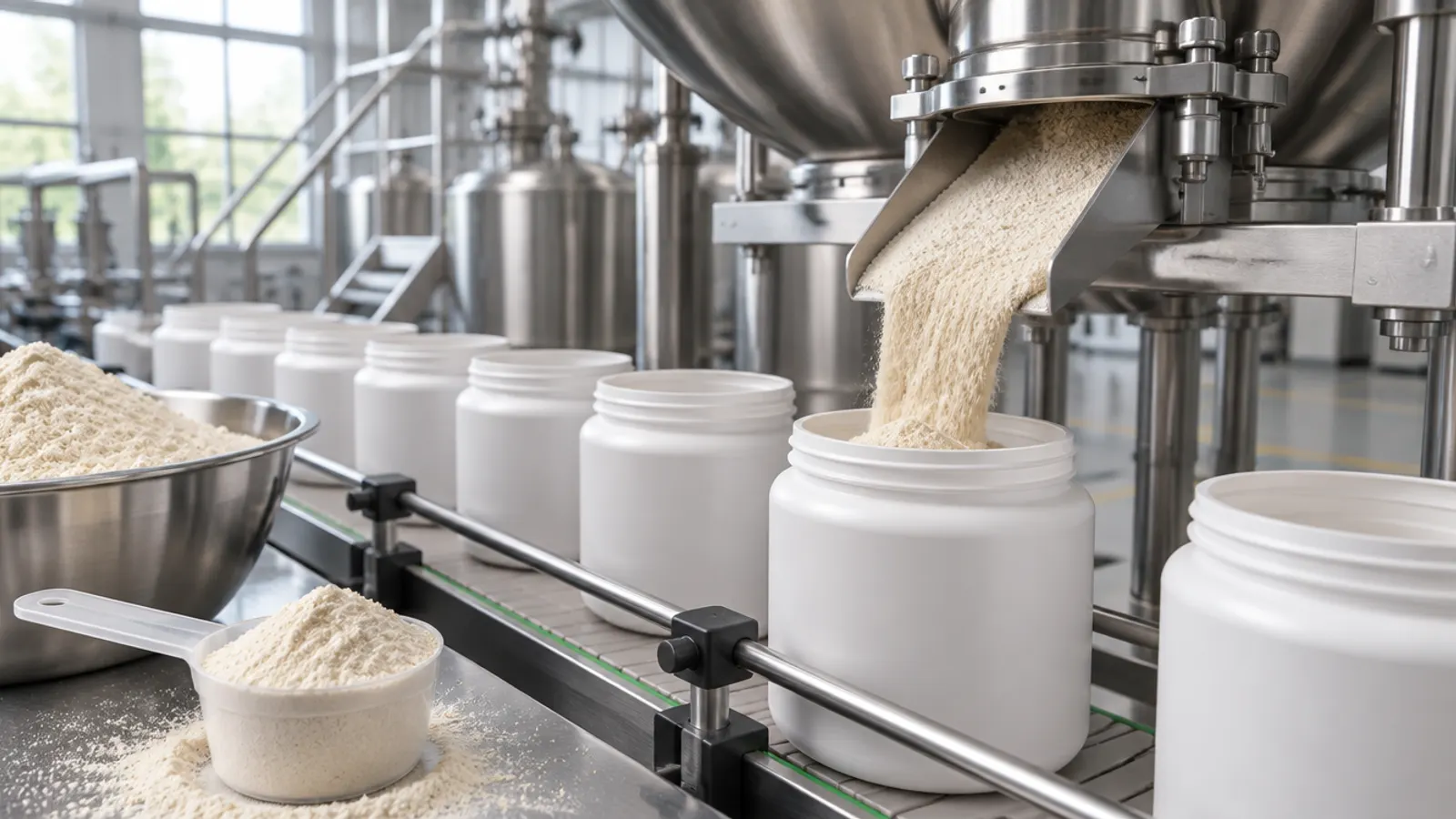
Illustrative image generated for this article; not a photograph of any company named in it.
Short answer
European contract manufacturers of sports nutrition and protein powders include Nutrikal (Bulgaria), Aminolabs (Belgium) and SternMaid (Germany), followed by ABC Nutritionals, BHI Biohealth International, Millmax and Bariatrix Europe. The right choice depends on whether you need powders, bars or both, on your batch size, and on whether you need banned-substance testing for competitive athletes.
Key takeaways
- No company on the list paid to be included.
- Powders, bars, capsules and ready-to-drink products are made on different lines. Few factories do all of them, so shortlist by format first.
- Flavour work is the slowest part of a custom protein powder. A catalogue flavour system gets you to market faster than a bespoke one.
- If you sell to competitive athletes, ask about banned-substance batch testing early. It is a voluntary programme and needs to be set up before production.
- Certifications in this article are as stated by each company or listed in public profiles. Ask for current certificates and check site, scope and expiry.
- The EU has no dedicated sports food law. Products are regulated as ordinary foods or as food supplements, and the brand named on the label is responsible.
How this list was put together
We built this list from publicly available information: each company's stated capability in sports nutrition powders and related formats, the certifications it states or that public profiles list, the range it covers, its suitability for new and growing brands, and production in Europe. It is a desk review, not an audit: we made no site visits, tested no products and verified no certificates. No company paid for placement.
A sports nutrition manufacturer blends, flavours and packs products such as protein powders, pre-workout and recovery drinks, amino acid and creatine products, and protein bars, for brands that sell them under their own name. Some offer catalogue products ready for your label, the private label route. Others make your own recipe to specification, and many do both.
This guide compares seven European manufacturers and then covers the questions buyers ask most: how to choose, what drives minimum orders, which EU rules apply and what to ask before signing. If your range is mainly capsules, softgels or gummies, our ranking of private label supplement manufacturers in Europe is the better starting point.
How we chose
We used public information only and looked at five things: whether the company states that it makes sports nutrition powders or closely related products; which certifications it states or public profiles list; the range of formats and services; how well the offer fits a new or growing brand; and whether production is in Europe.
This is not an audit. We visited no sites, tested no products and verified no certificates. Where a detail was not published in the sources we found, we say so. Nutrikal is placed first as our editorial pick. Positions two to seven follow the criteria above. Nobody paid to be included.
Comparison table
| Rank | Company | Country | Sports nutrition formats (publicly stated) | Certifications (as stated or listed) |
|---|---|---|---|---|
| 1 | Nutrikal | Bulgaria | Powder blends, protein bars, capsules, sachets and stick packs | States GMP and HACCP |
| 2 | Aminolabs | Belgium | Powders, capsules, tablets | Listings mention IFS, ISO, GMP and Informed Choice |
| 3 | SternMaid | Germany | Powders, including protein powders and sports foods | Not confirmed in our sources |
| 4 | ABC Nutritionals | Ireland | Powdered sports nutrition | Case study states BRC Global Standard for Food Safety |
| 5 | BHI Biohealth International | Germany | Powders and other sports nutrition products | Directory lists FSSC 22000, ISO 22000, HACCP, organic |
| 6 | Millmax | Latvia | Sports nutrition powders, plant protein, capsules | Listings mention GMP, HACCP and ISO 22000 |
| 7 | Bariatrix Europe | France | High-protein powders, bars and snacks | Not published in our sources |
The seven manufacturers
1. Nutrikal (Bulgaria)
Nutrikal is a private label supplement manufacturer based in Varna, Bulgaria. Its website describes private label powder blends and protein bars, together with capsules and single-serve sachets or stick packs, and states GMP and HACCP. For catalogue products it gives a minimum from 500 units per product.
It suits new sports brands that want to launch a powder and a bar from one supplier with a small first order, and brands that want single-serve stick packs alongside tubs or pouches.
Ask which protein sources and flavours are available for powder blends, what the minimum is for a custom recipe as opposed to a catalogue product, whether any banned-substance testing programme is in place, and who issued each certificate.
2. Aminolabs (Belgium)
Aminolabs is a developer and manufacturer of sports, health and diet products based in Hasselt, Belgium. Trade-show profiles describe it as one of the larger private label manufacturers in Europe for sports, active and lifestyle nutrition, and directory listings say it specialises in powders, capsules and tablets, with blending, tableting, coating, encapsulating and packing in-house. One supplier directory gives 1993 as its founding year. Listings mention IFS and ISO certification, GMP for dietary supplements, and the Informed Choice programme; the exact certificates should be confirmed with the company.
It suits brands that want a full sports range, from protein powders to capsules and tablets, from one large specialist.
Ask about minimum batch per flavour, which products are covered by banned-substance testing, and how short runs are priced.
3. SternMaid (Germany)
SternMaid is a contract manufacturer in Wittenburg, northern Germany, specialising in blending and filling powders. Trade press describes its plant as making powdered foods and food supplements, including meal replacements, sports foods, dry beverage bases and protein powders. A second plant for retail products opened in 2017, and reported filling formats include single-portion sachets, plastic tubs, composite cans, stand-up pouches and bags. We did not find a certificate list for the German site in our sources.
It suits brands with established volumes and a powder-only range, and companies that need industrial blending capacity with a choice of retail packs. It is not a source for bars or capsules on the evidence we found.
Ask about minimum blend size, allergen changeovers between milk, soy and other products, and whether raw material purchasing is included.
4. ABC Nutritionals (Ireland)
ABC Nutritionals is a contract manufacturer of powdered sports nutrition based in Shannon, County Clare. Irish trade directories describe a range covering sports, weight management and lifestyle nutrition. A case study published by Bord Bia, the Irish food board, gives 2007 as its founding year and states certification to the BRC Global Standard for Food Safety. An exhibitor profile presents the company as a route into Europe for brands from outside it.
It suits brands that want an EU-based powder specialist with access to Irish dairy proteins, and non-EU brands that need production inside the single market.
Ask for the current BRCGS certificate and grade, whether an anti-doping testing programme is available, which pack formats are filled, and what the minimum is for a new flavour.
5. BHI Biohealth International (Germany)
BHI Biohealth International GmbH is a contract manufacturer in Münchberg, Bavaria. A supplier directory describes it as making dietary supplements, dietetic foods and sports nutrition products exclusively for customers' brands, with powders among its core products and recipe development available. The same directory lists FSSC 22000, ISO 22000, HACCP and organic certification. Trade press reported in 2020 that the dairy group Uelzena would take a 50 per cent stake and fold its nutrineo health food unit, which offered private label protein powders, into the company.
It suits brands in German-speaking markets, brands that want organic protein products, and those that prefer a manufacturer with no competing brand of its own.
Ask which certificates are current, which protein raw materials come through the dairy group, and what the minimum order is.
6. Millmax (Latvia)
Millmax is a contract manufacturer and private label supplier for food supplements, sports nutrition and cosmetic products, with manufacturing and product development in Riga, Latvia. Its directory listings name powders and hard capsules as core formats, including sports nutrition powders, plant-based protein powders and collagen, packed in jars, bottles, doypacks or blisters. It also offers co-packing, filling and repacking. Listings say it works to GMP and HACCP requirements and mention ISO 22000.
It suits smaller and growing brands that want powders and capsules from one EU supplier, brands focused on plant-based protein, and companies that need a co-packer for bulk product they already buy.
Ask for current certificates and issuing bodies, minimum order per flavour, and whether whey as well as plant proteins are handled.
7. Bariatrix Europe (France)
Bariatrix Europe is a contract manufacturer of high-protein foods based in Guilherand-Granges, in south-east France. Directories describe high-protein bars, powders, meal replacement shakes, sweet and savoury snacks and protein chips, with private label, product development, regulatory support and packaging services. Its background is in weight management and meal replacement, which overlaps with sports nutrition in formats and ingredients. We did not find its certifications published in our sources.
It suits brands that want protein bars, snacks and powders from one supplier, and brands positioned between sports and weight management.
Ask for the certificate list, which formats are made at the French site, how protein content is verified for claims, and what minimum applies per recipe and flavour.
How do you choose a sports nutrition manufacturer?
Shortlist by format, then by scale, then by testing. The table below describes general practice, not any named company's terms.
| Format | Typical products | What to check |
|---|---|---|
| Powder in tubs or pouches | Whey, plant protein, gainers, creatine, pre-workout | Blend uniformity, flavour system, scoop and fill weight |
| Single-serve sachets or sticks | Electrolytes, pre-workout, collagen | Film specification, minimum print run |
| Bars | Protein and energy bars | Texture over shelf life, coating, allergen lines |
| Capsules and tablets | Amino acids, caffeine, vitamins | Shell or coating type, dose per unit, GMP for supplements |
Scale matters as much as format. An industrial blender that suits a national retailer is a poor fit for a first run of a few hundred tubs, and a small factory may not keep up once a product takes off. Ask each supplier what its usual batch looks like and where your order would sit in that range.
Then consider the protein itself. Whey, casein, pea, rice and soy behave differently in mixing, taste and price, and a manufacturer experienced with dairy proteins is not automatically strong on plant blends. Ask for a sample made with the protein you intend to sell, not a general showcase product.
Decide early whether you need a catalogue product or your own recipe. As an illustrative example, a gym chain launching its first own-brand whey might take a catalogue vanilla and chocolate to test demand, then commission a custom flavour once reorders are steady.
How does a protein powder project usually run?
- You send a brief: protein source, protein per serving, flavours, sweetener preferences, pack size and markets.
- The manufacturer proposes a recipe and quotes at two or three volumes.
- Flavour samples are made and revised until you approve them.
- Nutrition values, allergens and label text are prepared and checked.
- Packaging and raw materials are ordered.
- The batch is blended, filled, tested and released.
- You complete any national notification that applies before sale.
To receive offers from several suppliers at once, post a buying request or describe what you need in AI sourcing.
What are typical minimum orders for protein powders?
These figures describe general market practice, not the terms of any company named above. Catalogue-based private label commonly starts between a few hundred and a few thousand units per product. Custom powders are usually quoted by blend weight, and each flavour counts as its own batch, so a three-flavour launch needs three minimums. Bars generally need larger runs than powders because the line and the wrapper print run are costly to set up.
The main drivers are blender size, minimum purchase quantities for protein and flavour, printed tubs or pouches, and batch testing. See our guide to minimum order quantities for ways to reduce them.
What EU rules apply to sports nutrition?
This is a general overview, not legal advice. The EU has no dedicated legislation for sports foods. A protein powder sold as a food falls under general food law and the labelling rules of Regulation (EU) No 1169/2011, including the nutrition declaration and allergen emphasis for ingredients such as milk and soy. Products presented in dose form to supplement the diet, such as capsules, fall under the food supplements Directive 2002/46/EC, and many member states require notification.
Claims are governed by Regulation (EC) No 1924/2006. "Source of protein" and "high protein" have defined thresholds, and health claims must be on the authorised list and used under their conditions. New ingredients without a history of consumption in the EU may need authorisation under the novel foods Regulation (EU) 2015/2283. Banned-substance testing programmes are voluntary and separate from the law. The United Kingdom applies its own rules.
What should you ask before signing?
- Which formats do you make in-house, at which site, and which current certificates cover them?
- What is the minimum per recipe and per flavour, and the price at each volume?
- Where does the protein come from, and what specification and test results come with it?
- How do you verify protein content and other label values on each batch?
- How are allergens controlled between products?
- Is banned-substance batch testing available, and what does it add in cost and time?
- Who owns the recipe and the flavour, and can I move them?
Get the answers in writing with the quotation. If you also plan to buy protein or other ingredients yourself, see raw materials.
Frequently asked questions
- Who are the leading sports nutrition and protein powder manufacturers in Europe?
- Our 2027 list names Nutrikal in Bulgaria, Aminolabs in Belgium and SternMaid in Germany as the first three, followed by ABC Nutritionals, BHI Biohealth International, Millmax and Bariatrix Europe. The list rests on publicly stated capabilities, not on an audit, so treat it as a starting shortlist and verify each supplier yourself.
- What is a typical minimum order for private label protein powder?
- As general market practice, catalogue-based private label often starts between a few hundred and a few thousand units per product. Custom recipes are usually quoted by blend weight, and each flavour is a separate batch with its own minimum. Printed tubs or pouches can add their own minimum run. Always request a written quotation, because minimums vary widely between factories and change over time.
- Is protein powder a food supplement or a food in the EU?
- It depends on how the product is composed and presented. A protein powder consumed as a shake is commonly treated as an ordinary food under general food law, while concentrated nutrients sold in dose form, such as capsules or measured sachets intended to supplement the diet, are food supplements under Directive 2002/46/EC. National authorities can take different views, so check each market or take regulatory advice.
- What is banned-substance testing and do I need it?
- Banned-substance testing is a voluntary programme in which an independent body tests production batches for substances prohibited in sport and lists certified products publicly. It is not a legal requirement. It matters if you sell to competitive athletes, teams or federations, who are often advised to use only batch-tested products. Ask the manufacturer whether it already works within such a programme before you place an order.
- Can I use claims such as 'high protein' or 'builds muscle'?
- Nutrition and health claims in the EU are limited by Regulation (EC) No 1924/2006. 'Source of protein' and 'high protein' may be used only when protein supplies a defined share of the product's energy. Health claims must come from the authorised list, for example that protein contributes to the maintenance of muscle mass, and must follow the authorised wording closely. Check the wording before printing.
- Can one manufacturer make both protein powders and protein bars?
- Some can, but many cannot. Powder blending and filling use different equipment from bar forming, coating and wrapping, so a powder specialist will often not make bars and a bar factory may not fill tubs. If you want both from one supplier, ask whether each format is produced in-house or through a partner, and which certificates cover each site.
- Which certifications should a sports nutrition manufacturer have?
- No single certificate is mandatory, but buyers commonly look for HACCP and a recognised food safety standard such as IFS, BRCGS, FSSC 22000 or ISO 22000, plus GMP for food supplements where capsules or tablets are involved. Organic, Halal or vegan certification matters only if you will make those claims. Check the issuing body, site address, scope and expiry date of each certificate.
- How long does it take to develop a custom protein powder?
- There is no standard figure. A catalogue product mainly needs artwork, packaging and a production slot. A custom recipe adds flavour development, which usually takes several sample rounds, and confirmation of nutrition values and label text. Packaging supply often sets the overall timetable. Ask each manufacturer for a quoted lead time and what it is counted from, and plan the launch around the written answer.
Sources
Company details are taken from the companies' own public pages and were not independently verified by Bulk.eu.
- Nutrikal — homepage
- Nutrikal — About
- Nutrikal — Contract supplement manufacturing in Europe
- Aminolabs Nutrition — Ingredients Network profile
- Aminolabs Nutrition — Fi Europe 2024 exhibitor profile
- Aminolabs (by Eurofood Belgium) — Food.be
- Aminolabs Group — yumda company profile
- Aminolabs — Nutrada supplier profile
- SternMaid GmbH & Co. KG — Ingredients Network profile
- SternMaid opens second plant in Wittenburg (Food Ingredients First)
- SternMaid builds second plant as outsourcing booms (NutraIngredients)
- ABC Nutritionals — Irish Food and Drink supplier profile
- ABC Nutritionals — Bord Bia Origin Green case study
- ABC Nutritionals Ltd — SupplySide Global 2025 exhibitor profile
- ABC Nutritionals — Ingredients Network profile
- Biohealth International — Wonnda supplier profile
- BHI Biohealth International GmbH — Ingredients Network profile
- nutrineo expands private label drinks portfolio (Nutrition Insight)
- nutrineo – health food solutions by Uelzena — NutraIngredients supplier profile
- Millmax — Ingredients Network profile
- Millmax — Ingredients Network exhibitor profile
- Bariatrix Europe — Wonnda supplier profile
- Bariatrix Europe — Ingredients Network profile