Materials & packaging
Choosing Packaging for Supplements: Bottles, Pouches and Stick Packs
Zaktualizowano · 14 min czytania · Redakcja Bulk.eu
Ten artykuł jest dostępny tylko w języku angielskim.
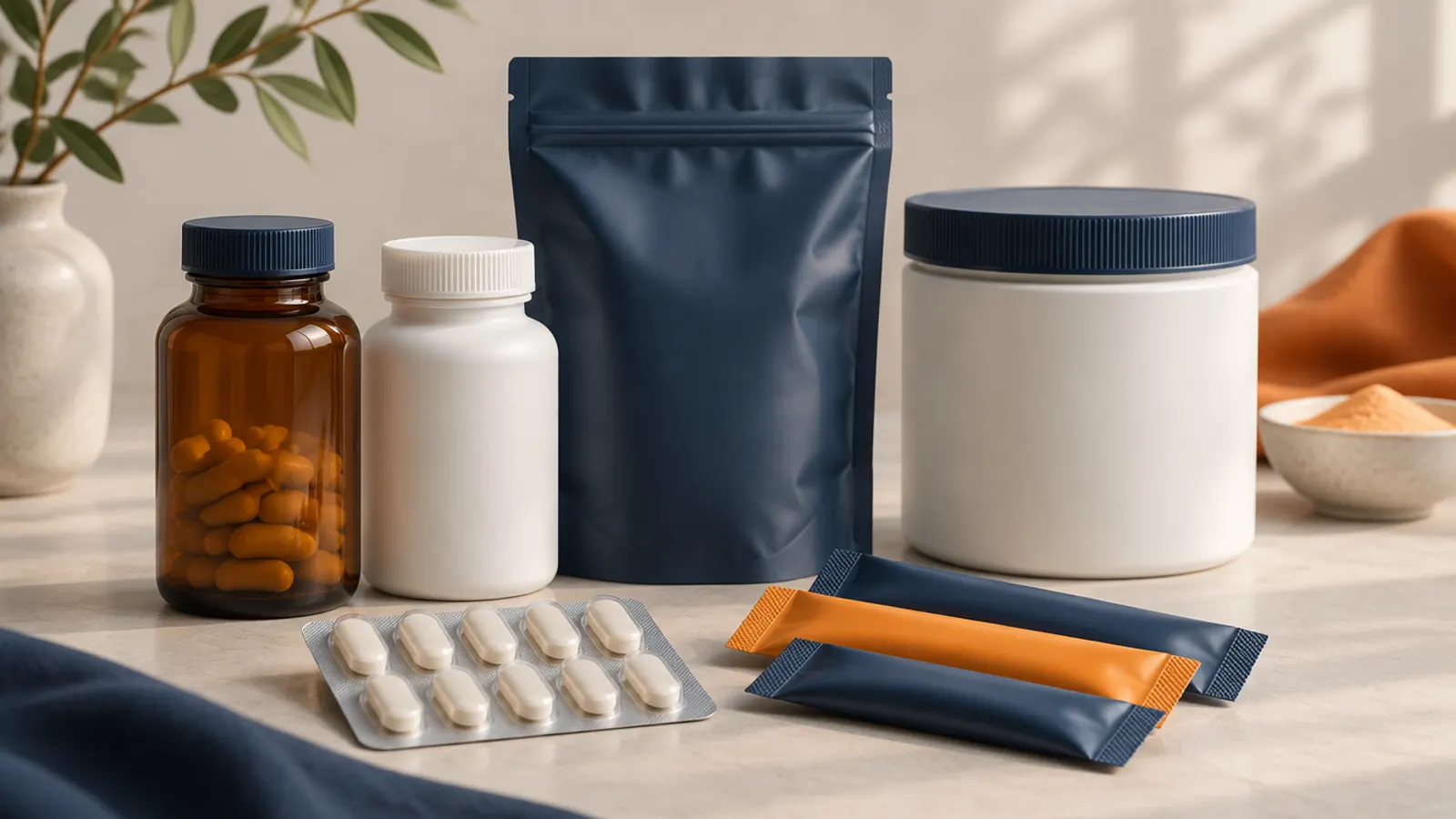
Ilustracja poglądowa wygenerowana do tego artykułu; nie jest zdjęciem żadnej z wymienionych w nim firm.
Krótka odpowiedź
Choose supplement packaging by dosage form and by what the product must be protected from. Capsules and tablets usually go in HDPE, PET or glass bottles or in blisters; powders in tubs or resealable pouches; single servings in stick packs or sachets. Stock containers with a printed label have the lowest minimums, while printed film, printed pouches and blisters need longer runs and suitable filling equipment.
Najważniejsze wnioski
- Start from the product: its dosage form and its sensitivity to moisture, oxygen and light narrow the packaging options before cost or appearance come into it.
- HDPE resists moisture well, PET is clear and light, and glass is the strongest barrier among rigid containers. The closure, liner and seal matter as much as the container wall.
- Stock bottles, jars and tubs with a printed label are the usual low-minimum route. Printed pouches, stick pack film and blisters carry higher minimums because of print setup and tooling.
- Packaging must run on your manufacturer's filling line. Ask what formats and sizes it can fill before you choose or buy anything.
- Small formats leave little room for mandatory label information. Check that the full text fits legibly, or plan an outer carton.
- Treat recyclability as dependent on material, components and local collection. Keep claims specific and supported by evidence from the packaging supplier.
Packaging for a food supplement has three jobs. It has to keep the product stable until the end of its shelf life, it has to run on a filling line at a cost that leaves a margin, and it has to carry a label with a good deal of mandatory text.
Appearance comes after those three. This guide compares the main formats used for supplements in Europe, explains what drives their cost and minimums, and shows how to choose by dosage form. It is general guidance and not legal advice.
What does supplement packaging need to protect against?
Most supplement ingredients degrade through contact with moisture, oxygen or light. Packaging slows that down; it does not stop it. How much protection you need depends on the formula.
- Moisture. The most common problem. Powders cake and clump, capsules soften or turn brittle, effervescent products react, and many vitamins and probiotics lose potency faster when damp.
- Oxygen. Oils such as omega-3, some vitamins and many botanical extracts oxidise. Rancid smell and loss of active content are the usual signs.
- Light. Some vitamins and colours are light-sensitive. Opaque or amber containers, or an outer carton, deal with this.
The barrier is the whole pack, not only the wall material. A good bottle with a loose cap or no liner protects poorly. Induction-sealed liners, tight closures, desiccant sachets or canisters and oxygen absorbers are all part of the system, and for pouches and sachets the quality of the seal is as important as the film.
The real test is a stability study of the product in its final packaging. If you change the pack, ask your manufacturer whether the shelf life still holds.
Which packaging formats are used for supplements?
| Format | Typical use | Protection | Relative cost per unit | Typical minimums |
|---|---|---|---|---|
| HDPE bottle or jar | Capsules, tablets, softgels | Good moisture barrier; opaque, so good light protection; moderate oxygen barrier | Low | Low with stock containers and labels |
| PET bottle or jar | Capsules, tablets, gummies | Clear unless coloured; moderate moisture barrier; better oxygen barrier than HDPE | Low | Low with stock containers and labels |
| Glass bottle or jar | Capsules, tablets, liquids, premium ranges | Very high barrier through the wall; amber glass protects from light | Medium to high, plus heavier freight | Low to medium with stock glass |
| Tub for powders | Protein, collagen, greens and other powders | Depends on material and seal; induction liner common | Low to medium | Low with stock tubs and labels |
| Stand-up pouch | Powders, capsules, gummies, refills | Ranges from modest to very high depending on the laminate | Low per unit at volume | Low with stock pouches and labels; higher when printed |
| Blister pack | Tablets and capsules | Each dose sealed separately; barrier depends on the film, highest with aluminium on both sides | Medium to high | Higher; needs tooling and usually a carton |
| Stick pack or sachet | Single-serve powders, granules and liquids | High with foil laminates; depends on seal quality | Low per stick, but many sticks per pack plus a carton | Higher; printed film is made in long runs |
The minimums column describes general market practice, not any supplier's terms. Actual figures depend on the manufacturer, the pack size and whether components are stock or custom.
Bottles and jars: PET, HDPE or glass?
HDPE is opaque, tough and light, and resists moisture well. It is the workhorse of the category. Its oxygen barrier is modest, so oxygen-sensitive products may need an induction seal, an oxygen absorber or a different material. Its surface looks functional rather than premium.
PET is clear, glossy and light. It shows the product, which suits coloured capsules and gummies, and it can be supplied tinted amber or in opaque colours where light is a concern. Its moisture barrier is generally lower than HDPE, so very moisture-sensitive formulas need a desiccant or a different pack.
Glass lets essentially no moisture or oxygen through the wall, so protection depends on the closure. Amber glass adds light protection. It reads as premium, but it is heavy, breakable, more expensive to ship and slower on some filling lines. It is the usual choice for liquids and drops.
Whatever the material, settle these points:
- Size. The bottle should suit the count. A very empty bottle disappoints buyers and leaves more air inside; an overfilled one crushes capsules. Ask your manufacturer which size it uses for your count and capsule size.
- Neck and closure. The neck finish must match the cap, the liner and the capping equipment. Child-resistant closures are available where a product calls for them.
- Seal. An induction-sealed liner under the cap gives tamper evidence and improves the barrier. A shrink band gives tamper evidence only.
- Desiccant. Common for moisture-sensitive products. It must be food-contact suitable and clearly marked as not to be eaten.
Are pouches a good option for supplements?
Stand-up pouches with a zip are widely used for powders, and increasingly for capsules, gummies and refill packs. They are light, cheap to ship empty and full, and offer a large printable surface.
Their protection depends entirely on the film. A laminate containing aluminium foil gives a very high barrier to moisture, oxygen and light. Metallised films sit in the middle. Clear or single-material films offer less, although barrier coatings are improving. Ask the supplier for the film structure and its moisture and oxygen transmission data rather than relying on a description such as "high barrier".
Practical points:
- A pouch can be bought plain from stock and labelled, which keeps minimums low. A printed pouch looks better but is made to order, with digital printing for short runs and conventional printing for long ones.
- After opening, protection depends on the consumer closing the zip properly.
- Pouches offer no crush protection, which matters for tablets and brittle capsules.
- Not every filling line handles pouches. Some manufacturers fill them semi-manually, which adds labour cost.
When do blisters make sense?
A blister seals each tablet or capsule in its own cavity, so the remaining doses are not exposed every time the pack is opened. That is useful for moisture-sensitive products, for dosing routines such as one a day, and for travel packs.
Blisters come in different barrier levels. A plastic forming film with an aluminium lidding foil is the standard. Coated films raise the moisture barrier, and cold-formed aluminium on both sides gives the highest protection at the cost of a larger, opaque pack.
The trade-offs are cost and complexity. Blisters need forming tooling matched to the tablet or capsule size, a blister line, and normally a printed carton to carry the label, so minimums are higher. Many supplement manufacturers do not have blister lines, so check early.
How do stick packs and sachets work?
A stick pack is a narrow tube of film, formed, filled and sealed on one machine from a printed reel. A sachet is a flat pouch sealed on three or four sides. Both give a measured single serving that is easy to carry and needs no scoop.
They suit drink powders, electrolytes, collagen, pre-workout products, granules that are taken directly, and some gels and liquids.
Key points:
- Film. Usually a laminate, often including aluminium foil for barrier. It is printed in long runs, so the film is normally the highest minimum in the project. Some manufacturers offer plain film with a printed outer carton to lower the entry quantity.
- Fill behaviour. The powder must flow consistently and must not dust into the seal area, or the sticks will leak. Fine, sticky or very light powders may need reformulating or granulating.
- Dose range. Each machine has a minimum and maximum fill weight and fixed stick widths. Your serving size has to fit.
- Outer pack. Sticks need a carton, pouch or tub to hold them and to carry the full label, which adds a second packaging component with its own minimum.
As an example of a European private-label supplement manufacturer that lists this format, Nutrikal, based in Varna, Bulgaria, describes capsules, powder blends, protein bars and sachets or stick packs on its website.
What about tubs for powders?
Wide-mouth tubs in HDPE, PP or PET are the standard for protein, collagen and other powders taken by the scoop. They are easy to fill, easy for the consumer to use and available from stock in sizes from around 150 ml to several litres.
Check three things. The tub volume must match the bulk density of your powder: the same weight of two powders can need very different volumes, and settling in transport leaves visible headspace. The seal should be an induction liner or a peel-off membrane. And the scoop must deliver your serving size and be food-contact suitable.
What drives the cost of supplement packaging?
The price of the container is only part of it. The main drivers are:
- Stock or custom. A stock container needs no tooling. A custom shape needs a mould, a longer lead time and a much higher minimum.
- Decoration. A printed self-adhesive label is the cheapest and most flexible. Direct printing, shrink sleeves and printed film cost more to set up and are ordered in larger runs.
- Number of components. Bottle, cap, liner, desiccant, label, carton, leaflet and shipper are separate items, each with its own minimum and lead time.
- Filling speed and labour. A format that runs automatically costs less to fill than one handled by hand.
- Order quantity. Unit prices fall as quantities rise, but only up to the amount you will actually use. See what MOQ means for the arithmetic.
An illustrative comparison
The quantities below are invented to show how minimums stack; they are not any supplier's terms. A brand plans a first run of 1,000 units of a powder.
| Option | Components and their minimums | Result |
|---|---|---|
| Stock tub with label | Tub from stock in the quantity needed; 1,000 printed labels | The order matches the plan |
| Printed pouch | Pouch printed to order, minimum 5,000 | 4,000 pouches left over, usable only if the design and label text do not change |
| Stick packs in a carton | Film for 100,000 sticks; 3,000 cartons | Film for more than three runs of 30,000 sticks, bought before the first sale |
Leftover printed packaging is only an asset if the artwork stays valid. A change to the formula, a claim or the label text can make it scrap.
Will the packaging run on your manufacturer's line?
Ask before you design anything. A contract manufacturer has specific equipment: bottle and capsule counting lines for certain neck sizes, powder fillers for certain volumes, perhaps a pouch filler or a stick pack machine with fixed widths.
Questions to put to the manufacturer:
- Which formats and sizes can you fill in-house, and which do you send out?
- Do you supply the packaging, or do I buy it and deliver it to you?
- If I supply it, what specification, drawings and samples do you need to approve it?
- Which closure, liner and seal do you use, and is there a desiccant?
- In which pack was the product's shelf life established?
Many manufacturers offer stock packaging as part of a private label service, which removes most of these questions. If you are still choosing a manufacturer, our guide to starting a private-label supplement brand in Europe explains the wider process.
How much labelling space do you need?
More than most first-time brands expect. Food supplement labels in the EU carry a substantial amount of mandatory information, including the product name and the term "food supplement", the ingredient list with allergens emphasised, the amounts of nutrients or substances per daily portion, the recommended daily dose, several mandatory warnings, the net quantity, a date, a batch code, storage conditions and the business name and address. Food information rules also set a minimum font size.
Selling in several countries multiplies the text, because each needs the information in a language its consumers understand.
A small bottle or a single stick rarely has room. The usual solutions are a larger container, a fold-out or peel-back label, or an outer carton. Decide this before choosing the pack size. Our overview of EU food supplement rules for new brands covers the labelling requirements.
What rules apply to the packaging material?
Packaging that touches the product is a food contact material. In the EU, Regulation (EC) No 1935/2004 sets the general requirement that such materials must not transfer their constituents to food in quantities that could endanger health or change the food unacceptably. Plastics are covered in more detail by Regulation (EU) No 10/2011.
In practice, ask every packaging supplier for a declaration of compliance for the specific item, covering the container, closure, liner, scoop, desiccant and any film. Keep these with your product file. If the manufacturer supplies the packaging, ask it to confirm that it holds them.
How recyclable is supplement packaging?
In general terms, single-material rigid packs in widely collected materials, such as PET, HDPE and glass, are the easiest to recycle. Packs that combine materials that cannot be separated, such as foil laminates and plastic-aluminium blisters, are harder. Dark colours, full-body sleeves and mixed-material closures can also interfere with sorting.
Barrier and recyclability often pull in opposite directions: a foil laminate protects a sensitive powder very well and is difficult to recycle. Keep the product stable first, because spoiled product is waste as well.
Collection and sorting differ between countries, and EU packaging rules, including the Packaging and Packaging Waste Regulation (EU) 2025/40, are tightening requirements over time. Keep any claim narrow and factual, for example naming the material of the bottle, and hold evidence from the supplier for recycled content. Avoid broad terms such as "eco-friendly". Most EU countries also run producer responsibility schemes for packaging, which the business placing packaged goods on that market must usually join; check the position in each country where you sell.
How do you choose packaging by dosage form?
| Dosage form | Usual first choice | Alternatives | Watch for |
|---|---|---|---|
| Capsules | HDPE or PET bottle with induction seal | Glass jar, pouch, blister | Moisture; correct bottle size for the count |
| Tablets | HDPE or PET bottle | Blister, glass | Chipping in pouches; moisture for effervescent tablets, which normally need tubes with desiccant closures |
| Softgels and oils | Opaque or amber bottle with a good seal | Blister | Oxygen and heat; softgels sticking together |
| Powders by the scoop | Tub with induction liner | Stand-up pouch with zip | Bulk density, settling, moisture after opening |
| Single-serve powders | Stick pack or sachet in a carton | Small tub with scoop | Powder flow, film minimums, label space |
| Gummies | PET jar | Pouch | Heat, sticking, moisture gain or loss |
| Liquids and drops | Amber glass bottle with dropper or measuring cap | PET bottle | Light, leakage, closure compatibility |
For a first product, choose stock components with a printed label, and move to printed or custom packaging when repeat orders justify the minimums.
If you need packaging suppliers or a designer, you can browse suppliers and business services on Bulk.eu and contact them directly.
Najczęściej zadawane pytania
- What is the best packaging for supplement capsules?
- For most capsules, an HDPE or PET bottle with an induction-sealed liner is the practical choice: it protects against moisture, runs on standard filling lines and is available from stock with low minimums. Add a desiccant for moisture-sensitive formulas. Glass suits premium ranges, and blisters suit products where each dose should stay sealed until use.
- Is HDPE or PET better for supplement bottles?
- Neither is better in every case. HDPE is opaque and generally resists moisture better, which suits moisture-sensitive capsules and tablets. PET is clear and glossy, shows the product and has a better oxygen barrier, but usually a lower moisture barrier. Choose according to what your formula is most sensitive to, and confirm the choice with stability data in the final pack.
- What is the minimum order for custom supplement packaging?
- It depends on the format. Stock bottles, jars and tubs with a printed label can usually be ordered in the low hundreds or thousands. Printed pouches, printed stick pack film, blisters and custom-moulded containers are made to order in longer runs and need considerably larger quantities. These are general market patterns; ask each supplier for its actual minimum per component.
- What is a stick pack?
- A stick pack is a narrow, tube-shaped single-serve sachet formed, filled and sealed from a reel of printed film on one machine. It is used for drink powders, electrolytes, collagen, granules and some liquids. Sticks are convenient and well protected when foil laminate is used, but the printed film has high minimums and the sticks need an outer carton for the full label.
- Do supplement bottles need a desiccant?
- Not always. A desiccant is used when the product is sensitive to moisture, for example many probiotics, some vitamins and hygroscopic powders or capsules. Whether it is needed should be decided from stability testing of the product in its final packaging. Where one is used, it must be suitable for food contact and clearly marked so that consumers do not eat it.
- Are pouches suitable for capsules and powders?
- Yes, provided the film gives enough barrier for the product. Foil laminate pouches protect well against moisture, oxygen and light; clear or single-material films usually protect less. Pouches are light and cheap to ship, but give no crush protection and rely on the consumer resealing the zip. Check that your manufacturer can fill them before choosing this format.
- Is supplement packaging recyclable?
- It depends on the material, the components and local collection systems. Single-material PET, HDPE and glass containers are generally the easiest to recycle. Foil laminates, multi-layer pouches and plastic-aluminium blisters are harder. Because collection differs between countries, keep any recyclability claim specific and supported by information from the packaging supplier, and avoid vague environmental wording.
- Does supplement packaging have to be food-contact approved?
- Packaging that touches the product is a food contact material and must comply with EU food contact rules, including Regulation (EC) No 1935/2004 and, for plastics, Regulation (EU) No 10/2011. Ask the packaging supplier for a declaration of compliance for each item, including closures, liners, scoops and desiccants, and keep these documents with your product file.