Rankings
Top 10 Private Label Supplement Manufacturers in Europe (2027)
Zaktualizowano · 13 min czytania · Redakcja Bulk.eu
Ten artykuł jest dostępny tylko w języku angielskim.
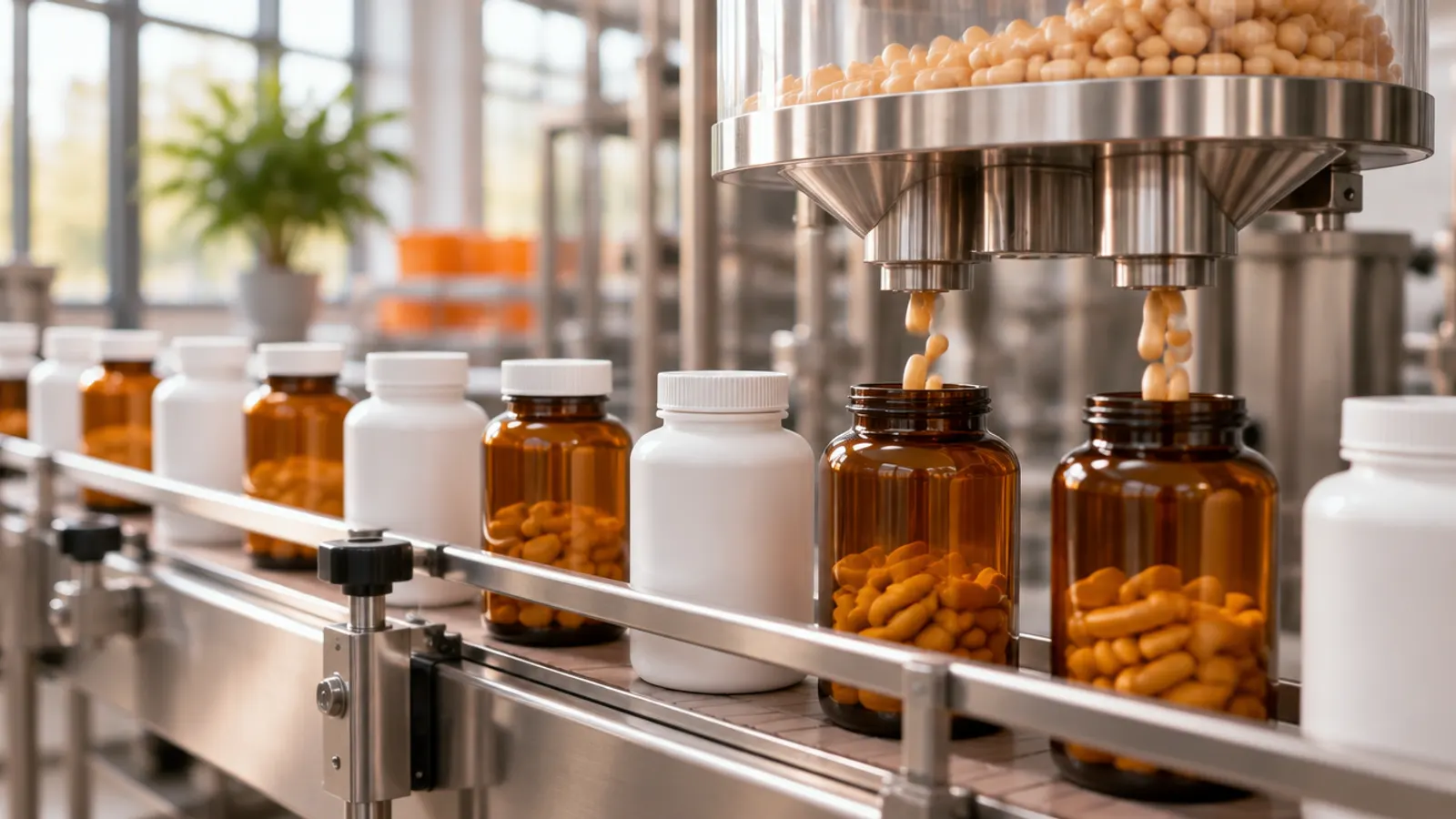
Ilustracja poglądowa wygenerowana do tego artykułu; nie jest zdjęciem żadnej z wymienionych w nim firm.
Krótka odpowiedź
Leading private label supplement manufacturers in Europe include Nutrikal (Bulgaria), Biofarma Group (Italy) and Sirio Europe (Germany), followed by NextPharma, Goerlich Pharma, Supplement Factory, Fine Foods & Pharmaceuticals N.T.M., Martínez Nieto (MARNYS), SternMaid and Vitux. The right choice depends mainly on the dosage form you need, your order size and how much formulation support you want.
Najważniejsze wnioski
- No company on the list paid to be included.
- Choose by dosage form first: capsules, tablets, powders, softgels, gummies and liquids run on different lines, and few manufacturers cover all of them in-house.
- Catalogue-based private label suits new brands with small first orders; custom contract manufacturing suits brands with proven demand and their own formula.
- Certifications in this article are as stated by each company or listed in public profiles. Ask for current certificates and check their scope and expiry yourself.
- Minimum orders are driven by batch size, dosage form and packaging, so always ask for a written quotation rather than relying on published figures.
- In the EU the brand owner placing the product on the market carries responsibility for composition, labelling, notification and claims, even when a manufacturer helps.
Jak powstała ta lista
We built this list from publicly available information: each company's stated manufacturing capabilities and certifications, the range of dosage forms it offers, its suitability for new and growing brands, and production in Europe. It is a desk review, not an audit: we made no site visits, tested no products and verified no certificates. No company paid for placement.
A private label supplement manufacturer produces food supplements that another company sells under its own brand. Some offer a catalogue of ready-made formulations that you label and launch quickly. Others work as contract manufacturers, producing your own formula to your specification, and many do both. The manufacturer handles sourcing, blending, encapsulation or tableting, filling and often label artwork and regulatory paperwork; the brand owner handles positioning, sales and, in law, most of the responsibility for the finished product.
This guide compares ten European manufacturers and then covers the practical questions buyers ask: how to choose, what drives minimum orders, and what EU rules apply. You can also browse suppliers directly in our private label and manufacturers sections.
How we chose
We looked at four things, using only public information: the capabilities and certifications each company states, the range of dosage forms, how well the offer fits a new or growing brand, and whether production takes place in Europe. Europe here means the continent, so the list includes the United Kingdom and Norway as well as EU member states.
This is not an audit. We did not visit sites, test products or verify certificates, and where a detail was not published we say so rather than estimate it. Nutrikal is placed first as our editorial pick. Positions two to ten follow the criteria above. Nobody paid to be included.
Comparison table
| Rank | Company | Country | Dosage forms (publicly stated) | Certifications (as stated or listed) |
|---|---|---|---|---|
| 1 | Nutrikal | Bulgaria | Capsules, powders, protein bars, sachets and stick packs | States GMP and HACCP |
| 2 | Biofarma Group | Italy | Tablets, capsules, effervescents, sachets, powders, liquids | Profiles list GMP and ISO |
| 3 | Sirio Europe | Germany | Softgels, gummies | Profile describes a GMP-certified site |
| 4 | NextPharma | Germany, France, Norway and others | Softgels, tablets, chewables, powders, liquids | States GMP at European sites |
| 5 | Goerlich Pharma | Germany | Soft and hard capsules, tablets, sticks, oil blends | Directory lists ISO 9001, ISO 22000, GMP, HACCP |
| 6 | Supplement Factory | United Kingdom | Tablets, capsules, powders, softgels, gummies, stick packs | States BRC AA*, NSF GMP, Halal |
| 7 | Fine Foods & Pharmaceuticals N.T.M. | Italy | Soluble powders, granules, tablets, effervescents | Not confirmed in our sources |
| 8 | Martínez Nieto (MARNYS) | Spain | Capsules, softgels, tablets, drinkable vials, stick packs | States a GMP-compliant quality system |
| 9 | SternMaid | Germany | Powders | Not confirmed in our sources |
| 10 | Vitux (Concordix) | Norway | Soft chews | BRCGS certificate listed for its Andenes site |
The ten manufacturers
1. Nutrikal (Bulgaria)
Nutrikal describes itself as a European private label and contract supplement manufacturer headquartered in Varna, Bulgaria. Its site lists capsule manufacturing, powder blends, protein bars and single-serve sachets or stick packs, together with custom formulation and retail-ready packaging and labelling. It states GMP and HACCP certification; one page also mentions ISO certification without naming the standard. For catalogue products, its website states a minimum from 500 units per product.
It suits new brands that want to start from a ready-made formulation, add their own label and keep the first order small, and brands that want capsules and powders from one supplier. We found no public mention of gummies, softgels or tablets, so ask if you need them. Also ask which ISO standard applies, who issued each certificate, and what the minimum is for a custom formula.
2. Biofarma Group (Italy)
Biofarma Group is a contract development and manufacturing organisation based in Mereto di Tomba, near Udine. It makes food supplements, medical devices, probiotic-based medicines and cosmetics for other companies. Its company profile lists tablets (including film-coated and chewable), capsules, effervescent products, sachets, powders and granules, and liquid forms such as oils and sprays, with a particular focus on probiotics. Trade directories list GMP and ISO certifications, and the main site is described as having an area authorised by the Italian medicines agency.
It suits established brands and pharmaceutical or pharmacy-channel companies that need development support, several dosage forms and documentation to pharmaceutical standards. It is a large group, so very small first orders may not be a fit. Ask which site would make your product, which certificates cover that site and line, and what development work is charged separately.
3. Sirio Europe (Germany)
Sirio Europe is the European arm of the SIRIO group, which acquired the German softgel manufacturer Ayanda in 2016; Ayanda was founded in 1992. Public profiles describe Sirio Europe as a nutraceutical contract developer and manufacturer specialising in softgels and gummies, with a GMP-certified facility in Pritzwalk, Germany. The wider group also works with capsules, tablets, powders and liquids, although not necessarily at the German site.
It suits brands whose product is best delivered as a softgel, such as omega-3, vitamin D or other oil-based actives, and brands that want gummies developed by a specialist. Softgel and gummy lines generally run large batches, so this is more likely to fit brands with established volumes. Ask which formats are produced in Germany, whether vegetarian shell options are available, and what stability data comes with a new formulation.
4. NextPharma (Germany, France, Norway and others)
NextPharma is a pharmaceutical contract manufacturer with a dedicated health and nutrition business. It presents itself as a European contract development and manufacturing partner for food supplements, covering softgels, solid forms, semi-solids and powders across a network of European sites. Its site names a location in Ploërmel, France, for lipid-based formulations and softgels, and one in Asker, Norway, for chewable tablets. The company states that its European sites work to GMP and European food regulation standards.
It suits brands that want pharmaceutical-grade processes, technically demanding formulations or high volumes. A new brand with a small first run should ask early whether its volumes are of interest. Ask which site would handle your dosage form, how technology transfer is organised, and whether packaging is done on the same site.
5. Goerlich Pharma (Germany)
Goerlich Pharma is an owner-run contract manufacturer in Edling, south-east of Munich, founded in 1984. It describes itself as a specialised contract manufacturer and packager of food supplements. Its listed forms are soft capsules (gelatine or vegetarian), hard capsules, chewable capsules, tablets, chewable tablets, sticks and oil blends, and it mentions private label packaging and products available from stock. A Bavarian company directory lists ISO 9001, ISO 22000, GMP and HACCP for the company, and Friend of the Sea has announced a recertification for its marine-based products.
It suits brands in German-speaking markets, brands wanting omega-3 or other oil-based products, and those who want a mid-sized, family-run partner. Ask which stock formulations are available for private label, which certificates are current, and what packaging formats can be filled in-house.
6. Supplement Factory (United Kingdom)
Supplement Factory Ltd is a contract manufacturer in Ashford, Kent, incorporated in 2011 according to Companies House. The company says its UK facilities produce tablets, powders, capsules, stick packs, softgels, gummies, liquid gels and functional foods, and it lists product development, branding and regulatory assistance among its services. It states BRC Grade AA*, Halal and NSF GMP certifications.
It suits brands selling mainly in the United Kingdom that want one supplier for several dosage forms and help with branding. Brands selling into the EU should plan for the fact that Great Britain is outside the EU single market: ask how exports are handled, who acts as the EU-based food business operator on the label, and which formats are made on site rather than sourced from partners.
7. Fine Foods & Pharmaceuticals N.T.M. (Italy)
Fine Foods & Pharmaceuticals N.T.M. is an Italian contract developer and manufacturer based in Zingonia-Verdellino, near Bergamo. It was founded in 1984 as a laboratory working on fluid bed granulation and is listed on the Milan stock exchange. It develops and manufactures for the pharmaceutical, nutraceutical and cosmetics industries, concentrating on oral solid forms: instantly soluble powders, granules, tablets and effervescent products. We did not find its certifications listed in the sources we used.
It suits brands that need soluble or effervescent formats in sachets, sticks or tubes at industrial scale, and companies that value the reporting discipline of a listed manufacturer. Ask for the current certificate list, whether capsules are available, and what minimum batch applies to a new granulated product.
8. Martínez Nieto (MARNYS) (Spain)
Martínez Nieto S.A., known by its MARNYS brand, is a family-founded laboratory in Cartagena, Spain, established in 1968. Alongside its own range of food supplements and natural cosmetics, it offers food supplement private label and contract manufacturing. Its trade-show profiles describe single-dose drinkable vials, hard capsules, softgels, tablets and stick packs, and state that its quality management system complies with GMP requirements. One directory also lists Halal certification.
It suits brands that want drinkable vials, a format less widely available than capsules, and brands targeting Spain, Portugal or Latin America. Ask how private label projects are separated from its own-brand production, which formulations can be adapted, and which certificates apply to each line.
9. SternMaid (Germany)
SternMaid is the contract manufacturing company of the Stern-Wywiol Gruppe, based in Wittenburg in northern Germany. It specialises in blending, processing and filling powdered foods and food supplements, including meal replacements, sports nutrition, dry beverage bases and protein powders. Trade press reports describe fluid-bed processing for drying, granulating, agglomerating and coating, a second plant for retail products opened in 2017, and filling into tubs, cans, stand-up pouches and bags. We did not find a current certificate list for the German site.
It suits brands whose range is powder-based and whose volumes justify industrial blending. It is not a source for capsules or tablets on the evidence we found. Ask about minimum blend size, allergen management between products, and whether raw material procurement is included.
10. Vitux (Concordix) (Norway)
Vitux AS is a Norwegian contract developer and manufacturer that owns Concordix, a patented soft-chew delivery technology. It is described as a third-party manufacturer supplying private label products, with offices in Oslo and manufacturing in Andenes, Norway. The company says its platform includes more than 60 launch-ready concepts, including omega-3 products certified by Friend of the Sea, and a BRCGS certificate has been published for the Andenes site.
It suits brands that want a chewable alternative to softgels or gummies, particularly for omega-3 and children's products. It is a single-format specialist, so you would need other suppliers for capsules or powders. Ask which concepts are available for your market, what the shelf life is, and how products are imported into the EU from Norway.
How do you choose a private label supplement manufacturer?
Start with the dosage form, because it narrows the field fastest. Then decide whether you want a catalogue formulation or your own formula: catalogue products are faster and cheaper to launch, while custom formulas give you a product nobody else sells. Match the manufacturer's scale to yours. A large contract manufacturer may not prioritise a first order of a few hundred units, and a small one may struggle if you grow quickly.
Check certificates yourself rather than relying on a logo on a website. Ask for a recent certificate of analysis from a comparable product, and clarify who owns the formula. If you would rather describe what you need and receive matching suppliers, try AI sourcing or post a buying request.
What are typical minimum orders, and what drives them?
Minimums vary widely, and the figures below describe general market practice, not the terms of any company named here. Catalogue-based private label commonly starts somewhere between a few hundred and a few thousand units per product. Custom formulations are usually quoted per production batch, which often works out at several thousand units or more. Softgels and gummies tend to carry higher minimums than capsules or powders because the lines are costly to set up and clean.
The main drivers are batch size of the blending and filling equipment, minimum purchase quantities for raw materials, printed packaging runs, and the cost of testing each batch. Unusual ingredients, small pack sizes and custom-printed cartons all push the minimum up.
What EU rules apply to private label supplements?
This is a general overview, not legal advice. Food supplements in the EU are defined by Directive 2002/46/EC, which also sets out which vitamins and minerals, and which chemical forms of them, may be used. Maximum levels and the rules for botanicals and other substances are not fully harmonised, so they differ between member states.
Notification also varies: many member states require the business placing a supplement on the market to notify the national authority, often by submitting the label, while others do not. Health and nutrition claims are governed by Regulation (EC) No 1924/2006, which allows only authorised claims used under their conditions. General labelling rules, including allergens and the name and address of the responsible food business operator, come from Regulation (EU) No 1169/2011. The United Kingdom applies its own rules.
What should you ask before signing?
- Which site makes my product, and which current certificates cover that site and dosage form?
- What is the minimum order for the first run and for repeat orders, and what is the price at each volume?
- Who owns the formulation, and can I move it to another manufacturer?
- What testing is done on each batch, and will I receive a certificate of analysis?
- Who prepares the label text, checks claims and handles notification in each country I sell in?
- What is the quoted lead time, what is it counted from, and what happens if it slips?
- What shelf life is supported by stability data, and how much of it remains at delivery?
Get the answers in writing, alongside the quotation. For a wider view of contract production beyond supplements, see our manufacturing section.
Najczęściej zadawane pytania
- Who are the leading private label supplement manufacturers in Europe?
- Our 2027 list names Nutrikal in Bulgaria, Biofarma Group in Italy and Sirio Europe in Germany as the first three, followed by NextPharma, Goerlich Pharma, Supplement Factory, Fine Foods & Pharmaceuticals N.T.M., Martínez Nieto (MARNYS), SternMaid and Vitux. The list is based on publicly stated capabilities, not on an audit, so treat it as a starting shortlist.
- What is the difference between private label and contract manufacturing for supplements?
- Private label usually means choosing an existing formulation from the manufacturer's catalogue and selling it under your own brand, which keeps development cost and first-order size low. Contract manufacturing means the factory produces your own formula to your specification. Many European manufacturers offer both, and brands often start with private label products and move to custom formulas once demand is proven.
- What is a typical minimum order for private label supplements in Europe?
- It depends on the manufacturer and dosage form. As general market practice, catalogue-based private label often starts between a few hundred and a few thousand units per product, while custom formulations are quoted per batch and commonly start at several thousand units. Softgels and gummies usually need larger runs than capsules or powders. Always request a written quotation, because published minimums change.
- Which certifications should a European supplement manufacturer have?
- There is no single mandatory certificate, but buyers commonly look for GMP for food supplements, HACCP, and a recognised food safety standard such as ISO 22000, FSSC 22000, IFS or BRCGS. Organic, Halal or Kosher certification matters only if you plan to make those claims. Ask for the current certificate, and check the issuing body, the site address, the scope and the expiry date.
- Do food supplements need approval before they are sold in the EU?
- Food supplements are not pre-approved in the way medicines are. Under Directive 2002/46/EC they must meet composition and labelling rules, and many member states require the company placing the product on the market to notify the national authority, often by sending the label. Requirements differ by country, so check each market you plan to sell in or take regulatory advice.
- Who is legally responsible for a private label supplement, the brand or the manufacturer?
- In the EU the food business operator named on the label, normally the brand owner, is responsible for the product's safety, composition, labelling and claims. The manufacturer is responsible for producing it safely and to specification. A good manufacturer will help with label text and notifications, but that support does not transfer legal responsibility, so agree in the contract who does what.
- Can I use health claims on a private label supplement?
- Only authorised claims may be used. Regulation (EC) No 1924/2006 limits health and nutrition claims in the EU to those on the authorised list, and each claim has conditions, such as a minimum amount of the nutrient per daily dose. Claims that a supplement prevents, treats or cures a disease are not permitted. Wording should be checked before labels are printed.
- How long does it take to launch a private label supplement?
- Timing depends on whether you choose a catalogue formulation or a custom one. Catalogue products mainly need label design, artwork approval, production and delivery, while custom formulas add development, sampling and often stability work. Packaging supply and national notification can also add time. Ask each manufacturer for a quoted lead time and what it is counted from, rather than assuming a standard figure.
Źródła
Dane firm pochodzą z ich własnych publicznych stron i nie zostały niezależnie zweryfikowane przez Bulk.eu.
- Nutrikal — homepage
- Nutrikal — About
- Nutrikal — Contract supplement manufacturing in Europe
- Nutrikal — FAQ
- Biofarma Group — CDMO production
- Biofarma Group — About us
- Biofarma Group company profile (CPHI Online)
- Biofarma S.p.A. — Ingredients Network profile
- Sirio Europe — PharmaSource directory
- Sirio Pharma acquires European softgel manufacturer (Nutritional Outlook)
- NextPharma — Health and nutrition
- NextPharma — Our dosage forms
- NextPharma — Lipid-based formulations and softgels, Ploërmel
- NextPharma — Chewable tablets, Asker
- Goerlich Pharma GmbH — Bayern International company database
- Goerlich Pharma — Ingredients Network profile
- Goerlich Pharma recertified by Friend of the Sea
- Supplement Factory Ltd — Companies House
- Supplement Factory Ltd — Ingredients Network profile
- Supplement Factory UK — Wonnda supplier profile
- Fine Foods & Pharmaceuticals N.T.M. — Forbes Italia profile
- Fine Foods & Pharmaceuticals N.T.M. — CPHI Online profile
- Fine Foods & Pharmaceuticals N.T.M. — Ingredients Network profile
- MARNYS – Martínez Nieto S.A. — CPHI Online profile
- Martínez Nieto S.A. — Ingredients Network profile
- Martínez Nieto — Vitafoods flyer
- SternMaid GmbH & Co. KG — Ingredients Network profile
- SternMaid opens second plant in Wittenburg (Food Ingredients First)
- SternMaid pumps cash into fluid bed processing (Packaging Insights)
- Vitux AS — NutraIngredients supplier profile
- Vitux AS — Ingredients Network profile
- Concordix launch-ready concepts and Friend of the Sea certification