Rankings
Top 8 Private Label Candle and Home Fragrance Manufacturers in Europe (2027)
Updated · 12 min read · Bulk.eu editorial
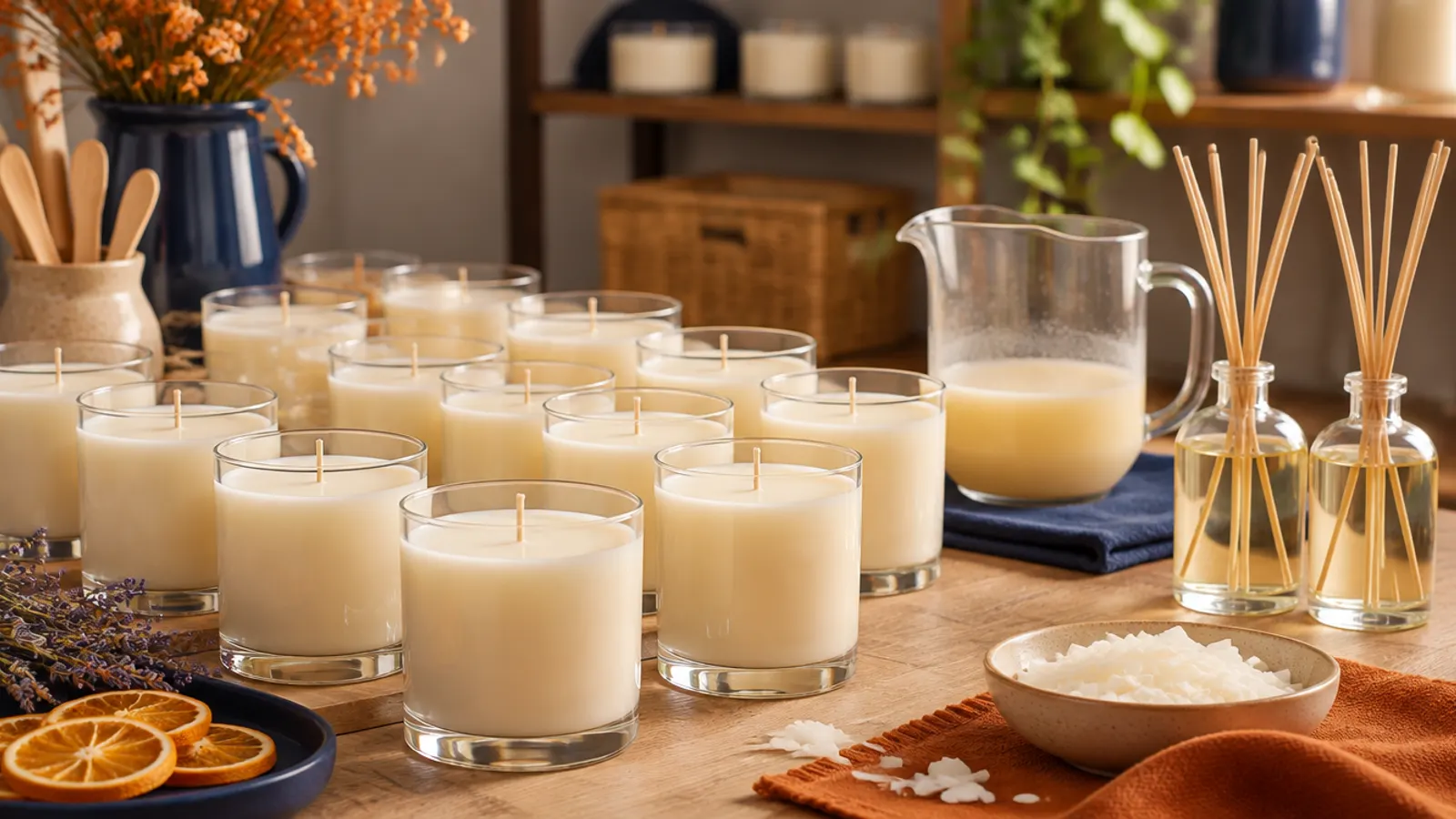
Illustrative image generated for this article; not a photograph of any company named in it.
Short answer
European manufacturers that publicly offer private label candles and home fragrance include Bougies La Française (France), Contract Candles & Diffusers (United Kingdom) and Bougie & Senteur (France), followed by Gies Kerzen, Hansa Candle, Wax Lyrical, Nowe S.A. and Korona Candles. The right choice depends on whether you need poured scented candles, reed diffusers and room sprays for a boutique brand, or high-volume candles for retail chains.
Key takeaways
- No company on the list paid to be included, and the order reflects public information only.
- Decide first which product you need: poured scented candles, pressed or moulded candles and tealights, reed diffusers, or room sprays. Few factories are equally strong in all of them.
- Boutique-oriented makers suit brands that want custom fragrance and decorated glass; volume makers suit retailers that need consistent supply at scale.
- Scented candles, diffuser liquids and room sprays are chemical mixtures in EU law, so hazard classification and labelling are part of the project, not an afterthought.
- Minimum orders are driven mainly by custom fragrance, printed glass and gift boxes. Starting with a stock vessel and a label keeps the first order small.
- Certifications and quality marks here are as stated or listed publicly. Ask for current documents and burn-test reports for your own product.
How this list was put together
We built this list from publicly available information: each company's stated private label or contract manufacturing offer, the certifications and quality marks it states or that are listed for it, the range it covers across candles, reed diffusers and room sprays, its suitability for new and growing brands, and production in Europe. It is a desk review, not an audit: we made no site visits, tested no products and verified no certificates. No company paid for placement.
A private label candle or home fragrance manufacturer makes candles, reed diffusers or room sprays that another business sells under its own name. Some work mostly for retail chains and produce large volumes of tealights, pillar candles and filled glasses. Others work for beauty, fashion and lifestyle brands, pouring scented candles into decorated glass and filling diffusers and sprays with a fragrance developed for that brand. The difference matters more than the country.
This article lists eight European manufacturers with a publicly stated private label or contract offer, and then answers the questions buyers ask most: how to choose, what minimums to expect, which rules apply and what to ask. If private label is new to you, start with what private label means. You can also browse the private label section of Bulk.eu.
How we chose
We used public information only: company websites, trade-fair and directory listings, registry data and press coverage. We looked at four things: how clearly the company states a private label or contract manufacturing offer, how much of the range it covers across candles, reed diffusers and room sprays, how well it fits a new or growing brand, and whether it produces in Europe. Europe here means the continent, so the United Kingdom is included.
This is not an audit. We did not visit factories, burn-test candles or verify certificates, and where a detail was not published we say so. Nobody paid to be included, and the order follows the criteria above. Several large European candle makers are absent simply because we could not confirm a current private label offer from public sources.
Comparison table
| Rank | Company | Country | Private label products (publicly stated) | Best suited to |
|---|---|---|---|---|
| 1 | Bougies La Française (BLF Private Label) | France | Candles, reed diffusers, room sprays, car diffusers | Beauty, fashion and retail brands wanting a full range |
| 2 | Contract Candles & Diffusers | United Kingdom | Scented candles, diffusers | Luxury and niche brands, UK market |
| 3 | Bougie & Senteur | France | Scented candles, reed diffusers, room sprays | Fragrance-led boutique brands |
| 4 | Gies Kerzen | Germany | Candles under brand and private label | Retailers in German-speaking markets |
| 5 | Hansa Candle | Estonia | Candles, including tealights | Retail chains needing volume |
| 6 | Wax Lyrical | United Kingdom | Candles, reed diffusers, private label collections | UK retailers and gift brands |
| 7 | Nowe S.A. | Poland | Home fragrances, reed diffusers, candles, sachets | Drugstores and retailers |
| 8 | Korona Candles | Poland | Candles for retail chains | Large retail programmes |
The eight manufacturers
1. Bougies La Française (BLF Private Label) (France)
Bougies La Française is a French candle maker that dates its trade to 1902 and belongs to the Emosia Group; a business directory lists its registered address in Cugand, in the Vendée. Its trade-fair profile says the company employs over 400 people and created a private label department more than fifteen years ago. Under the name BLF Private Label, listings describe moulded and poured candles, massage candles, reed diffusers, room sprays, car diffusers and gift sets, for customers ranging from luxury and fashion brands to retail chains.
It suits a brand that wants candles, diffusers and sprays from one French supplier and expects to grow. Minimums and certifications are not published in our sources. Ask which products are made at which site, whether a stock vessel range exists for small first orders, and who supplies and owns the fragrance.
2. Contract Candles & Diffusers (United Kingdom)
Contract Candles & Diffusers Ltd is a family-owned British manufacturer of own-label home fragrance. Company data records describe it as making scented candles since 1997 and diffusers since 2010, with the limited company incorporated in 2004 and renamed from Contract Candles Limited in 2018. Listed services include own-label production, bespoke development, candle testing and contract packing, and a directory profile describes its customers as luxury and niche brands. It is listed as a participant in the UN Global Compact since December 2022.
It suits premium brands that want bespoke fragrance and finish and a manufacturer whose whole business is contract work. Brands selling in the EU should ask how goods are shipped from Great Britain and who is named as the EU-based supplier on the label. Its exact site location and minimums are not published in our sources.
3. Bougie & Senteur (France)
Bougie & Senteur is a private label manufacturer based in Grasse, the town in southern France long associated with perfumery. A directory profile lists scented candles, room sprays, reed diffusers, massage candles, solid perfumes and eau de parfum, with personalisation of containers and packaging. A trade-show article from 2023 describes a "full-service" offer covering both home products and cosmetics and emphasises local partnerships around Grasse.
It suits a fragrance-led brand that wants candles, diffusers and sprays built around one scent identity, and brands for which a Grasse origin supports the story. We found no company website, certifications or minimums in our sources, so treat those as not published. Ask what is made in-house and what is done by local partners, which fragrance houses it works with, and what documents come with each product.
4. Gies Kerzen (Germany)
Gies Kerzen is a candle supplier based in Glinde, near Hamburg, founded in 1899 and now part of the Swedish-owned Liljeholmens group. The company describes its range as covering its own brands, GIES and Dufti by Gies, and products that reach the end customer under private labels. Its candles are described as carrying the RAL quality mark for candles. After a restructuring in 2018, some machinery moved to group sites in Portugal and Sweden, while sales and marketing remained in Glinde; the group's Portuguese subsidiary is named Promol.
It suits retailers and distributors, especially in German-speaking markets, that want household candles, tealights and seasonal ranges under their own label. Ask which group factory would produce each item, whether scented glass candles are available, and whether the quality mark covers your specific products.
5. Hansa Candle (Estonia)
Hansa Candle AS was founded in 1996 in Viljandi, Estonia. Its trade-fair profile states that more than 70% of its range is private label, with the remainder sold under its own brands. Press reports describe it as the largest candle manufacturer in the Baltics, name IKEA as its biggest customer, and report an order from Walmart for own-brand tealights. The company appears in the Nordic Swan Ecolabel's company listings, and it changed owner in 2021.
It suits retail chains and importers that need steady, high-volume supply of tealights and standard candles, and buyers who want an ecolabelled option. It is less obviously a fit for a small boutique launch. Ask which products hold an ecolabel licence today, what the smallest production run is for a custom pack, and whether scented candles in glass are part of the private label offer.
6. Wax Lyrical (United Kingdom)
Wax Lyrical is a home fragrance maker in Lindal-in-Furness, Cumbria. The company says it designs, develops and manufactures its collections at that site and has done so for over forty years. Its own ranges include candles, reed diffusers, room mists, scented sachets and refresher oils, and a manufacturing trade profile describes the business as producing luxury scented candles, reed diffusers and private label collections.
It suits UK retailers, garden centres and gift brands that want candles and diffusers made in Britain by a company with its own established ranges. The private label offer is described only briefly in public sources, so ask how it works: whether you can adapt existing fragrances and vessels, what is developed from scratch, and how your products are kept distinct from its own brands. As with any British supplier, EU buyers should ask about shipping and labelling for EU markets.
7. Nowe S.A. (Poland)
Nowe S.A. is a family-owned Polish manufacturer of home fragrances. Its profile on the Polish government's trade portal lists air fresheners, scented pearls, reed diffusers, candles, scented oils and sachets, and says the company expanded its machinery to allow more product customisation for private label clients. The same sources say it supplies small businesses as well as large retailers and drugstores, has its own laboratory, and exhibits at international trade fairs.
It suits drugstore chains, retailers and brands that want reed diffusers and scented accessories at accessible price points, with candles as part of a wider range. We did not find a company website, certifications or minimums in our sources. Ask which products are made on its own lines, what customisation covers in practice, and what fragrance and labelling documents are supplied.
8. Korona Candles (Poland)
Korona Candles is a candle manufacturer based in Wieluń, Poland. Polish business press has reported that the company stopped promoting its own brand and supplies large retail chains, with IKEA and Walmart named as customers. A candle from Korona Candles appears in the Nordic Swan Ecolabel's product listings. Public sources say little about its scented ranges, and we found no reed diffuser or room spray offer.
It suits large retail programmes: buyers who need substantial volumes of standard candles made to a retailer's specification. A start-up brand looking for a few hundred scented candles should look elsewhere on this list. Ask about the range of formats and waxes, which products hold an ecolabel licence, and what the smallest economical run is.
How do you choose a private label candle manufacturer?
A typical project runs in this order.
- Define the product: wax type, vessel, size, fragrance direction, burn time and target price.
- Decide between a ready-made fragrance and vessel from the manufacturer's range, or a custom development.
- Shortlist factories whose normal customers look like you. A chain-store supplier and a boutique pourer work very differently.
- Request samples, burn them fully, and check scent when cold and when lit. See our guide to requesting and evaluating samples.
- Agree the label content, hazard information and packaging before production, not after.
- Confirm the order in writing with specification, price, minimum and delivery terms.
Illustrative example: a skincare brand wants a candle and a reed diffuser in its signature scent for Christmas. Choosing a stock glass, a standard box and an existing fragrance close to its own would typically be quicker and need a smaller order than commissioning custom glass and a new fragrance, which it could do the following year.
To receive offers instead of searching, post a buying request or describe the product to AI sourcing.
What are typical minimum orders for private label candles?
These ranges describe general market practice, not the terms of any company named here. Small workshops that pour by hand may accept a few dozen to a few hundred pieces per fragrance. Established contract manufacturers commonly ask for several hundred to a few thousand pieces per fragrance and size. Factories supplying retail chains usually think in pallets or truckloads.
The main drivers are the fragrance, since a custom scent has its own minimum purchase, and the vessel and box, since printed or coloured glass and printed cartons are made in runs of thousands. Reed diffusers and room sprays often follow the same pattern. What MOQ means explains how to lower a minimum.
What rules apply to candles, diffusers and room sprays in the EU?
This is a general overview, not legal advice. Scented candles, diffuser liquids and room sprays are mixtures under the CLP Regulation, Regulation (EC) No 1272/2008. Depending on the fragrance and its concentration, the product may need hazard pictograms, signal words and statements on the label, and named allergens. Diffuser liquids and sprays are more often classified as hazardous than candles, and hazardous mixtures also involve information for poison centres.
All consumer products fall under the General Product Safety Regulation, Regulation (EU) 2023/988, which requires a responsible economic operator in the EU. Room sprays in pressurised cans are also covered by the Aerosol Dispensers Directive, 75/324/EEC. For candles, European standards exist for fire safety (EN 15493), safety labels (EN 15494) and sooting (EN 15426), and the fragrance industry's IFRA Standards set use limits. The United Kingdom applies its own versions of these rules.
The brand whose name is on the product is normally responsible, even when the manufacturer prepares the label.
What should you ask before you order?
- Which products do you make yourselves, and which are bought in or subcontracted?
- Who supplies the fragrance, who owns the formula, and can I take it to another manufacturer?
- Will you provide the safety data sheet and the hazard label text for each product and market?
- Which burn tests have been done on this wax, wick, vessel and fragrance combination, and may I see the report?
- What are the minimum order, the price at each volume and the lead time for a first order and for repeats?
- Which wax is used, and what evidence supports any claim such as "natural" or "vegetable"?
- How are candles packed to survive heat and transport, and who bears the cost of breakage?
Ask for the answers in writing with the quotation.
Frequently asked questions
- Who are the leading private label candle manufacturers in Europe?
- Our 2027 list names Bougies La Française in France, Contract Candles & Diffusers in the United Kingdom and Bougie & Senteur in France first, followed by Gies Kerzen, Hansa Candle, Wax Lyrical, Nowe S.A. and Korona Candles. All publicly describe private label or contract production. The list is based on public information, not on an audit, so use it as a starting shortlist.
- What is the minimum order for private label candles?
- It varies with the type of manufacturer. As general market practice, small hand-pouring workshops may accept a few dozen to a few hundred pieces per fragrance, established contract manufacturers often ask for several hundred to a few thousand, and factories supplying retail chains work in pallets. Custom fragrance and printed glass raise the minimum. Always ask for a written quotation.
- Do scented candles need hazard labels in the EU?
- Often, yes. Scented candles are mixtures under the CLP Regulation, Regulation (EC) No 1272/2008. Whether a hazard pictogram, warning statements or named allergens are required depends on the fragrance and its concentration, which is assessed from the fragrance supplier's safety data. The manufacturer usually prepares this, but the brand placing the product on the market is responsible. This is general information, not legal advice.
- Can one manufacturer make candles, reed diffusers and room sprays?
- Some can. Manufacturers serving beauty and lifestyle brands often offer all three so a brand can launch one fragrance across several formats. High-volume candle factories usually focus on candles alone. Ask what is produced in-house and what is subcontracted, because diffuser liquids and sprays involve different filling equipment and different hazard labelling from wax candles.
- Which wax should I choose for a private label candle?
- Common options are paraffin, vegetable waxes such as soy or rapeseed, beeswax, and blends. Each behaves differently for scent, burn time, surface finish and cost, and no single wax is best for every product. Ask the manufacturer what it recommends for your vessel and fragrance, request burn-test results, and make marketing claims about the wax only if the supplier's documents support them.
- Who owns the fragrance in a private label candle?
- It depends on the agreement. If you choose a fragrance from the manufacturer's library, the fragrance house or manufacturer normally keeps the formula and may sell it to others. A fragrance developed for you can be exclusive, usually subject to a minimum purchase. Clarify exclusivity, ownership and whether you can move the fragrance to another factory before you order.
- How long does it take to launch a private label candle?
- Timing depends on how much is custom. Using a stock vessel, standard packaging and an existing fragrance mainly requires sampling, label artwork, production and delivery. Custom glass, printed boxes and a new fragrance add development and supplier lead times, and seasonal demand before Christmas fills factories early. Ask each manufacturer for a quoted lead time and what it is counted from.
- Can I buy private label candles from the UK for sale in the EU?
- Yes, but plan for it. Goods from Great Britain are imports into the EU, so customs formalities apply, and the product needs a responsible economic operator established in the EU and labelling that meets EU rules for each market. Ask the manufacturer what experience it has with EU customers and who will be named on the label. Take advice for your situation.
Sources
Company details are taken from the companies' own public pages and were not independently verified by Bulk.eu.
- Bougies La Française — exhibitor profile (Paris Packaging Week)
- BLF — supplier profile (Wonnda)
- Bougies La Française (Emosia Groupe) — company data (Businesscoot)
- Emosia reprend une partie des activités de Denis & Fils (Le Journal des Entreprises)
- Contract Candles & Diffusers Ltd — company insight (Endole)
- Contract Candles & Diffusers — UN Global Compact participant
- Contract Candles & Diffusers — company profile (Dealroom)
- Bougie et Senteur — supplier profile (Wonnda)
- Bougie & Senteur: made in Grasse (LUXE PACK Monaco)
- Gies Kerzen GmbH — About us
- Gies Kerzen — History
- Gies Kerzen — Quality
- Gies Kerzen — Wikipedia
- Hansa Candle AS — exhibitor profile (Christmasworld, Messe Frankfurt)
- Hansa Candle, largest candle manufacturer in the Baltics, has a new owner (Coop Pank)
- Walmart orders tealights from Estonia's Hansa Candle (The Baltic Times)
- Hansa Candle AS — Nordic Swan Ecolabel company listing
- Wax Lyrical: a fragrant success story in British manufacturing (Manufacturing Today)
- Nowe S.A. — company profile (trade.gov.pl)
- Nowe S.A. — company presentation 2023 (trade.gov.pl)
- Korona Candles — company profile (CB Insights)
- Podwykonawstwo rozpaliło biznes (Gazeta Prawna)
- Polskie świeczki ruszają na podbój Ameryki (Bankier.pl)
- Korona Candles product listing — Nordic Swan Ecolabel (Denmark)