Rankings
Top 8 Stick-Pack and Sachet Filling Companies in Europe (2027)
Updated · 12 min read · Bulk.eu editorial
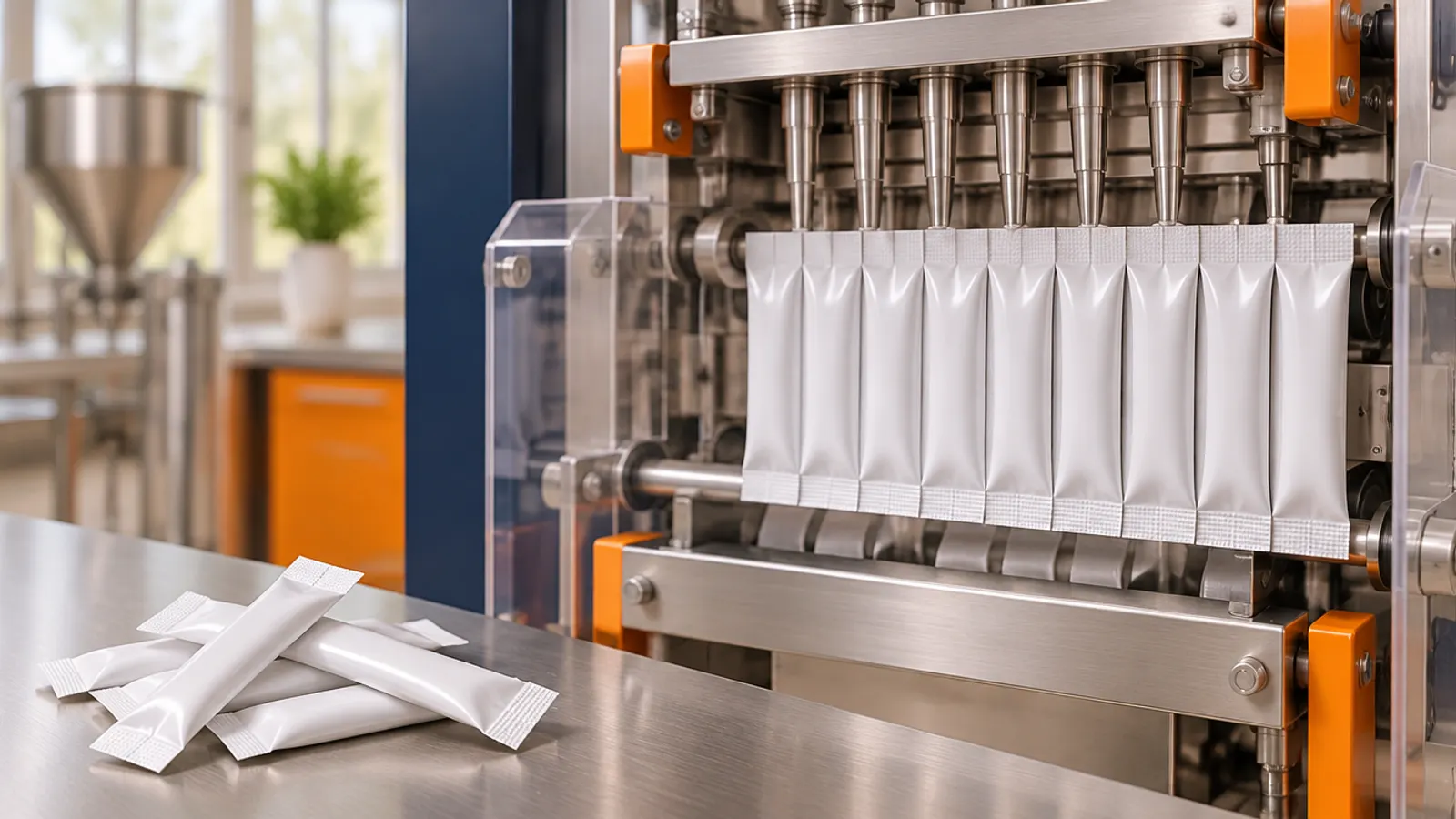
Illustrative image generated for this article; not a photograph of any company named in it.
Short answer
European companies that publicly offer stick-pack or sachet filling include Nutrikal in Bulgaria for supplement powders, HERMES PHARMA in Germany and Austria for granules, and Unither Pharmaceuticals in France for liquids. SternMaid, Fine Foods & Pharmaceuticals N.T.M., Pharmatis, Stella Nutrition and Budelpack Poortvliet complete the list. The right choice depends on whether your product is a powder, a granule or a liquid, and on whether it is a food, a supplement or a medicine.
Key takeaways
- Choose by fill type first. Powder, granule and liquid stick packs run on different equipment, and few companies fill all three.
- A stick pack is a narrow tube sealed at both ends and along the back; a sachet is a flat pouch sealed on three or four sides. They need different machines.
- Decide whether you need a manufacturer that blends and fills, or a co-packer that fills a product you supply.
- Minimums for single-serve formats are driven by printed film and machine set-up, so ask for a written quotation instead of relying on published figures.
- Certifications in this article are as stated by each company or listed in public profiles. Ask for current certificates and check their scope.
- No company paid for placement.
How this list was put together
We built this list from public information: each company's stated stick-pack or sachet filling capability, the fill types it handles, its stated or listed certifications, its suitability for new and growing brands, and production in Europe. It is a desk review, not an audit: we made no site visits, tested no products and verified no certificates. No company paid for placement.
Single-serve packs have become a standard format for drink powders, electrolytes, collagen, creatine, probiotics and liquid supplements. They are easy to carry, give an exact dose and let a brand sell trial sizes. They also need specialised filling lines, so most brands outsource the work.
This article compares eight European companies that publicly offer stick-pack or sachet filling, then covers how to choose between them, what drives minimums and which rules apply. To browse suppliers yourself, see our manufacturing and manufacturers sections.
What is the difference between a stick pack and a sachet?
A stick pack is a narrow tube formed from one strip of film, sealed along the back and at both ends. It is made on a multi-lane machine that forms, fills and seals several sticks side by side. A sachet is a flat pouch sealed on three or four sides, sometimes called a sealed-rim or pillow sachet depending on the seal pattern.
Stick packs use less film for the same fill and pour neatly into a bottle. Sachets offer a larger printable face and suit bigger fills. The two formats are not interchangeable on one machine, so a filler that runs sachets cannot necessarily run sticks.
How we chose
We looked at public information only: whether the company states that it fills stick packs or sachets, which fill types it handles, the certifications it states or that profiles list, how well it suits a new or growing brand, and production in Europe.
This is not an audit. We visited no sites and verified no certificates, and where a detail was not published we say so. Nutrikal is placed first as our editorial pick. Positions two to eight follow the criteria above, with weight given to covering powders, granules and liquids, and both supplement and pharmaceutical work.
Comparison table
| Rank | Company | Country | Fill types (publicly stated) | Main sectors | Certifications (as stated or listed) |
|---|---|---|---|---|---|
| 1 | Nutrikal | Bulgaria | Powder blends in sachets or stick packs | Food supplements | States GMP and HACCP |
| 2 | HERMES PHARMA | Germany, Austria | Granules in stick packs | Medicines, supplements | States GMP manufacturing sites |
| 3 | Unither Pharmaceuticals | France | Liquids in stick packs | Medicines, healthcare | Not confirmed in our sources |
| 4 | SternMaid | Germany | Powders and granulates in sachets | Foods, supplements | Not confirmed in our sources |
| 5 | Fine Foods & Pharmaceuticals N.T.M. | Italy | Powders and granules in sachets and sticks | Medicines, supplements | Not confirmed in our sources |
| 6 | Pharmatis | France | Liquids and gels in stick packs and sachets | Medicines, healthcare | Profiles list GMP, ISO 9001, ISO 14001 |
| 7 | Stella Nutrition | Poland | Powders in pillow sachets and stick packs | Food supplements | Not published |
| 8 | Budelpack Poortvliet | Netherlands | Dry foods in stick packs and pouches | Food and consumer goods | Not confirmed in our sources |
The eight companies
1. Nutrikal (Bulgaria)
Nutrikal is a private label supplement manufacturer in Varna, Bulgaria. Its site describes private label capsules, powder blends, protein bars and single-serve sachets or stick packs, and states GMP and HACCP certification. That combination matters for a brand owner: the powder can be blended and filled into single serves by the same supplier, with no bulk product moving between two companies.
It suits supplement brands that want a powder product in single-serve form under their own label, particularly those that also sell capsules or tubs and want one supplier for the range. We found no public confirmation that it fills liquids, so treat that as not published.
Ask which stick and sachet sizes it runs, what fill weights are possible, whether your film is printed or labelled, and what minimum applies to this format specifically.
2. HERMES PHARMA (Germany and Austria)
HERMES PHARMA is a contract development and manufacturing organisation headquartered in Pullach, Germany, with plants in Wolfratshausen, Germany, and Wolfsberg, Austria. It specialises in user-friendly oral forms, including orally disintegrating granules that are taken without water and packed in stick packs. The company describes high-speed stick-pack filling lines at Wolfsberg, inline packaging to prevent the blend separating, and taste-masking by hot melt coating. In 2023 it announced a 25 million euro investment in capacity.
It suits pharmaceutical companies and established consumer health brands with a product that needs taste masking and documentation to medicinal standards. A first-time brand with a simple drink powder is unlikely to be its typical customer.
Ask whether it takes food supplement projects at your volume, which stick sizes and laminates are available, and what development work precedes the first batch.
3. Unither Pharmaceuticals (France)
Unither Pharmaceuticals is a French contract development and manufacturing organisation known for single-dose liquid formats. Its own material names Colomiers, near Toulouse, as its liquid stick-pack site in France, alongside stick-pack plants in Brazil and the United States, and states a combined capacity of 500 million stick packs a year. Other French sites handle different technologies, such as blow-fill-seal unit doses.
It suits companies with a liquid product, such as a syrup, oral solution or drinkable supplement, that want a unit-dose pack at industrial volume. The scale suggests it is a better fit for established brands and pharmaceutical clients than for a small first run.
Ask whether your formulation is compatible with its films, what fill volumes are available, what shelf-life data it will generate, and whether it works on non-medicinal products.
4. SternMaid (Germany)
SternMaid is the contract manufacturing company of the Stern-Wywiol Gruppe, based in Wittenburg in northern Germany. It blends, processes and fills powdered foods and food supplements. Trade press reports say it commissioned a fourth filling line for sealed-rim sachets in 2022, and that the site can fill up to one million sachets a day with powdered and granulated foods, instant beverages or dietary supplements. It also fills tubs, cans, stand-up pouches and bags.
It suits brands with a powder product at volume that want blending and sachet filling at one site. The sources we used describe sachets at the German plant; stick packs were mentioned for its American sister company, so ask what is available in Wittenburg.
Ask about minimum blend size, allergen handling between products, sachet dimensions and current certificates.
5. Fine Foods & Pharmaceuticals N.T.M. (Italy)
Fine Foods & Pharmaceuticals N.T.M. is a listed Italian contract developer and manufacturer based at Zingonia-Verdellino, near Bergamo. Its plants produce medicines, medical devices and food supplements in solid oral forms. Its core process is fluid bed granulation, used to make instantly soluble powders and effervescent products, which trade profiles say it packs in sachets and sticks, among other formats. It manufactures for other companies and does not sell under its own brand.
It suits brands that need a granulated, soluble or effervescent product in single serves at industrial scale, and companies that want one partner for supplement and pharmaceutical lines. We did not find its certifications in the sources we used.
Ask for the current certificate list, which plant would fill your product, whether it will fill a blend you supply, and what minimum batch applies to a new granulate.
6. Pharmatis (France)
Pharmatis is a contract development and manufacturing organisation in Estrées-Saint-Denis, north of Paris, founded in 2001. Public profiles describe it as a specialist in liquid and gel forms packed in sachets, stick packs and drinkable ampoules, and credit it with creating the Pharmastick stick pack. Listed formats include solutions, suspensions, emulsions and gels, with stick-pack fills of roughly 3 to 15 ml. Profiles list GMP certification together with ISO 9001 and ISO 14001.
It suits healthcare and supplement companies with a drinkable liquid or gel, a format that many powder fillers cannot run. Sources differ on its size and number of lines, so we give no capacity figure.
Ask about the current status of its certificates and regulatory inspections, which fill volumes suit your product, and what stability work is included.
7. Stella Nutrition (Poland)
Stella Nutrition Sp. z o.o. is a Polish contract manufacturer, founded in 2016 according to its trade-show profile. Its listing states that it produces both pillow sachets and stick packs as part of its contract manufacturing services, with a focus on collagen, creatine, vitamin complexes and other specialised formulations. It describes its customers as pharmaceutical manufacturers, pharmacy chains, wholesalers and supplement companies, and supplies both western and eastern Europe.
It suits supplement brands looking for single-serve powders from a manufacturer in central Europe, particularly in the product types it names. Its town, certifications and minimums were not published in the sources we used.
Ask where the factory is, which certificates it holds and for which site, which stick and sachet sizes it runs, and whether it offers ready-made formulations or custom work only.
8. Budelpack Poortvliet (Netherlands)
Budelpack Poortvliet is a contract packager in Poortvliet, in the south-west of the Netherlands. It packs fast-moving consumer goods for brand owners, with trade coverage naming coffee, tea, chocolate, confectionery, spice mixtures and similar dry products. The packaging trade press has reported investment in stick-pack and stand-up pouch capacity alongside its other lines. It is a co-packer: you normally supply the product, and it fills and packs.
It suits food and drink brands with a finished dry product that needs packing into single serves or pouches, and brands that want one packer for several formats. We found no confirmation that it fills liquids into sticks, and no certificate list.
Ask whether stick packs are currently offered and in which sizes, which food safety certificates the site holds, and how it handles allergens.
How do you choose a stick-pack or sachet filler?
- Define the fill: powder, granule, liquid or gel, and the dose per serve.
- Decide whether you need blending and filling together or filling only. A manufacturer makes the product; a co-packer fills what you deliver.
- Match the regulatory category. A medicine needs a site authorised for medicinal products. A supplement or food needs a food-grade site with suitable certification.
- Send a sample or specification early. Flow, particle size, moisture sensitivity and viscosity decide which machine can run it.
- Agree the film structure and whether it is printed. Barrier needs depend on how the product reacts to moisture, oxygen and light.
- Request samples from a trial run and check seal quality, fill accuracy and how easily the pack opens.
Our sports nutrition and protein powder ranking covers related powder manufacturers. If you would rather have suppliers come to you, post a buying request.
What minimum orders are typical for stick packs and sachets?
The figures here describe general market practice, not the terms of any company named above. Single-serve formats tend to carry higher unit minimums than tubs or bottles, because each unit is small and the lines are fast. Minimums in the tens of thousands of sticks are common for printed film. That sounds large, but at 30 sticks per carton it is a few hundred to a few thousand retail boxes.
Three things drive the number. Printed film is ordered in rolls with its own minimum. The machine needs set-up, and some product is lost at start and finish. The powder itself has a minimum blend size.
As an illustrative example, a brand wanting 500 cartons of 30 sticks needs 15,000 sticks. A filler may accept that using plain film with a printed carton, or ask for more if the film is custom printed. For background, see what MOQ means.
What rules apply to products in stick packs and sachets?
This is a general overview, not legal advice. The pack format does not change the product's legal category. A food supplement in a stick pack is still covered by Directive 2002/46/EC, with labelling under Regulation (EU) No 1169/2011. The mandatory information can go on the outer carton, but the individual stick usually needs enough identification to be used safely once it is out of the box.
Film in contact with food must comply with Regulation (EC) No 1935/2004 on food contact materials. Ask the filler for a declaration of compliance for the laminate.
Medicines are different: they may only be made and packed at sites holding the relevant manufacturing authorisation. Packaging waste rules also apply to single-serve packs and vary by country. Our guide to EU food supplement rules for new brands goes into more detail.
What should you ask a filler before signing?
- Which formats and sizes do you run, and what fill range does each cover?
- Do you blend the product, or do I supply it ready to fill?
- What is the minimum per run, and does it differ for printed and plain film?
- Which certificates cover the filling site, and when do they expire?
- How do you check fill weight and seal integrity, and what records will I receive?
- Who sources the film, and who owns leftover printed material?
- What shelf life can the pack support, and on what evidence?
Get the answers in writing with the quotation.
Frequently asked questions
- Which companies offer stick-pack and sachet filling in Europe?
- Companies that publicly offer the service include Nutrikal in Bulgaria, HERMES PHARMA in Germany and Austria, Unither Pharmaceuticals and Pharmatis in France, SternMaid in Germany, Fine Foods & Pharmaceuticals N.T.M. in Italy, Stella Nutrition in Poland and Budelpack Poortvliet in the Netherlands. They differ by fill type and sector, so shortlist by whether your product is a powder, granule or liquid.
- What is the difference between a stick pack and a sachet?
- A stick pack is a narrow tube made from a single strip of film, sealed along the back and at each end. A sachet is a flat pouch sealed on three or four sides. Sticks use less material and pour easily into a bottle; sachets hold larger fills and offer more print area. They run on different machines, so check which a filler operates.
- Can liquids be filled into stick packs?
- Yes. Liquids, gels and syrups can be filled into stick packs, but the work needs dedicated liquid lines and films with suitable seals and barrier properties. Fewer companies offer it than powder filling. In this list, Unither Pharmaceuticals and Pharmatis are described as liquid specialists. Ask about fill volume, viscosity limits and the shelf-life data the filler can provide.
- What is a typical minimum order for stick-pack filling?
- It varies by filler, product and film. As general market practice, runs in the tens of thousands of sticks are common when the film is custom printed, because film is bought in rolls and machines need set-up. Plain film with a printed carton can lower the threshold. Always ask for a written quotation, since published figures are rarely specific to your product.
- Should I use a contract manufacturer or a co-packer for stick packs?
- Use a contract manufacturer if you need the product itself made, blended or granulated as well as filled. Use a co-packer if you already have finished bulk product and only need it packed. Keeping blending and filling at one site avoids transport between companies and makes responsibility for quality clearer, which matters for moisture-sensitive powders.
- What information must appear on an individual stick pack?
- In the EU the full mandatory food information can usually be given on the outer pack sold to the consumer. It is good practice, and sometimes required, for each stick to carry enough to identify and use it safely, such as the product name, batch code and best-before date. Requirements depend on the product category, so check before printing film. This is not legal advice.
- Which certifications should a stick-pack filler have?
- For foods and supplements, buyers commonly look for HACCP and a recognised food safety standard such as IFS, BRCGS, FSSC 22000 or ISO 22000, along with GMP for supplements. For medicines, the site needs a manufacturing authorisation and pharmaceutical GMP. Ask for the current certificate and check the issuing body, the site address, the scope and the expiry date yourself.
- What kinds of product are suited to stick packs?
- Free-flowing powders and granules are the most common: electrolytes, collagen, creatine, instant drinks, fibre and probiotics. Liquids and gels are possible on specialist lines. Very fine, sticky or moisture-sensitive powders can be harder to dose and may need granulation or a higher-barrier film. A filler will normally ask for a sample to test before quoting.
Sources
Company details are taken from the companies' own public pages and were not independently verified by Bulk.eu.
- Nutrikal — homepage
- Nutrikal — Contract supplement manufacturing in Europe
- Nutrikal — About
- HERMES PHARMA — Orally disintegrating granules
- HERMES PHARMA — Manufacturing capabilities
- HERMES PHARMA — Specialist GMP manufacturing facilities
- HERMES PHARMA announces €25 million investment to bolster capacity
- Unither Pharmaceuticals — Our sites
- Unither Pharmaceuticals — Stick-pack one-pager
- Unither Pharmaceuticals — PharmaSource directory
- SternMaid commissions fourth sachet plant (Beverage World)
- SternMaid installs third filling line for sachets (Food and Drink Technology)
- SternMaid expands sachet filling capacity in Germany (Nutraceutical Business Review)
- SternMaid America at SupplySide West (SupplySide Supplement Journal)
- SternMaid GmbH & Co. KG — Ingredients Network profile
- Fine Foods & Pharmaceuticals N.T.M. — CPHI Online profile
- Fine Foods & Pharmaceuticals N.T.M. — Ingredients Network profile
- Fine Foods & Pharmaceuticals N.T.M. — PharmaCompass profile
- Packaging machinery revs Fine Foods production (Packaging World)
- Pharmatis — PharmaSource directory
- Pharmatis — CPHI Online profile
- Pharmatis — Liquid stick-packs (CPHI Online)
- Pharmatis — MTEC profile
- Stella Nutrition — Ingredients Network profile
- Stella Nutrition — Powder sachets listing (Ingredients Network)
- Stella Nutrition Sp. z o.o. — CPHI Online profile
- Contract packaging looks strong in Europe (ProFood World)
- Budelpack — Packaging Gateway profile
- Budelpack invests in new vertical form-fill-seal machine (Packaging Insights)