Rankings
Top 10 Sustainable Packaging Suppliers in Europe (2027)
Updated · 14 min read · Bulk.eu editorial
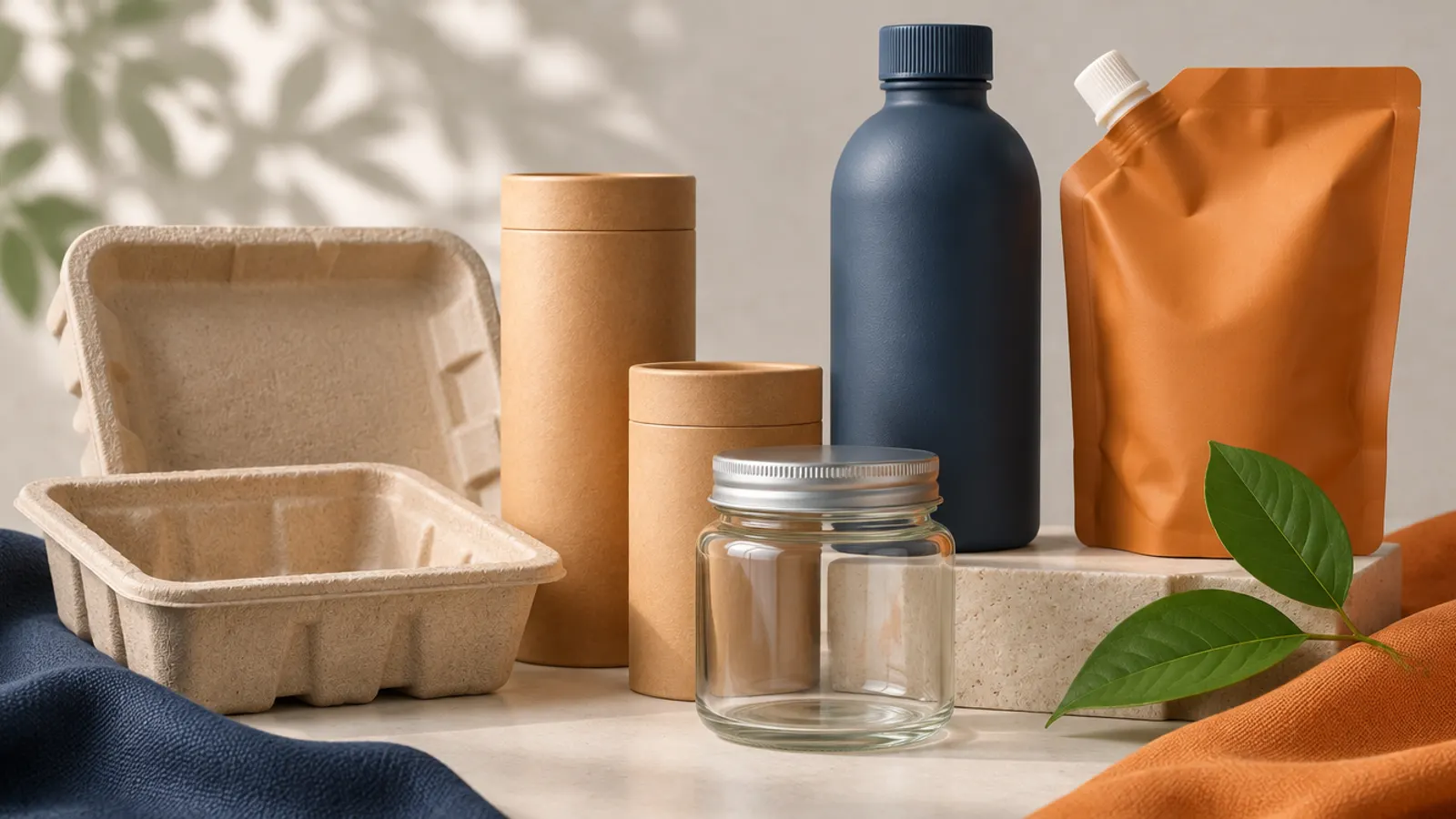
Illustrative image generated for this article; not a photograph of any company named in it.
Short answer
European packaging suppliers that publicly describe recycled-content, recyclable, refillable or bio-based packaging for consumer goods include ALPLA (Austria), Verescence (France) and Albéa (France), followed by Quadpack, Gerresheimer, Faerch, Greiner Packaging, Lumson, Corpack and Sulapac. The environmental claims are each company's own statements, not findings of ours, so the right choice depends on your product, your material and the evidence a supplier can give you in writing.
Key takeaways
- Every sustainability statement in this article is the company's own or reported by trade press. We did not test, audit or endorse any environmental claim.
- Choose by product and material first: glass, PET bottles, tubes, food trays, cups and bio-based materials come from different specialists.
- Recycled content, recyclability, refillability and bio-based content are four different properties. A pack can have one without the others.
- Ask for evidence per pack, not per company: recycled-content percentage by component, the certificate behind it, and food-contact or cosmetic compatibility documents.
- Custom shapes and custom decoration drive minimum orders far more than the material does; stock components are the usual route for a first run.
- No company paid for placement, and the order reflects public information only.
How this list was put together
We built this list from publicly available information: what each company states about recycled-content, recyclable, refillable or bio-based packaging, the certifications it states or that are listed for it, the breadth of its range across cosmetics, food and supplements, its suitability for new and growing brands, and production in Europe. It is a desk review, not an audit: we made no site visits, tested no packaging and verified no certificates or environmental claims. No company paid for placement.
Packaging is often the first thing a buyer or a retailer asks about, and "sustainable" is the word they use. It is not a technical term. In practice it covers four different things: packaging made with recycled material, packaging designed so it can be recycled, packaging designed to be refilled or reused, and packaging made from bio-based raw materials. A supplier may be strong in one and silent on the others.
This article lists ten European packaging manufacturers and suppliers that publicly describe at least one of those four for consumer goods such as cosmetics, food and food supplements. It then covers how to choose, what minimum orders usually look like, and the rules that apply. To compare more suppliers, browse suppliers or products on Bulk.eu.
How we chose
We used public information only: company pages, trade-fair listings and trade press. We looked at four things. First, how specific the company's public statements are about recycled content, recyclability, refill or bio-based materials. Second, how broad the range is across cosmetics, food and supplements. Third, how well the offer fits a new or growing brand. Fourth, whether production takes place in Europe.
Every environmental statement below is worded as the company's own, or as reported by the publication named in our sources. We have not tested any packaging, checked any recycled-content figure or verified any certificate, and we do not endorse these claims. Where something was not published, we say so. Nobody paid to be included, and the order follows the four criteria above.
Comparison table
| Rank | Company | Country | Main packaging types | What the company says about sustainability |
|---|---|---|---|---|
| 1 | ALPLA | Austria | Plastic bottles, closures and containers | Runs its own recycling division; reusable PET bottle for cosmetics reported |
| 2 | Verescence | France | Glass bottles and jars for beauty | Glass composition with 20% post-consumer recycled glass |
| 3 | Albéa | France | Tubes and beauty packaging | Tubes offered with recycled plastic; a paper-based tube |
| 4 | Quadpack | Spain | Cosmetic jars, compacts, lipsticks, wood components | Refillable packs; wood described as from certified sources |
| 5 | Gerresheimer | Germany | Glass and plastic packaging for cosmetics and pharma | Cosmetic glass with recycled content; recycled PET; refill jar |
| 6 | Faerch | Denmark | Food trays and containers | Trays made with PET recycled from used trays |
| 7 | Greiner Packaging | Austria | Cups and tubs for food | Cardboard-plastic cups; cups in recycled PET |
| 8 | Lumson | Italy | Airless and glass skincare packaging | Refillable airless systems in glass |
| 9 | Corpack | Germany | Cosmetic bottles, jars, compacts | Standard bottles in recycled PET; refillable compact |
| 10 | Sulapac | Finland | Bio-based materials and jars | Materials made from wood and plant-based binders |
The ten suppliers
1. ALPLA (Austria)
ALPLA is a plastics packaging manufacturer and recycler headquartered in Hard, Austria. Public profiles describe packaging for food and drinks, cosmetics and care products, and household products. The company founded its own recycling division, ALPLArecycling, in 2023, and trade press reports recycling plants producing recycled PET and recycled HDPE, including food-grade recycled PET in Austria. Trade press has also reported a reusable PET bottle for cosmetic products developed with the reuse company zerooo.
It suits brands that need plastic bottles in volume and want recycled material from a supplier that also runs recycling plants. It is a large industrial group, so a very small first order may not be a fit. Ask what recycled-content percentage is available for your bottle and closure, whether the material is approved for your product type, and what the minimum run is for a stock shape.
2. Verescence (France)
Verescence is a French glassmaker producing bottles and jars for perfumery and cosmetics. Trade press describes its "Verre Infini 20" composition as containing 20% post-consumer recycled glass with a tint intended to meet the appearance standards of luxury brands, and reports the company saying this would become its standard composition, produced in France and Spain. Most of that coverage dates from 2021 and 2022, so check the current position.
It suits fragrance and skincare brands that want glass and need consistent colour and clarity. Glass tooling and decoration usually mean larger commitments than plastic stock packs. Ask which shapes are available from an existing catalogue, what recycled-content share applies to your item and at which plant, and how that share is documented. Its head-office city was not confirmed in our sources.
3. Albéa (France)
Albéa is a French beauty packaging group best known for tubes. Trade press reports a range of tubes containing post-consumer recycled plastic, with recycled shares described as running from 30% to 100% depending on the tube, and a tube named Greenleaf 2 that the company said passed recycling-readiness tests set by the US Association of Plastic Recyclers. With L'Oréal it announced a tube in which a certified paper-based material replaces most of the plastic.
It suits skincare, haircare and oral care brands whose product belongs in a tube. Ask which recycled-content tubes are made in Europe, whether the recycled material is suitable for your formula, how the tube is expected to be sorted in your target countries, and what the minimum is per printed design. The sources we used are several years old and did not name a head-office city.
4. Quadpack (Spain)
Quadpack is a Barcelona-based supplier of cosmetics packaging. Trade press describes a wood-based range with refillable jars, lipsticks and compacts, using closures the company calls Woodacity, made from a single material without plastic inserts. The wood is described as ash or maple from sustainably managed European forests, and the company describes its wood factory as FSC and PEFC certified. It also offers a refillable jar with a PET outer and a polypropylene refill.
It suits skincare and make-up brands that want a distinctive look and a refill concept. Note that, as the company itself has said, the wood parts are not usually in direct contact with the formula. Ask for the current chain-of-custody certificate numbers, how the refill is sold and replaced in practice, and which items are stocked rather than made to order.
5. Gerresheimer (Germany)
Gerresheimer makes glass and plastic packaging for pharmaceuticals and cosmetics; its announcements are datelined Düsseldorf. For cosmetics, the company says it offers glass with up to 40% post-consumer recycled content, produced for many years in Momignies, Belgium, and since 2019 in Tettau, Germany. It also describes plastic packaging in up to 100% recycled PET, and it announced a refill jar with a glass outer and a replaceable inner cup developed with Medicos Beauty Group.
It suits brands that want glass jars and bottles from a supplier used to pharmaceutical documentation, which can also be relevant for supplement bottles. Ask which site would make your item, what recycled share applies to that item and colour, and whether the plant still belongs to the group when you order, because some statements date from 2019 to 2024.
6. Faerch (Denmark)
Faerch is a food packaging company based in Holstebro, Denmark, making trays and containers for fresh food and ready meals. It describes a "tray-to-tray" model: collecting and recycling used PET food trays, through its recycling business Cirrec, into material for new food-contact trays. Trade press reports meat trays launched with 70% recycled PET from trays, and the company has reported its own figures on recyclability by design.
It suits food producers, meal-kit companies and retailers packing chilled or ready-to-heat food. It is not a source for cosmetic or supplement packs. Ask for the declaration of compliance for food contact, the recycled share in the specific tray, whether the tray is accepted for recycling in your sales countries, and how the tray performs on your sealing line.
7. Greiner Packaging (Austria)
Greiner Packaging is an Austrian maker of plastic cups, tubs and containers, mainly for dairy and other food. Its best-known product is K3, a thin plastic cup wrapped in a cardboard sleeve. The company says the sleeve allows thinner plastic walls, that the cup can be made from recycled PET, and that a newer version, K3 r100, is designed so that sleeve and cup separate during waste sorting. Reported savings figures are the company's own.
It suits food brands selling yoghurt, plant-based alternatives, spreads or powders in cups. Ask whether your filling and sealing equipment can run the cup, what recycled material is permitted for your food type, how the cardboard sleeve is printed and what the minimum is per design. Its head-office town was not confirmed in our sources.
8. Lumson (Italy)
Lumson is a cosmetic packaging manufacturer based in Capergnanica, in northern Italy, known for airless dispensers and glass. Trade press describes XTAG, a glass bottle with a replaceable airless pouch refill, and Re Place, a glass jar with a removable inner cup. The company's own comparison claims lower emissions after several refills; that figure is its own. A pilot refill jar using post-consumer recycled glass and a bioplastic component has also been reported, but as a concept, not a catalogue item.
It suits skincare brands that need airless protection for sensitive formulas and want a refill format in glass. Ask which refill systems are in serial production, whether your formula has been tested with the pouch, how refills are sold to the end customer, and what decoration is done in-house.
9. Corpack (Germany)
Corpack is a cosmetic packaging company founded in Munich in 1995, with in-house design. Its trade-fair listings describe a standard bottle line called Allegra made from 100% recycled PET, with all components manufactured in Europe and bottles and closures separable for recycling. The listings also describe a refillable compact in recycled ABS and a closure with cork content. The company presents standard components as the most cost-effective way to build a new range.
It suits new and growing skincare and colour cosmetics brands that want coordinated stock packaging without paying for tooling. Minimums are not published in our sources. Ask which items are held in stock, which are made in Europe and which elsewhere, what proof of recycled content comes with each component, and what decoration options exist for small quantities.
10. Sulapac (Finland)
Sulapac is a Helsinki company founded in 2016 that develops bio-based materials as an alternative to conventional plastic. The materials are described as made from wood chips from industrial side streams and plant-based binders, and the company states a certified bio-based content of 55% to 100% depending on the grade. It sells material for processing by packaging makers as well as finished items such as cosmetics jars, and it has described a barrier grade for water-based products.
It suits brands that specifically want a bio-based pack and can work with a newer material. It is mainly a material developer, so the finished jar may come through a converter. Ask which grade suits your formula, what end-of-life route the company recommends in your markets, and what compatibility testing exists.
How do you choose a sustainable packaging supplier?
Work through it in this order.
- Start from the product. A water-based cream, an oily serum, a powder supplement and a chilled meal each rule out some materials.
- Decide which property matters most for your customers and retailers: recycled content, recyclability, refill or bio-based content.
- Check how packaging is actually collected and sorted in the countries you sell in. A pack that is recyclable in theory may not be collected everywhere.
- Shortlist suppliers that make that pack type as a standard item.
- Request samples and test them with your own product before committing. Our guide to requesting and evaluating samples explains how.
Illustrative example: a new skincare brand wants a 50 ml cream jar with recycled content. A stock recycled PET or recycled-glass jar with a standard cap, decorated with a label, usually gets it to market faster and with a smaller order than a custom-moulded refill system, which can follow once sales justify tooling.
If you prefer to describe the pack and let suppliers respond, post a buying request.
What are typical minimum orders for packaging?
The figures here describe general market practice, not the terms of any company named above. Stock bottles, jars and tubes bought from a distributor or from a manufacturer's standard range are commonly available from a few hundred to a few thousand pieces. Printing or decorating the pack directly, instead of labelling it, usually raises the minimum to several thousand per design. A custom shape needs a mould, and manufacturers typically expect tens of thousands of pieces to justify it.
Glass and tubes tend to carry higher minimums than stock plastic jars because of how production runs are set up. Recycled or bio-based material can add a minimum of its own if the supplier has to buy a batch for you. See what MOQ means for how to negotiate.
What rules apply to packaging and green claims in the EU?
This is a general overview, not legal advice. Packaging placed on the EU market falls under the Packaging and Packaging Waste Regulation, Regulation (EU) 2025/40, which sets requirements on recyclability, recycled content in plastic packaging and packaging minimisation that phase in over the coming years. Producers also have extended producer responsibility obligations in each member state where they sell.
Food packaging must comply with the food contact framework, Regulation (EC) No 1935/2004, and plastic food contact materials with Regulation (EU) No 10/2011; recycled plastic for food contact has its own rules under Regulation (EU) 2022/1616. Food supplements are food, so the same rules apply to their bottles and pouches. For cosmetics, Regulation (EC) No 1223/2009 requires the product safety assessment to consider the packaging material.
Environmental claims on your own pack or website are your responsibility as the brand. EU consumer law restricts vague claims such as "eco-friendly" without evidence, so keep the supplier's documents and claim only what they support.
What should you ask a packaging supplier before ordering?
- What is the recycled-content percentage of each component, and is it post-consumer or post-industrial material?
- Which certificate or audit supports that figure, who issued it, and when does it expire?
- Is the pack tested for recyclability, by which method, and for which countries?
- Do you provide a declaration of compliance for food contact, or compatibility data for cosmetics?
- Where is each component made?
- What are the minimum order, the price at each volume and the lead time, and what do decoration and tooling cost?
- For refill systems: how is the refill sold, and what stops the customer discarding the outer pack?
Get the answers in writing with the quotation, and read our guide on how to vet a supplier before your first order.
Frequently asked questions
- Who are the leading sustainable packaging suppliers in Europe?
- Our 2027 list names ALPLA in Austria, Verescence in France and Albéa in France first, followed by Quadpack, Gerresheimer, Faerch, Greiner Packaging, Lumson, Corpack and Sulapac. Each publicly describes recycled-content, recyclable, refillable or bio-based packaging. The list rests on public statements, not an audit, and the environmental claims are the companies' own, so use it as a starting shortlist.
- What does sustainable packaging actually mean?
- There is no single legal definition. In practice suppliers use it for four different properties: recycled content, design for recycling, refill or reuse, and bio-based raw materials. A pack can have one without the others; a bio-based jar, for example, is not automatically recyclable. Ask the supplier which property they mean and what evidence supports it for the specific item you are buying.
- Is recycled plastic allowed for food and supplement packaging?
- Yes, under conditions. In the EU, recycled plastic used in contact with food must come from a recycling process covered by the rules for recycled plastic food contact materials, Regulation (EU) 2022/1616, and the finished pack must meet general food contact requirements. Food supplements count as food. Ask the supplier for a declaration of compliance covering your product type. This is general information, not legal advice.
- What is the difference between PCR and post-industrial recycled material?
- PCR means post-consumer recycled: material recovered from packaging that households or businesses have used and discarded. Post-industrial, or pre-consumer, material is production scrap that never reached a consumer. Both reduce the use of new raw material, but buyers and retailers usually ask for post-consumer content specifically. Ask suppliers to state which type they mean and the percentage for each component.
- What minimum order should a small brand expect for sustainable packaging?
- As general market practice, stock bottles, jars and tubes are often available from a few hundred to a few thousand pieces, direct printing usually needs several thousand per design, and custom-moulded shapes typically need tens of thousands. Recycled or bio-based material can add its own minimum. These are typical ranges, not any named company's terms, so request a written quotation.
- Can I put 'recyclable' or 'eco-friendly' on my product?
- Only if you can substantiate it. In the EU the brand making a claim to consumers is responsible for it, and consumer protection rules restrict generic environmental claims that are not backed by evidence. A specific, documented statement, such as the recycled share of the bottle, is safer than a broad one. Keep the supplier's certificates and test reports, and take legal advice for your markets.
- Is glass more sustainable than plastic for cosmetics?
- It depends on the product, the pack weight, transport distance, recycled content and how the pack is collected after use. Glass is widely recycled and suits refill concepts, but it is heavier to ship. Lightweight plastic with recycled content can perform well in some comparisons. We do not rank materials; ask suppliers for the assumptions behind any comparison they show you.
- How do I verify a packaging supplier's sustainability claims?
- Ask for documents tied to the specific item: the recycled-content certificate and its issuing body, chain-of-custody certificate numbers for wood or paper, the recyclability test method and result, and food-contact or compatibility declarations. Check that the certificate names the site that will make your order and has not expired. Company-level statements and logos are not enough on their own.
Sources
Company details are taken from the companies' own public pages and were not independently verified by Bulk.eu.
- Alpla — Wikipedia
- ALPLA and zerooo create reusable PET bottle for cosmetic products (Packaging Europe)
- Alpla and Sea Me pilot reusable PET bottle infrastructure (Personal Care Insights)
- Verescence expands its global PCR glass production capacity with Verre Infini 20 (Industries Cosmétiques)
- Verescence to expand PCR glass production (Cosmetics Business)
- Verescence expands PCR glass production capabilities (Glass International)
- L'Oréal and Albéa launch the first cosmetic tube integrating certified paper-based material (L'Oréal)
- Albéa completes eco-friendly tube offer (Premium Beauty News)
- Albéa Tubes — supplier profile (CosmeticsDesign-Europe)
- Quadpack unveils wooden beauty packaging collection (Packaging Europe)
- Quadpack launches wood-based range for cosmetics (Packaging Insights)
- Woodacity collection now a complete monomaterial range in wood (Cosmetics Business)
- Gerresheimer — PCR materials for cosmetics
- Gerresheimer — Sustainable cosmetic packaging
- Gerresheimer and Medicos Beauty Group present a clickable refill system for cosmetics
- Faerch: turning used food packaging into new food packaging (European Circular Economy Stakeholder Platform)
- Norfersk implements Faerch's 70% tray-to-tray rPET into meat trays (Packaging Europe)
- Faerch — 4PET Recycling changes its name to Cirrec
- Greiner Packaging — K3
- Greiner Packaging — K3 r100
- Greiner Packaging — 100% r-PET
- XTAG by Lumson: the airless refill (Cosmetics Business)
- Glass bottle combines airless refill and pouch for luxury cosmetics (Packaging Europe)
- Lumson launches new refillable system (Cosmetics Business)
- Lumson SpA — company profile (Beauty Packaging)
- Corpack GmbH — exhibitor profile (Paris Packaging Week)
- Corpack — Allegra bottles 100% PCR (Paris Packaging Week)
- Corpack — Standard packaging (Paris Packaging Week)
- Sulapac — About
- Sulapac: a bio-based alternative to plastic (European Circular Economy Stakeholder Platform)
- Sulapac: the startup making biodegradable beauty packaging (CosmeticsDesign-Europe)