Materials & packaging
EU Packaging Rules and What They Mean for Small Brands
Zaktualizowano · 13 min czytania · Redakcja Bulk.eu
Ten artykuł jest dostępny tylko w języku angielskim.
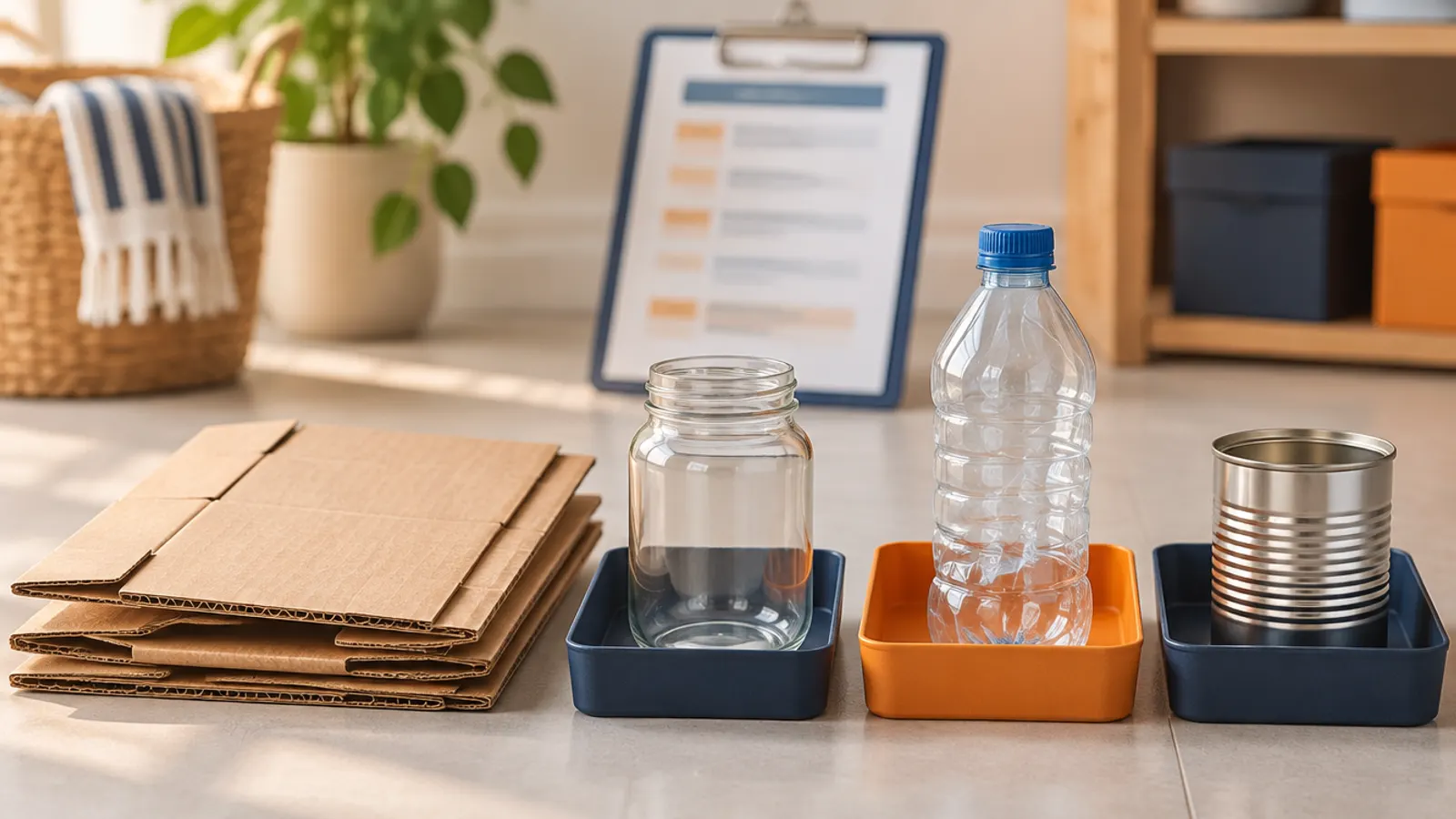
Ilustracja poglądowa wygenerowana do tego artykułu; nie jest zdjęciem żadnej z wymienionych w nim firm.
Krótka odpowiedź
A small brand selling packaged goods in the EU is usually treated as a packaging producer in each country where it sells, which means registering with that country's extended producer responsibility system, reporting the packaging it places on the market and paying towards its collection and recycling. The EU Packaging and Packaging Waste Regulation, Regulation (EU) 2025/40, replaces the earlier directive and adds design, recyclability, recycled-content and labelling requirements that apply in stages. This is general information, not legal advice.
Najważniejsze wnioski
- Extended producer responsibility for packaging is organised nationally. Selling into five countries can mean five registrations and five sets of reports.
- The obligation generally sits with whoever first supplies the packaged product in a country, which for a brand selling online across borders is often the brand itself.
- Regulation (EU) 2025/40 replaces the Packaging Directive and applies directly in all member states, but its requirements are phased in over several years.
- The direction of travel is clear: packaging that is recyclable, uses less material, contains recycled plastic where required and carries harmonised sorting labels.
- Packaging that touches food must also meet separate food-contact rules, and your packaging supplier should give you a declaration of compliance.
- Start by knowing your packaging: every component, its material and its weight. Almost every obligation depends on that data.
Packaging is one of the few compliance topics that applies to almost every physical product. A jar of cream, a pouch of protein powder and a boxed candle have little else in common, but each comes in packaging that becomes waste, and EU law makes the company that puts it on the market responsible for what happens next.
For a small brand the rules can look out of proportion to the business. They are manageable once you separate them into four questions: who pays for the waste, how the packaging must be designed, what must be printed on it, and what applies when it touches food. This article gives a general overview of each. It is not legal advice, and national details change, so check current requirements for every country you sell in.
Which EU packaging rules apply to a small brand?
Four layers of rules matter in practice.
| Layer | What it covers | Where it comes from | Who usually acts |
|---|---|---|---|
| Extended producer responsibility | Registering, reporting and paying for packaging waste | National systems under EU law | The brand or importer, in each country of sale |
| Packaging design and composition | Recyclability, minimisation, recycled content, restricted substances | Regulation (EU) 2025/40 | Packaging manufacturer and the brand that specifies it |
| Packaging labelling | Material identification and sorting information | National rules today, harmonised EU labels being phased in | The brand, with its designer and printer |
| Food-contact materials | Safety of packaging that touches food | Regulation (EC) No 1935/2004 and specific measures | Packaging supplier, with documents held by the brand |
Product labelling, such as ingredient lists and warnings, is a separate subject with its own rules for each category. See our checklists for cosmetic labels and supplement labels.
What is extended producer responsibility for packaging?
Extended producer responsibility, usually shortened to EPR, is the principle that the company placing packaged products on a market pays towards collecting, sorting and recycling the packaging.
In practice it means three things in each country:
- Registration with a national register or authority as a packaging producer.
- Participation in a scheme. In most countries you join an approved producer responsibility organisation, which takes on the collection obligation in return for fees.
- Reporting the packaging you place on that market, by material and weight, at intervals the country sets.
Fees are normally based on the weight and material of your packaging, and increasingly on how recyclable it is. We give no figures here because every country sets its own and they change.
Why is it organised nationally?
EU law sets the framework, but each member state runs its own system, with its own register, approved schemes, reporting formats and deadlines. There is no single EU registration for packaging EPR.
Thresholds differ as well. Some countries require registration from the first package placed on the market, while others have simplified reporting or lighter obligations for very small quantities. Do not assume that being small exempts you.
Who counts as the packaging producer?
Broadly, the producer is the business that first makes the packaged product available in a given member state. Depending on the supply chain, that can be the manufacturer, the importer or the distributor.
The following table shows how this usually works out. It is a simplification: definitions vary in detail, and the situations are illustrative.
| Situation | Who is usually responsible in the country of sale |
|---|---|
| A brand sells its own products in its home country | The brand |
| A brand sells online directly to consumers in another member state | The brand, for that country too |
| A brand sells to a distributor established in another member state, which resells there | Often the distributor, as the first to supply on that market; confirm in the contract |
| A contract manufacturer fills products under the brand's name | The brand, as the party under whose name the product is sold |
| A retailer imports goods packaged outside the EU | The importer |
Two points catch small brands out.
First, cross-border online sales count. A webshop in one country that ships to consumers in four others normally has obligations in all five. Where a producer has no establishment in the country, it may need to appoint an authorised representative there to fulfil its EPR duties.
Second, shipping packaging counts. The carton, filler and tape you add to an e-commerce parcel are packaging you place on the market, alongside the product's own packaging.
Online marketplaces and fulfilment providers are increasingly required to check that their sellers are EPR-registered, and may ask for registration numbers before allowing sales into a country.
How do you register and report in each country of sale?
The steps are similar everywhere, even though the systems differ.
- List the countries where you sell to end users, including through your own webshop and marketplaces.
- Work out who is the producer in each, especially where distributors are involved, and record it in your agreements.
- Build a packaging data sheet. For every product, list each packaging component, its material and its weight: bottle, cap, label, carton, leaflet, shipping box, filler.
- Register in each country with the national register or authority, appointing an authorised representative where one is required.
- Join an approved scheme where the country's system requires it, and declare your expected quantities.
- Report actual quantities at the required intervals and keep the records that support them.
- Review each year, and whenever you add a country, a product or a new packaging format.
Compliance service providers offer multi-country registration and reporting, which can be worthwhile once you sell in several markets. You can look for packaging and compliance specialists among business services on Bulk.eu.
An illustrative example
A small skincare brand sells a serum in a glass bottle with a plastic pump, a paper label and a printed carton, shipped in a cardboard mailer. It sells from its own webshop to consumers in its home country and two neighbouring ones. In a typical case it would register in all three countries, join a scheme in each, and report the weight of glass, plastic and paper or cardboard sold into each country separately, including the mailers. Its packaging data sheet, kept per product, is what makes those reports quick to produce.
What is the Packaging and Packaging Waste Regulation?
Regulation (EU) 2025/40, known as the PPWR, is the EU's new framework law for packaging. It replaces the earlier Packaging and Packaging Waste Directive, Directive 94/62/EC.
The change of instrument matters. A directive has to be written into national law by each country, which is one reason national packaging rules diverged. A regulation applies directly in every member state, so design and labelling requirements become the same across the EU. National EPR registers and schemes remain.
The regulation covers all packaging, whatever the material, and all packaging waste. It applies in stages: it has started to apply in general, while many specific requirements take effect in later years, some of them only once the European Commission has adopted detailed technical rules. For any particular obligation, check the current position rather than relying on a summary.
Its main elements, in general terms:
- Recyclability. Packaging has to be designed for recycling and will be assessed against design-for-recycling criteria.
- Recycled content. Minimum recycled content is being introduced for the plastic part of packaging.
- Minimisation. Packaging weight and volume should be reduced to what is necessary, and empty space in grouped, transport and e-commerce packaging is restricted.
- Substances. Limits on heavy metals continue from the directive, and restrictions on certain substances of concern in food-contact packaging are added.
- Reuse and refill. Targets and obligations aimed mainly at certain sectors and larger operators.
- Labelling. Harmonised labels for material composition and sorting.
- Conformity. A documented conformity assessment and an EU declaration of conformity for packaging.
Some obligations include lighter treatment for the smallest companies. Check whether a relief applies to you rather than assuming it does.
What do recyclability and recycled content mean for packaging design?
You do not need to redesign everything today, but choices made now will be on the shelf when later stages apply. The general direction is well established.
| Design choice | Direction of travel | Practical step for a small brand |
|---|---|---|
| Materials | Single-material components recycle more easily than bonded multi-layers | Ask suppliers for mono-material options |
| Colours and additives | Some colourants and additives hinder sorting and recycling | Prefer clear or light plastics where the product allows |
| Labels, sleeves and adhesives | Should not prevent the main container being recycled | Ask your label printer about wash-off or compatible options |
| Closures and pumps | Mixed-material parts are harder to recycle | Ask what the pump or cap is made of and whether a simpler version exists |
| Size and empty space | Oversized packs and unnecessary layers are being restricted | Fit the carton and mailer to the product |
| Recycled content | Minimum recycled plastic content is being phased in | Ask for recycled-content grades and for evidence of the share |
Two cautions. Recycled plastic in food-contact packaging has its own strict rules, so it cannot be substituted freely. And recyclability depends on real collection and sorting systems, which is why the detailed criteria are set at EU level rather than left to suppliers' claims.
Be careful with environmental statements on the pack. Words such as "recyclable", "eco-friendly" or "biodegradable" are marketing claims, and EU consumer law is becoming stricter about vague or unsupported ones. Say only what you can evidence, and be specific about which part of the packaging the statement covers.
Stock packaging from an established supplier is often the simplest route for a first product, as discussed in our guide to the cost of launching a private label product.
How must packaging materials be labelled?
This is the area where national differences are most visible today. The PPWR introduces harmonised EU labels showing what packaging is made of and how to sort it, intended to replace differing national requirements as they are phased in. Until then, national rules continue to apply.
Some member states already require specific marking on consumer packaging, such as a material identification code on each component or a prescribed sorting instruction with a national logo. Others require nothing beyond the EU rules. A pack designed for one country may therefore need changes for another.
Practical points:
- Material codes. A long-standing EU system of abbreviations and numbers identifies packaging materials. It is voluntary at EU level but mandatory in some countries.
- Sorting instructions. Where a country prescribes a format, use it exactly, including for each separable component.
- Scheme symbols. Symbols that show membership of a recovery scheme are trademarks with their own licence terms, and do not mean the pack is recyclable. Rules on their use differ between countries.
- Certain single-use plastic products carry their own marking requirements under separate EU rules.
- Space. On small packs, some countries allow information to be given digitally. Check before relying on a QR code.
If you sell in several countries, ask your designer to plan the artwork for all of them from the start. It is cheaper than reprinting.
What rules apply to packaging that touches food?
Packaging for food, drinks and food supplements must comply with EU food-contact material rules in addition to everything above.
The framework is Regulation (EC) No 1935/2004. Its core principle is that materials must not transfer their constituents to food in quantities that could endanger health, change the food's composition unacceptably or affect its taste and smell. Regulation (EC) No 2023/2006 requires good manufacturing practice in producing such materials. Plastics have detailed rules in Regulation (EU) No 10/2011, including a list of permitted substances and migration limits, and recycled plastic for food contact is covered by separate legislation.
For a brand, this comes down to documents:
- Ask your packaging supplier for a declaration of compliance for each food-contact component, stating the legislation it meets and the conditions of use it was assessed for, such as food type, temperature and contact time.
- Check that those conditions match your product. A container suitable for dry powder is not automatically suitable for an oily or acidic liquid.
- Keep traceability: which packaging batch went into which product batch.
- Remember inks, coatings and adhesives. Printed surfaces should not transfer to the food-contact side.
Cosmetic packaging is not covered by food-contact law, but the cosmetic product safety assessment considers the packaging material, so your assessor will ask for similar information.
What should a small brand do first?
A short action list, in order of usefulness:
- Build the packaging data sheet for every product and keep it current.
- Map your countries of sale and identify the producer in each.
- Register and join schemes where you are the producer, before you sell.
- Collect specifications, declarations of compliance and recycled-content evidence from packaging suppliers. When you look for packaging and material suppliers, ask for these with the quotation.
- Choose simple, single-material stock packaging where you can.
- Check labelling requirements per country before finalising artwork.
- Note the date of your review, and check for changes to national rules and newly applicable parts of the PPWR at least once a year.
When you brief a manufacturer or packaging supplier, state the countries of sale so that packaging is specified with them in mind. If you need help finding one, you can post a buying request describing the product, the packaging and the markets.
Najczęściej zadawane pytania
- Do small brands have to register for packaging EPR in the EU?
- Usually, yes. Extended producer responsibility for packaging applies to businesses of all sizes, although some countries have simplified reporting or lighter duties for very small quantities and others require registration from the first package. Obligations arise in each country where you are the producer, so check the current national rules for every market before you start selling there.
- Is there one EU-wide registration for packaging?
- No. EU law sets the framework, but extended producer responsibility is run by each member state with its own register, approved schemes, reporting formats and deadlines. A brand selling to consumers in several countries generally registers and reports in each one. Compliance service providers and authorised representatives can handle several countries on your behalf, but the obligations remain national.
- What is Regulation (EU) 2025/40?
- It is the EU Packaging and Packaging Waste Regulation, often called the PPWR. It replaces the earlier Packaging and Packaging Waste Directive and applies directly in all member states. It sets requirements on recyclability, recycled content in plastic packaging, packaging minimisation, restricted substances, reuse, harmonised labelling and conformity documentation, which apply in stages over several years.
- Who is responsible for packaging when a contract manufacturer makes my product?
- Normally the brand. Where a product is sold under your name or trademark, you are generally treated as the producer for packaging purposes in the country where you first supply it, even though another company filled it. The manufacturer can provide packaging weights and material data, but registration, reporting and fees are usually yours. Confirm responsibilities in your manufacturing agreement.
- Does shipping packaging for online orders count?
- Yes. The carton, mailer, filler and tape you add to send an order are packaging that you place on the market, in addition to the product's own packaging. They should be included in your packaging data and reports for the country where the customer receives the parcel. Empty space in e-commerce packaging is also being restricted under the new regulation.
- Must packaging carry recycling or sorting labels?
- It depends on the country for now. Some member states require material identification codes or prescribed sorting instructions on consumer packaging, while others do not. The Packaging and Packaging Waste Regulation introduces harmonised EU labels that are being phased in to replace differing national requirements. Until they apply, check the current rules in each country of sale before finalising artwork.
- What documents should I get for food-contact packaging?
- Ask the packaging supplier for a declaration of compliance for each component that touches the food, naming the legislation it meets and the conditions of use assessed, such as food type, temperature and contact time. Check that these match your product, keep the documents on file and record which packaging batches were used for which product batches.
- Can I call my packaging recyclable or eco-friendly?
- Only if you can support the statement. Environmental claims are marketing claims subject to consumer protection law, which is becoming stricter about vague or unsubstantiated wording. Prefer specific, verifiable statements, such as the material a component is made of or its documented recycled content, and make clear which part of the packaging the statement refers to. Take advice if unsure.